What Is the Hotwife Lifestyle? The Real Psychology Behind It | Second Banana
The Hotwife Lifestyle:
Pride, Compersion, and a Wife’s Full Sexual Autonomy
The Dynamic That’s Having a Moment
Something has shifted in how people talk about non-monogamy. Among the many relationship orientations that have moved from the edges of ENM community into broader cultural conversation over the past few years, hotwifing has had arguably the most striking trajectory — from a term most people hadn’t encountered to one appearing in mainstream relationship features, podcast conversations, and the search histories of couples who would never have thought to look it up five years ago.
The growth isn’t accidental. It reflects something real about what a large number of couples actually want — a form of consensual non-monogamy that is built around a wife’s sexual freedom and her husband’s genuine, unambiguous enthusiasm for it. Not tolerance. Not reluctant agreement. Enthusiasm. Pride. The specific erotic charge that comes from watching or knowing that your partner is desired by others, pursued by others, pleasured by others — and that she has chosen this with your full blessing and your full attention.
That dynamic is older than the word for it. What’s changed is the language, the community infrastructure, and the growing cultural permission for couples to name what they want and go looking for it honestly.
This piece is the full account. What the hotwife lifestyle actually is, why it works psychologically for the couples who are drawn to it, what the stag/vixen framing adds, where it genuinely differs from adjacent dynamics, and how Second Banana’s tag system gives couples and the women they’re looking for the vocabulary to find each other.
Hotwifing isn’t a compromise. For the couples who want it, it’s an expression of exactly how much they trust each other.
What the Hotwife Lifestyle Actually Is
At its core, hotwifing describes a relationship dynamic in which a woman in a committed partnership has sex with other people — with the full knowledge, consent, and active enthusiasm of her partner. The husband or committed partner is not merely tolerating this. His enthusiasm is constitutive of the dynamic. The erotic charge for both people is inseparable from the fact that this is happening with both people’s full engagement.
A few things this definition includes that often get glossed over: the wife’s agency is central. This is not a dynamic where a man arranges sexual experiences for his wife. It’s one in which she pursues, chooses, and enjoys sexual connections with other people, and her partner’s role is to support, celebrate, and derive genuine pleasure from her doing so. The directionality matters. She is not an object being shared. She is a subject exercising autonomy, with a partner who finds that autonomy specifically and genuinely arousing.
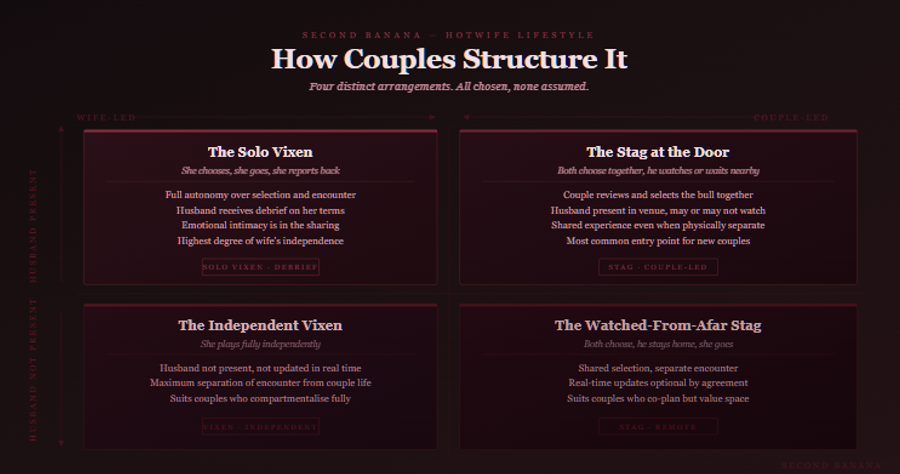
The other people involved — typically called bulls, though terminology varies across communities — are not interchangeable. The wife chooses them. Her standards, her preferences, her specific desires determine who she pursues. The husband’s role in that selection varies by couple: some husbands are involved in choosing, some prefer to hear about it afterward, some want real-time updates, some want full separation between their domestic life and their wife’s encounters. All of these are legitimate variations on the same fundamental structure.
What It Isn’t
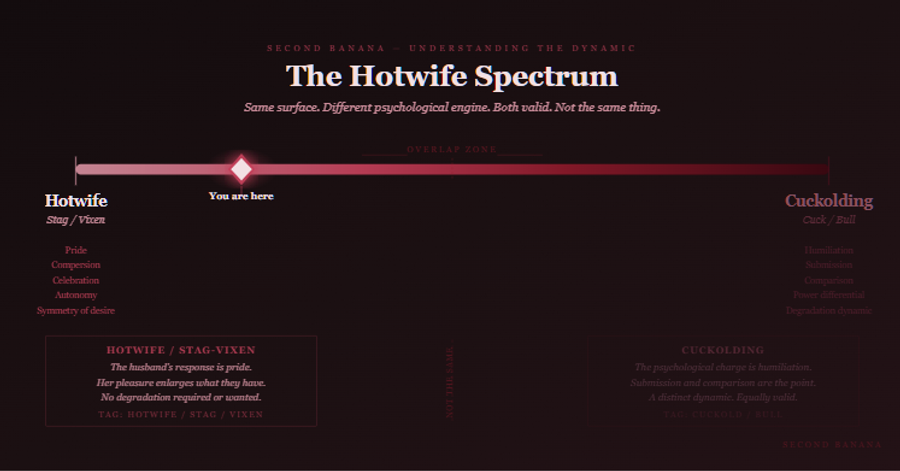
Hotwifing shares surface territory with cuckolding — both involve a wife having sex with other men with her partner’s knowledge. But the psychological engine is different, and the difference matters for the people in it. Cuckolding is typically organised around a specific psychological dynamic involving humiliation, submission, and the erotic charge of perceived inadequacy or comparison. The husband’s response to his wife’s encounters in a cuckold dynamic is often explicitly degrading — that’s part of the point.
In hotwifing, the psychological register is nearly the opposite. The husband’s response is pride. Compersion — the specific pleasure of watching someone you love experience pleasure. The knowledge that his wife is desirable, pursued, and satisfied. The couples in hotwife dynamics often describe the experience as deepening their intimacy rather than transgressing it, because the trust required and the communication involved are both substantial. If the cuckolding dynamic calls to you — if the humiliation dimension is part of what you’re drawn to — that’s a distinct orientation that deserves its own honest exploration. [internal link: The Psychology of Cuckolding]
Hotwifing also differs meaningfully from swinging, though there’s some community overlap. Swinging typically involves both partners having sexual encounters with other people, and the couple’s mutual participation is structurally important. In hotwifing, the husband is almost always not pursuing his own sexual encounters with other women. His role is specific to his wife’s experiences. This asymmetry is not incidental — it’s the point.
The Stag and Vixen Reframe
Within the broader hotwife community, a significant portion of couples now identify primarily as stag/vixen rather than hotwife/bull. The terminology shift is meaningful and worth understanding because it clarifies something the hotwife label leaves slightly ambiguous.
In the stag/vixen framework, the vixen is the wife — a woman who is sexually confident, who pursues her desires actively and on her own terms, and whose sexuality is celebrated rather than managed. The stag is the husband — not a passive figure but an active and proud participant in his wife’s sexual autonomy. The stag is not watching from the sidelines because he has to. He’s there because he wants to be, because his wife’s pleasure and desirability are sources of genuine pride.
What the stag/vixen framing adds is an explicit repositioning of the husband’s role from potentially passive to actively engaged. The stag isn’t waiting at home while his wife goes out. He’s often present, often involved in the social architecture of encounters, and his pleasure is bound up with the quality of his wife’s experience. He isn’t diminished by what she does. He’s enlarged by it.
This matters for the community’s self-image and for the experience of the people in it. Stag/vixen couples often emphasise that the dynamic requires and produces a specific kind of relationship security — one in which both people are so confident in what they have together that the wife’s sexual connections elsewhere feel like an addition to the relationship rather than a threat to it.
The stag isn’t losing something when his wife is with someone else. He’s watching someone he loves be fully, freely herself. That’s not loss. That’s intimacy.
The Psychology: Why This Works for the Couples It Works For
Compersion as an Erotic Experience
Compersion — the experience of pleasure derived from a partner’s pleasure — is a concept that originated in polyamory communities and has been adopted broadly in ENM contexts. In hotwifing, compersion takes on a specifically erotic dimension. The husband’s pleasure is not separate from his wife’s sexual experiences with others. It is constituted by them. What she feels, he feels at one remove — amplified by desire for her, by pride in her, by the specific intimacy of knowing exactly what she is capable of.
This is not a niche psychological profile. Research on sexual fantasy consistently finds that men are significantly more likely than average to report arousal from imagining their partners desired by or sexual with other men. The evolutionary psychology literature has proposed sperm competition theory as one mechanism — the idea that male arousal is heightened by the presence of sexual competition. But the lived experience of hotwife couples goes considerably beyond a biological mechanism. What they describe is something richer: a form of intimacy built on radical transparency, complete trust, and the specific pleasure of watching someone you love be fully desired.
The Role of Female Sexual Autonomy
For the wives in hotwife dynamics, what’s consistently reported in community accounts and in the emerging qualitative research on ENM is that the appeal is frequently about agency. The experience of being pursued on your own terms, of choosing partners according to your own desires rather than anyone else’s, of having a committed partner who not only permits but actively celebrates your sexuality — this is, for many women, a profoundly different experience from the sexual culture they grew up in.
Many women report that the hotwife dynamic is the first context in which their sexual desires have been treated as unconditionally important. Not something to be managed or accommodated, but something to be actively supported and celebrated. The practical experience of this — of having a husband who wants to hear about your desires, who is enthusiastic rather than threatened, who takes pride in your desirability — produces a specific kind of sexual confidence that women in the community often describe as transformative.
That transformation tends to feed back into the relationship itself. The communication required to make a hotwife dynamic function well — honest conversation about desires, experiences, feelings, and the specific texture of what each person wants from encounters — is more extensive than most couples practice in conventional monogamy. The couples who do it well tend to report that this enforced explicitness is one of the relationship’s most significant benefits, regardless of the sexual dimension.
The Security Paradox
Counterintuitively, hotwife dynamics tend to require and reinforce a high level of relationship security rather than undermining it. The couples who navigate this dynamic successfully are not the ones who are adding external encounters to cover over relationship problems. They are the ones who are secure enough in what they have that they can genuinely celebrate what their partner finds elsewhere.
This security paradox — the fact that the dynamic most associated in cultural imagination with relationship instability tends to produce and require the opposite — is one of the most consistently reported features of hotwife community accounts. What makes the dynamic work is exactly what makes relationships work in general: trust, honesty, ongoing communication, and a genuine orientation toward each other’s wellbeing rather than toward the performance of a role.
The Practical Landscape: What This Life Actually Looks Like
Structures and Variations
Hotwife dynamics vary considerably in their practical structure. Some couples are fully integrated — the husband is present for encounters, involved in planning, and gets real-time or detailed debrief accounts. Others maintain significant separation — the wife has encounters independently, and what she shares with her husband is on her terms. Some couples play regularly, some occasionally. Some have standing connections with specific bulls; others prefer each encounter to be with a new person.
The husband’s level of involvement with the bull also varies. Some stag/vixen dynamics involve the husband and bull having a cordial or even friendly relationship; in others, the husband prefers distance. Some couples have explicit rules about contact between wife and bull outside of sexual encounters; others are comfortable with ongoing connections. All of these are legitimate structures. The point is that they are explicitly chosen rather than assumed.
The Communication Architecture
What experienced hotwife couples consistently emphasise is that the communication load is front-loaded. Getting to the point where the dynamic functions smoothly requires extensive, honest, sometimes difficult conversation about things that most couples never discuss: exactly what each person finds arousing and why, what they would find difficult to hear and why, what they need from each other before, during, and after encounters, and what the encounters are actually for in terms of their shared erotic life.
This front-loading is not a cost to be minimised. It is one of the dynamic’s most significant benefits, because it forces couples into a level of honesty and self-knowledge that their relationship can carry forward in every dimension. The couples who have done this communication well tend to describe it as the most intimate thing they have ever done together.
Finding the Right People
The practical challenge of hotwifing — one that comes up repeatedly in community discussion — is finding the right bulls. The wife’s standards are the operative ones, and those standards are often specific: physical, communicative, emotionally intelligent, genuinely interested in her pleasure rather than in performing for a watching husband, respectful of the couple’s dynamic. This combination is not the norm on most platforms.
The additional challenge is communication before the encounter. A woman exploring the hotwife lifestyle needs to be able to communicate what she wants, what the dynamic involves, and what a potential partner’s role actually is — before any of that becomes relevant in person. This requires a platform where honest, specific communication is possible before photos become the primary currency.
What This Has to Do With Second Banana
A couple posting on Second Banana can represent their specific dynamic before anyone responds. Not “we’re into hotwifing” but: what kind of encounters she’s looking for, what level of involvement he has, what they need from a potential bull in terms of communication and approach, what the dynamic involves and what it doesn’t. A woman posting as a solo vixen can represent her standards and her situation clearly, so the people who respond are already in the right ballpark.
The tag system gives the hotwife community specific vocabulary:
- Hotwife / vixen — orientation and role
- Stag / bull — the partner’s role and what’s being sought
- Husband involved / husband not present — practical structure of encounters
- Ongoing connection / one-time encounter — relational intention
- Couple seeking bull / solo vixen / bull seeking couple — structural position
- Full swap / no swap — extent of involvement
These tags do the work of narrowing before the conversation starts. They mean that the people who reply already understand what they’re responding to — which is the condition that makes the first message worth reading.
The post-first, photo-second model matters particularly here. The qualities that make someone the right bull for a specific couple — emotional intelligence, communication style, genuine orientation toward the wife’s pleasure, understanding of what the dynamic involves — are not visible in a photograph. They are visible in how someone writes about who they are and what they want. Second Banana’s architecture selects for exactly this.
The anonymous posting option matters for couples who are navigating families, workplaces, or social circles where their dynamic would require more explanation than they want to offer before they’ve established trust. The ability to be fully honest about what you’re looking for before attaching your face to that honesty is not a workaround. It’s the condition under which real honesty becomes possible.