The Psychology of Cuckolding: What It Really Is and Why It Works | Second Banana
The Psychology of Cuckolding:
What It Really Is, Why It Works, and Why the Shame Has Always Been Misplaced
The Fantasy Nobody Admits To — Until They Do
There is a particular quality to the cuckolding fantasy that distinguishes it from almost every other sexual interest: the shame that surrounds it is itself part of the erotic architecture. The fantasy involves humiliation. The cultural response to it is also humiliating. For many men who have this fantasy, the two layers of shame become almost indistinguishable from each other, which makes honest self-examination unusually difficult.
This piece is the honest examination. What cuckolding actually is psychologically, what the research says about how common it is and why, what the neuroscience of the specific arousal pattern looks like, what the humiliation dimension actually involves for the people who find it compelling, and how the dynamic works in practice for the couples and individuals who pursue it with honesty and care.
It is also, necessarily, a piece that takes the subject seriously rather than treating it as a curiosity or a pathology. The DSM removed BDSM-related dynamics from its list of disorders — not because they became more mainstream, but because the clinical and research communities concluded that the pathology framing was never warranted. Cuckolding is not a disorder. It is a specific sexual and relational orientation that happens to be built around dynamics — humiliation, submission, the eroticisation of inadequacy — that mainstream culture finds uncomfortable to engage with honestly.
The discomfort is not a reason to avoid the engagement. It is, if anything, a reason to take it more seriously.
The shame around cuckolding is real. So is the arousal. Understanding why both exist is the beginning of being honest about what you actually want.
What Cuckolding Actually Is
Cuckolding describes a dynamic in which a man derives erotic pleasure from his female partner having sex with other men — with the specific psychological charge being located in the humiliation, submission, or comparison dimension of that experience. The cuckold is typically aware of the encounters, often in real time, and the awareness itself — including the feelings of inadequacy, jealousy, and submission it provokes — is central to the erotic experience rather than incidental to it.
This last point is the defining one, and it is what distinguishes cuckolding from adjacent dynamics. In hotwifing and the stag/vixen framework, the husband’s psychological response to his wife’s encounters is pride and compersion — he is enlarged by what she does, and the erotic charge is in her desirability and autonomy. In cuckolding, the psychological register is genuinely different. The cuckold’s response involves a specific pleasurable engagement with feelings of inferiority, inadequacy, or submission — feelings that are real, that sting, and that are simultaneously arousing precisely because they sting. [internal link: The Hotwife Lifestyle]
The bull — the man who has sex with the cuckold’s partner — typically occupies a specific role in this dynamic. He is not simply a third party. He often represents, explicitly or implicitly, something the cuckold perceives himself as lacking: physical dominance, sexual confidence, a particular kind of masculine authority. The comparison is the point. The cuckold’s awareness of the comparison, and his arousal at being on the lesser side of it, is the mechanism of the dynamic.
The cuckold’s partner — sometimes called the cuckoldress or the hotwife in a cuckolding context, though the latter term carries different connotations — plays a role that varies considerably across couples. In some dynamics she is an enthusiastic participant in the humiliation dimension, actively reinforcing the cuckold’s submissive experience. In others she is simply a person pursuing her own pleasure, with the cuckold’s psychological response to her doing so being his own domain. Both configurations are legitimate and common.
The Terminology Landscape
Cuckolding communities have developed a specific vocabulary worth understanding. The cuckold is the man in the submissive role whose partner has sex with others. The bull is the dominant male partner. The cuckoldress is the woman, particularly when she actively participates in the humiliation dynamic. Cuckolding is sometimes abbreviated to cucking. Cuckquean describes the female equivalent — a woman who is aroused by her male partner having sex with other women, with the same humiliation dynamic operative.
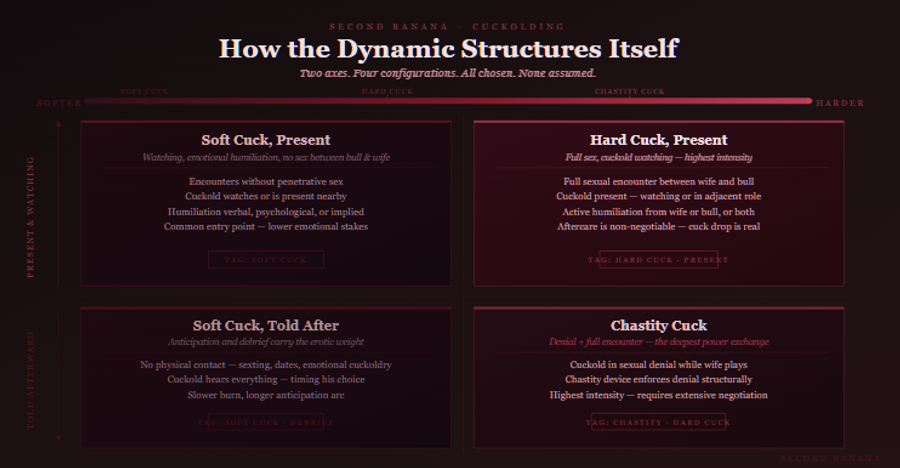
Soft cuckolding refers to dynamics that involve the humiliation and comparison elements without necessarily involving full sexual intercourse between the partner and the bull — sexting, dates, detailed accounts of encounters. Hard cuckolding involves the full dynamic including physical sex, often with the cuckold present. Chastity cuckolding introduces a further element: the cuckold is kept in sexual denial, typically via a chastity device, while his partner has encounters with the bull. Each of these is a distinct configuration with its own specific appeal.
The Data: How Common Is This?
The honest answer is: considerably more common than the cultural silence around it suggests. Justin Lehmiller’s survey of 4,175 Americans, published in Tell Me What You Want (2018), found that cuckolding fantasies were among the most frequently reported sexual fantasies for heterosexual men — with 58% of men and 33% of women reporting having fantasised about watching their partner with someone else. Among men specifically, it ranked as one of the top five most common fantasy themes.
The gap between fantasy prevalence and real-world practice is large, as it is for most sexual fantasies. Most people who have this fantasy never pursue it. But the fantasy prevalence alone makes the cultural silence around it remarkable — one of the most commonly reported male sexual fantasies is one of the least discussed, and the discussion that does exist is predominantly framed as pathological, comic, or shameful.
Community data tells a similar story. Cuckolding-related subreddits collectively have millions of members. Dedicated forums and communities have existed online for decades. The people in these communities are not a marginal fringe — they are, by any statistical accounting, a significant proportion of the adult male population who have simply found a space to engage honestly with a desire that their broader social world treats as unspeakable.
One of the most common male sexual fantasies is one of the least discussed. The silence isn’t evidence that it’s rare. It’s evidence that the shame is working.
The Psychology: Why This Specific Arousal Pattern
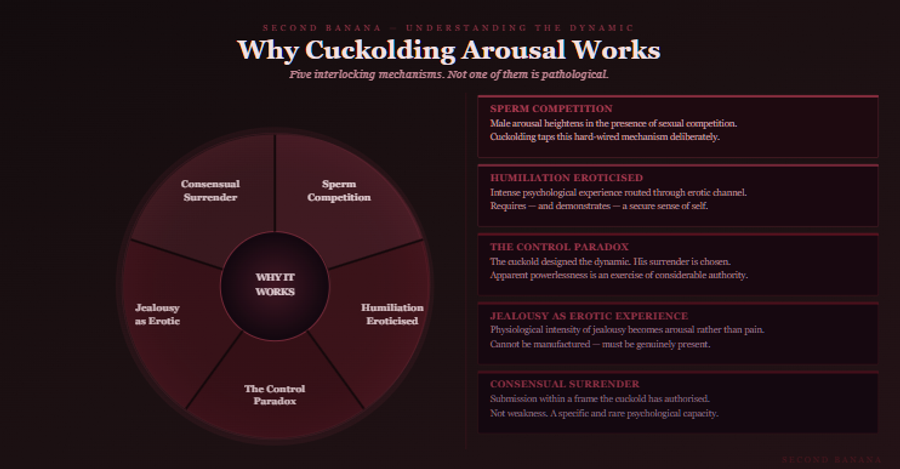
Sperm Competition Theory
The most frequently cited evolutionary explanation for cuckolding arousal is sperm competition theory, first proposed in the context of human sexuality by researchers including Robin Baker and Mark Bellis. The theory proposes that male arousal is heightened by the presence of sexual competition — specifically, by the awareness that a partner has been or may be sexual with another man. This heightened arousal, the theory suggests, serves an evolutionary function: it motivates increased sexual engagement and, in ancestral environments, increased ejaculate production in response to competitive threat.
The evidence for this mechanism in human male psychology is reasonably robust. Studies have found that men report heightened arousal when imagining their partners with other men, that sexual thoughts involving infidelity produce stronger arousal responses than equivalent non-infidelity thoughts, and that men in relationships where they suspect their partner’s fidelity show measurable physiological arousal responses. The mechanism is not consciously chosen — it appears to be a genuine, hard-wired feature of male sexual psychology that cuckolding fantasy and practice taps into deliberately.
Sperm competition theory explains the arousal mechanism. It does not explain the full complexity of the cuckolding dynamic, which involves psychological dimensions — humiliation, submission, the specific pleasure of inadequacy — that go considerably beyond a simple evolutionary arousal response.
The Eroticisation of Humiliation
The more psychologically interesting question is why the humiliation dimension is itself arousing — why the sting of inadequacy, rather than being purely painful, is experienced as pleasurable. This is the question that most popular accounts of cuckolding avoid, because it requires engaging honestly with the psychology of submission and masochism.
The most useful framework here comes from the BDSM psychology literature, which has extensively studied the mechanisms by which painful, humiliating, or degrading experiences become arousing for the people who seek them. The research consistently finds that submission and masochism are not expressions of low self-esteem or psychological damage — they are specific orientations toward the management of psychological intensity. Submissive and masochistic people typically have strong, well-developed senses of self that are capable of engaging with intense psychological experiences without being destabilised by them.
The humiliation in cuckolding works similarly. The cuckold who is aroused by the feeling of inadequacy is not a person who genuinely believes he is inadequate — he is a person who can engage with that feeling as an intense psychological experience, hold it within a consensual frame, and derive pleasure from its intensity. The experience is not about confirming a genuine belief in his own inferiority. It is about the specific erotic charge of temporarily inhabiting that psychological position.
This distinction matters enormously for understanding what cuckolding actually is and for countering the pathological framing that surrounds it. The cuckold is not damaged. He is not manifesting low self-worth through his sexuality. He is someone who has a specific and relatively unusual capacity to eroticise a particular kind of psychological intensity — a capacity that requires, rather than undermines, a secure sense of self.
Control and the Consensual Surrender of It
A dimension that often goes unexamined in popular accounts of cuckolding is the element of control. Despite the dynamic’s surface presentation — the cuckold as passive, helpless, subordinate — the actual architecture of cuckolding relationships typically places the cuckold in a position of considerable structural authority. He has established the dynamic. He has negotiated its terms. He has agreed to what happens and what doesn’t. The humiliation is consensual, which means it is chosen, which means it is, at root, an exercise of agency.
This is the paradox at the heart of all consensual power exchange: the person in the submissive position is the one who has authorised the dynamic. The bull’s authority is real within the scene precisely because the cuckold has made it so. The cuckoldress’s power over the cuckold’s feelings is real precisely because the cuckold has decided to give it that reality. The apparent powerlessness is the product of a very specific kind of power — the power to choose one’s own surrender.
Understanding this is essential for understanding why cuckolding works for the people it works for. It is not a dynamic in which someone is genuinely diminished. It is a dynamic in which someone has chosen, with care and intention, to experience what it feels like to be temporarily diminished — and has found that experience specifically, intensely pleasurable.
Jealousy as an Erotic Experience
Jealousy is typically understood as an emotion to be avoided, managed, or eliminated in healthy relationships. In cuckolding, jealousy is deliberately cultivated and experienced as erotically charged. This is one of the most psychologically distinctive features of the dynamic and one of the hardest for outsiders to understand.
The cuckolding literature describes this as the transformation of a typically negative emotional experience into an erotic one — a process that requires a specific kind of psychological plasticity. The cuckold who experiences jealousy as arousing is not someone who has confused his emotions or suppressed his pain. He is someone who has developed or discovered a capacity to engage with the physiological and psychological intensity of jealousy — the heightened attention, the racing heart, the acute awareness of his partner’s desirability to others — and route that intensity through an erotic channel rather than a painful one.
This capacity is not universal and it cannot be manufactured. People who try cuckolding primarily because a partner wants it, without the underlying psychological orientation that makes jealousy pleasurable rather than simply painful, frequently find the experience genuinely distressing rather than arousing. The distinction between a person for whom jealousy can be erotic and a person for whom it cannot is real and important — and it is one of the most critical things to be honest about before pursuing this dynamic.
The Relationship Architecture: How This Actually Works
Consent and Negotiation
Cuckolding requires more explicit negotiation than almost any other sexual dynamic, because the stakes of miscommunication are higher. The humiliation dimension means that the emotional intensity of the experience is substantial for everyone involved. The cuckold needs to know exactly what will happen and be genuinely prepared for the psychological experience it produces. The partner needs to know exactly what role she is playing and what the cuckold needs from her during and after. The bull needs to understand the dynamic he is entering and his role within it.
Experienced cuckolding communities emphasise the importance of extensive pre-negotiation on several specific dimensions: the degree of humiliation involved and its specific forms, the cuckold’s level of involvement during encounters (present and watching, present but not watching, informed afterward, kept ignorant as part of the dynamic), the partner’s role in the humiliation (active participant vs. simply pursuing her own pleasure), and the aftercare arrangements that follow intense scenes.
Aftercare deserves particular emphasis in cuckolding dynamics. The emotional intensity of the humiliation experience typically produces a significant psychological response in the cuckold — sometimes called ‘cuck drop’, analogous to sub drop in BDSM contexts — in the hours or days following an encounter. This is a genuine physiological and psychological response to the neurochemical intensity of the experience, and it requires active, caring management from the partner. Couples who navigate cuckolding successfully take aftercare as seriously as the encounter itself.
The Partner’s Experience
The cuckoldress’s experience of the dynamic is less frequently discussed than the cuckold’s, partly because the cultural narrative around cuckolding centres the male psychological experience and partly because the partner’s motivations are genuinely varied. Some women are drawn to the dynamic because they find the sexual freedom it provides genuinely appealing — the opportunity to pursue encounters with other men with full transparency and their partner’s enthusiastic consent. Some find the power dimension of the cuckoldress role specifically appealing — the experience of being actively desired by multiple men, of having a partner who is aroused by her desirability to others. Some are primarily motivated by their partner’s pleasure and find satisfaction in facilitating an experience he finds deeply compelling.
What is consistent across accounts is that the dynamic works best when the partner has genuine agency and genuine desire rather than feeling that she is performing a role for her partner’s benefit. A cuckoldress who is actively enjoying her encounters and her power within the dynamic is a different experience for the cuckold than a partner who is going through the motions. The authenticity of her experience is part of what makes the dynamic real rather than theatrical.
The Bull’s Role
The bull occupies a structurally complex position in cuckolding dynamics. He is typically cast as dominant, sexually confident, and superior to the cuckold in some explicitly acknowledged dimension. But he is also a participant in a dynamic that has been designed and authorised by the cuckold — which means his dominance is, at a structural level, entirely dependent on the cuckold’s consent.
Experienced bulls in the cuckolding community understand this complexity well. The role requires a specific combination of qualities: the ability to authentically inhabit the dominant role within the dynamic, genuine desire for and attention to the partner’s pleasure, sensitivity to the cuckold’s psychological experience, and clear understanding of the boundaries and structure of the arrangement. A bull who doesn’t understand the dynamic — who treats the cuckold with genuine contempt rather than consensual theatrical contempt, or who develops attachment to the partner that exceeds the agreed terms — is a bull who damages the dynamic rather than serving it.
Finding the right bull is one of the most consistently cited practical challenges in cuckolding communities. The combination of qualities required — physically and sexually confident, emotionally intelligent, respectful of the couple’s dynamic, genuinely oriented toward the partner’s pleasure, and capable of authentic participation in the humiliation dimension without genuine cruelty — is not common.
The Shame, and Why It Has Always Been Misplaced
The cultural shame around cuckolding operates on two distinct levels. The first is the general stigma around non-monogamy and consensual sexual arrangements that deviate from the default template. This stigma applies to hotwifing, polyamory, swinging, and every other form of ENM — cuckolding is not uniquely stigmatised in this dimension.
The second level is specific to cuckolding, and it cuts deeper. The dynamic involves a man finding pleasure in his own humiliation and submission — which runs directly against the cultural script for male sexuality, in which men are supposed to be dominant, possessive, and competitive rather than submissive, surrendering, and aroused by the idea of another man being sexually superior. The cuckold violates this script in ways that are visible and legible to anyone who encounters the dynamic, which makes the shame more pointed and more personal than the general ENM stigma.
The shame is misplaced for the same reason all sexual shame is misplaced when it applies to consensual adults doing something that harms no one. The cuckolding dynamic, when practised with honesty, clear negotiation, and genuine care for everyone involved, is not harmful. The cuckold is not a victim. The partner is not being exploited. The bull is not doing anything wrong. Three adults have agreed to participate in an experience that each of them finds compelling for their own reasons, and the fact that one of those reasons involves the deliberate cultivation of an intense and unusual psychological experience does not make it pathological.
The research supports this. Studies comparing BDSM practitioners — including those in cuckolding and power exchange dynamics — to non-practitioners consistently find no significant differences in psychological health, relationship satisfaction, or attachment style. Some studies find that BDSM practitioners score higher on certain measures of psychological wellbeing, possibly because the explicit communication and consent negotiation required by these dynamics produces genuine relational benefits.
The cuckold is not broken. He has a specific psychological orientation that requires more honesty, more communication, and more self-knowledge than most sexual dynamics demand. That is not a pathology. That is a high bar, and he clears it.
What This Has to Do With Second Banana
Second Banana was built on the conviction that sexual compatibility is specific, and that the right platform is one that allows you to represent your actual desires with precision before anyone responds. For cuckolding dynamics specifically, this precision is not a luxury — it is the condition that makes finding the right people possible at all.
The dynamic requires a specific combination of people: a cuckold who knows his own psychology honestly, a partner who is genuinely engaged rather than simply compliant, and a bull who understands the dynamic and can inhabit his role authentically. Finding all three in the right configuration on a platform that requires you to represent your desires through photographs and a handful of demographic data points is effectively impossible. The post-first model changes this.
The Second Banana tag system gives the cuckolding community specific vocabulary:
- Cuckold / cuckoldress — role and orientation
- Bull — what’s being sought and the specific dynamic required
- Humiliation / degradation — the specific psychological dimension
- Present / informed afterward / kept ignorant — level of cuckold involvement
- Soft cuck / hard cuck — extent of the dynamic
- Chastity — where relevant
- Aftercare important — signalling the seriousness of the emotional dimension
These tags do the work of finding the right people before the conversation starts. Someone who responds to a post tagged with ‘humiliation’ and ‘bull’ already understands the dynamic they’re entering. That’s not a small thing — it is the difference between a conversation that goes somewhere and one that requires extensive explanation of basic terms.
The anonymous posting option matters particularly for cuckolds and their partners, who are navigating a dynamic that carries more social stigma than most. Being able to represent yourself honestly before attaching your face to that honesty is not a workaround. For most people in this dynamic, it is the condition under which honesty becomes possible at all.
And the community Second Banana attracts — people who have thought carefully about their desires, who communicate explicitly, who take consent seriously — is disproportionately composed of people who will understand a cuckolding dynamic without requiring it to be justified from first principles. The platform self-selects for exactly the quality of person this dynamic requires.