Threesome Fantasy: Every Variation Explained — and Where to Find It | Second Banana
The Threesome Fantasy:
Every Variation, the Psychology Behind Each One, and How to Actually Find What You're Looking For
The Fantasy Everyone Has and Nobody Talks About Honestly
Let's start with the data, because it's striking: the threesome is consistently the most commonly reported sexual fantasy across large-scale surveys of both men and women. A 2016 study published in the Journal of Sexual Medicine, surveying over 1,500 adults, found that 82% of men and 31% of women had fantasised about group sex — with threesomes specifically topping the list for both genders. A 2020 Canadian study of over 1,000 participants found similar results, with threesomes ranking as the single most common fantasy regardless of gender or sexual orientation.
Which means that if you have had this fantasy — repeatedly, vividly, with considerable specificity about how it would actually go — you are in the statistical majority of adults. You are not deviant. You are not unusual. You are not secretly broken in some way that needs explaining away.
What the surveys don't capture, and what most content on this topic gets completely wrong, is that 'the threesome fantasy' is not a single thing. MFM is not the same as MMF. FFM is not the same as FMF. A couple looking for a unicorn is having a different experience from three people who all know each other. A soft swap arrangement carries different dynamics from full swap. The voyeuristic threesome — where one person's pleasure is in watching more than participating — is its own distinct experience.
The reason it matters is this: if you don't know exactly which variation you're fantasising about, you can't find the people who want the same thing. And if you find yourself pursuing the wrong version — the one you thought you wanted because it was the only version being described — the experience is almost guaranteed to disappoint.
This piece is the breakdown you actually need. Every major variation. What each one actually involves psychologically and practically. Why some people want one version and not another, even when those versions look similar from the outside. And how Second Banana's tag system gives you the vocabulary to find exactly what you're looking for, with exactly the right people.
The threesome isn't one fantasy. It's a family of related fantasies that share a surface similarity and diverge completely in what they're actually about.
The Variations: What Each One Actually Is
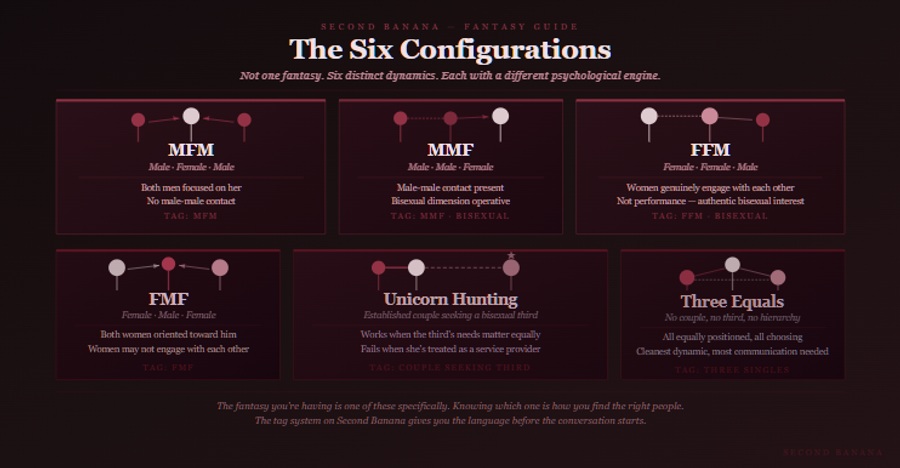
MFM: Male-Female-Male
MFM — one woman, two men — is the variation that appears most commonly in female-oriented erotica and in couples who approach threesomes with the woman's pleasure as the explicit organising principle. In an MFM dynamic, both men's attention, energy, and physical presence are directed primarily toward the woman. The two men are not interacting with each other.
This last point is the one most frequently glossed over, and it's the one that matters most for finding compatible partners. MFM is specifically and importantly not MMF — the distinction being whether there is any male-male contact or dynamic. In a true MFM arrangement, the two men are parallel rather than interacting: both present, both engaged with the woman, but not with each other. People who are specifically seeking MFM are often explicitly not interested in MMF, and conflating the two in your post or your tags is how you end up with the wrong situation.
The psychological pull of MFM, for the woman at the centre of it, is often about abundance and complete attention — the experience of being entirely surrounded by desire, of having needs met from multiple directions simultaneously, of being the singular focus of two people's pleasure-giving. For men who enjoy this dynamic, the appeal is often about the woman's pleasure and about the particular quality of attention and generosity that emerges when there is no competition and no performance anxiety because both are on the same side.
MFM arrangements are also frequently the entry point for couples exploring threesomes, because the dynamic is legible to both people in a couple: she remains the focus, there is no question of the male partner's sexuality being complicated by the dynamic, and the structure is clear.
MMF: Male-Male-Female
MMF uses the same three people as MFM but describes a fundamentally different experience. In an MMF dynamic, there is some degree of male-male interaction — ranging from incidental physical contact to explicit bisexual engagement. The F is still present and still central to the experience, but the defining characteristic of MMF is that the two men are not simply parallel: their dynamic with each other is part of what's happening.
This matters enormously for matching. A man who is bi-curious or bisexual and interested in exploring that dimension within a threesome context is seeking something specific that an MFM arrangement doesn't provide. The woman in an MMF arrangement is often part of a dynamic that includes watching two men together — which is its own significant appeal for many women, and an experience that is distinct from being the sole focus of two men's attention.
MMF carries more social complexity than MFM, partly because male bisexuality remains more stigmatised than female bisexuality in most cultural contexts, and partly because many men who are interested in MMF haven't fully examined or articulated that interest to themselves before they find themselves in a situation that brings it to the surface. The men who are clearest about wanting MMF — rather than hoping it emerges in an MFM context — tend to have better experiences with it.
If MMF is what you're looking for, say so explicitly. The Second Banana tag system exists for exactly this reason.
FFM: Female-Female-Male
FFM — two women, one man, with the women actively engaging with each other — is the variation most commonly depicted in mainstream pornography and therefore the variation most commonly assumed when men say they want a threesome. It is also the variation that causes the most mismatched expectations in practice.
The pornographic version of FFM tends to present the two women as equally enthusiastic about each other and equally focused on pleasing the man. The reality is considerably more varied. Two women who are both genuinely interested in each other AND in the man is a specific combination of orientations and desires that is not guaranteed to emerge simply because a man has located two women willing to be in the same room with him.
Genuine FFM — as a dynamic that works for everyone involved — requires that both women have authentic interest in each other, not merely a willingness to perform. The distinction between authentic FFM interest and performance is felt in the room. It affects the experience profoundly. Women who are straight but willing to perform bisexuality to please a male partner are not the same as women who are genuinely bi or queer and excited about the specific combination the dynamic offers.
The man in an FFM dynamic is also having a different experience depending on the configuration: whether he's the centre of attention, whether he's more of an appreciative audience for the two women, whether the dynamic is equal across all three. These variations are all legitimate. They are not the same experience.
FMF: Female-Male-Female
FMF is to FFM what MFM is to MMF: the same three people, a fundamentally different dynamic. In an FMF arrangement, the two women are not primarily engaging with each other — the male partner is the centre of attention from both. The women may have varying degrees of interaction, but the defining characteristic is that both are oriented toward the man rather than toward each other.
FMF is the dynamic that actually maps most closely onto what couples seeking a 'third' often describe wanting — a woman who joins a couple, engages primarily with the male partner, and whose interaction with the female partner is limited or absent. Whether this is actually what the female partner in the couple wants is a separate question that often doesn't get asked clearly enough before the situation develops.
FMF can work well when all three people genuinely want that specific dynamic — when the focus on the man is what everyone finds appealing, rather than a compromise or an avoidance of the question of whether the two women want to engage with each other. When it's genuinely chosen, it's a legitimate dynamic with its own distinct appeal.
Unicorn Hunting: The Dynamic That Deserves Its Own Section
Unicorn hunting describes the practice of an established couple — typically a man and a woman — seeking a bisexual woman who will join them as a 'third' for sexual encounters, often framed as joining 'the couple' in some broader relational sense. The term 'unicorn' comes from the kink community's wry acknowledgment that the person being sought — a bisexual woman who is equally attracted to both members of the couple, has no needs of her own that might complicate the couple's dynamic, and is available on the couple's terms — is essentially mythical.
Unicorn hunting has a complicated reputation in ENM and kink communities, and understanding why is useful even if you're approaching a threesome from a relatively straightforward place.
The most common version of unicorn hunting that earns its bad reputation involves a couple treating the third as a service provider rather than a person: an addition to their experience rather than someone with their own desires, needs, and expectations. The couple often maintains their primary bond as the structuring priority, the third is expected to accommodate both of them equally and simultaneously, and the implicit rules of the arrangement — often not stated explicitly — are designed to protect the couple's relationship rather than to serve the experience of all three people.
The third person in this dynamic frequently reports feeling like an afterthought: desired as an object rather than valued as a person. The couple's needs — including the female partner's potential jealousy or the male partner's specific fantasy — take precedence, and the third is expected to manage around them.
None of this means that an established couple seeking a third is inherently problematic. It means that how you approach it determines almost everything. The difference between unicorn hunting that works — where all three people feel genuinely seen, genuinely desired, and genuinely cared for — and the version that earns the reputation is the degree to which the third person's needs and desires are treated as equally important as the couple's.
On Second Banana, the tag system lets you signal your approach: whether you're a couple seeking a genuine connection with a third, or a solo person open to joining a couple, with transparency about what the dynamic actually involves.
Full Swap vs Soft Swap
Full swap and soft swap are terms that emerge primarily in swinger community contexts but are useful for anyone navigating threesomes and group dynamics.
Soft swap refers to a dynamic in which sexual activity goes up to a defined point but stops short of penetrative sex with someone other than your primary partner. The exact boundary varies by agreement: for some couples, soft swap means oral sex is fine but penetration isn't; for others, it means making out and manual stimulation but nothing beyond. The critical feature is the explicit agreed limit.
Full swap means penetrative sex with all parties is on the table. This is distinct from soft swap not just mechanically but psychologically — the experience of full sexual involvement with a third person carries a different emotional weight for most people than activity that stops short of it, regardless of whether that weight is positive, neutral, or complicated.
In the context of a threesome, the soft/full distinction maps onto a spectrum of how much sexual integration is wanted. Some threesomes are explicitly soft swap by prior agreement: we will all be together, there will be touch and pleasure and genuine engagement, but penetrative sex stays within the existing couple. Others are full engagement from the start. Both are legitimate. The problem is when the expectations aren't aligned before the encounter.
This is exactly the kind of thing that needs to be in the tag or in the post rather than left for the moment. 'Soft swap only' and 'full swap welcome' are two different invitations and they should read that way from the start.
The Voyeuristic Threesome
Less discussed but genuinely common: the threesome dynamic in which one person's primary pleasure is in watching rather than in physical participation. This ranges from a relatively equal participant who spends more time observing to someone who has joined a scene specifically to watch the other two people together.
The voyeuristic dimension can operate in any configuration. A man who enjoys watching two women together, who participates at the edges but whose real arousal is in witnessing, is having a different experience from the man who wants to be the centre of the dynamic. A woman who is excited about watching two men together while being present in the room is seeking something specific. A couple who wants to perform for a third who watches — rather than seeking a full participant — is offering a particular kind of connection.
The voyeuristic threesome often goes unnamed because the cultural script for threesomes assumes full participation from everyone. Naming it — in your post, in your tags, in your early conversation — helps you find the people who want the same dynamic and avoid mismatched expectations about who's doing what with whom.
Three Equals: No Couple, No Third
The least-discussed variation and arguably the cleanest psychologically: three people who are all equally positioned, none of whom is an established couple, none of whom is a 'third' being added to anyone's dynamic. Three people who want to have a sexual experience together, with roughly equal investment and equal agency in how it unfolds.
This configuration avoids many of the dynamics that complicate couple-plus-third arrangements: there's no primary bond to protect, no established partner whose comfort takes structural precedence, no implicit hierarchy. There are also no existing rules about what the experience can and can't include, which means all three people need to communicate clearly rather than relying on a couple's existing agreement.
The three-equals configuration is common in contexts where people have met through shared community — kink events, ENM gatherings, or platforms like Second Banana where everyone arrives as an individual with their own stated desires — rather than through a couple's search for an addition.
The Psychology: Why This Fantasy, and Why These Specific Variations
What Most People Are Actually Fantasising About
Large-scale fantasy research has identified several consistent psychological themes underneath the threesome fantasy, and understanding which theme drives your version tells you a lot about which variation is actually right for you.
Abundance and attention — the experience of being desired by more than one person simultaneously — is the most commonly reported theme. This is gender-neutral: it appears in women's threesome fantasies as strongly as in men's. The erotic charge is about being wanted, multiply and simultaneously, without having to choose.
Observation and exhibition — the pleasure of watching, being watched, or performing — runs through many threesome fantasies and maps directly onto the voyeuristic and exhibitionistic dimensions of the dynamic. For many people, a significant part of the appeal is in witnessing their partner's pleasure with someone else, or in being witnessed themselves.
Novel sensation and permission — the threesome as a context in which things that feel off-limits in everyday sexual life become available. This is where some of the male-male interest in MMF sits: a context that makes bisexual exploration feel more legible than a purely same-sex encounter might.
Generosity and service — for some, the appeal of a threesome is primarily about the pleasure of giving: the ability to attend to multiple people, to orchestrate an experience, to be the person who makes something extraordinary happen for someone they care about.
The Fantasy/Reality Gap — Why This Is Normal and What to Do About It
Research consistently finds that the threesome has among the largest gaps between fantasy appeal and real-world pursuit of any commonly reported fantasy. Most people who have this fantasy don't act on it — and of those who do, the experience sometimes matches the fantasy closely and sometimes diverges considerably.
The gap doesn't mean the fantasy was wrong. It often reflects the difference between the fantasy's focus (abundance, desire, sensation, the specific thing you're imagining) and the reality's additional content (logistics, communication, the specific people involved, the management of emotions that the fantasy tidily excluded). A fantasy about an MFM dynamic where both men are perfectly attuned to each other and to you doesn't account for the reality of two human men with their own needs and uncertainty and communication styles.
The solution is not to conclude that acting on the fantasy is a mistake. It's to approach the real thing with the same deliberateness the fantasy deserves: knowing exactly what variation you want, being explicit about it, finding people who want the same thing, and communicating about what the experience will involve before you're in it.
The fantasy succeeds because it's in your control. The reality succeeds because you've done the work to make it match.
The Communication That Has to Happen First
For Couples
The conversation that needs to happen before a threesome is not primarily about logistics. It's about desire: who specifically each person is attracted to in this scenario and why, what they're hoping to feel during it, what they might feel that they're not expecting to feel, and what they genuinely need to make the experience good rather than just something they got through.
The questions couples often avoid: Is one of us doing this primarily for the other? Is there something specific we're each hoping to get from this that we haven't said out loud? What happens if we feel differently about it afterward? What are the actual limits — stated explicitly rather than assumed?
The couples who have the best experiences with threesomes are not the ones who felt most certain going in. They're the ones who were most honest going in.
For Individuals
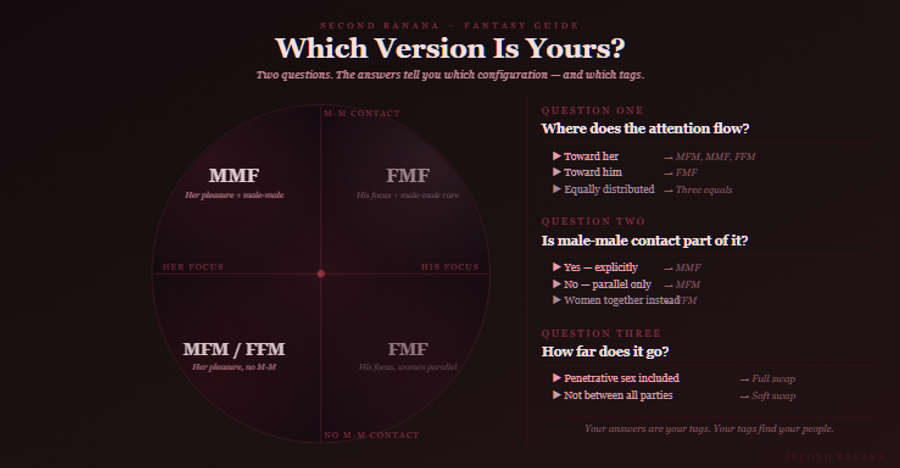
If you're a solo person interested in a threesome — whether joining a couple or meeting two other individuals — the most useful thing you can do before writing your post is be specific with yourself about which dynamic you're actually interested in.
Not 'a threesome' but: MFM or MMF. With an established couple or with two other singles. As an equal participant or with a voyeuristic dimension. Soft or full. These questions are not bureaucratic. They're the difference between finding the right people and finding the wrong ones.
The Conversation With the People Involved
Consent negotiation for a threesome is more complex than for a two-person encounter because you're managing three sets of desires, three sets of limits, and the dynamics between all three pairs within the group. The standard tools — explicit conversation about what's wanted and what isn't, agreed limits before the encounter, a mechanism for communicating during it — all apply, and they matter more because there are more moving parts.
One specific thing worth stating before the encounter: what happens if one person wants to stop or step back mid-scene. The answer is always that they can — but having said this explicitly before you're in the situation means nobody has to figure out how to raise it in the moment.
What This Has to Do With Second Banana
The threesome fantasy is exactly where this matters most. Because 'interested in threesomes' is not useful information. 'Interested in MFM threesomes where both men are focused on the woman and there is no male-male contact, looking for a confident bi woman who enjoys being the centre of that attention, full swap, no existing couple preferred' — that is useful information. It's the kind of specificity that finds the right person rather than a large undifferentiated pool of people who ticked a box.
The tag system gives you the vocabulary to represent this before you've had to write it out in full every time. Tags like:
- MFM / MMF / FFM / FMF — the configuration itself
- Soft swap / full swap — the extent of sexual involvement
- Couple seeking third / solo seeking couple / three singles — the structural position
- Voyeuristic / exhibitionistic — the observational dimension
- Bisexual / bi-curious / straight — the orientation of each person
- One-time encounter / ongoing connection — the relational intention
These tags do the work of narrowing before the conversation starts. They mean that the people who reply to your post already know which version of this they're interested in — and are more likely to be the right version.
The post-first model matters here too. A threesome requires communication before, during, and after. The people who can write clearly and specifically about what they want are more likely to be the people who can communicate clearly and specifically in the encounter itself. The Second Banana model self-selects for exactly the quality of person a threesome requires.
And the anonymous posting option — for people who are navigating jobs, families, or social contexts where their sexual interests are not something they want attached to their face and full identity before they've assessed safety — provides a meaningful layer of protection that mainstream apps strip away by default.