
Latex Kink: The Tactile, the Visual, the Second Skin, and Why This Material Produces Its Own Specific Erotic Territory | Second Banana
Latex:
The Tactile, the Visual, the Second Skin, and Why This Material Produces Its Own Specific Erotic Territory
A Material With Its Own Specific Charge
Latex fetishism — erotic attraction to latex as a material, in the forms it can take, and in the specific experiences of wearing or seeing it worn — is one of the oldest and most established material fetishes in the kink landscape, with a substantial community, a sophisticated culture of design and craft, and a range of genuine erotic orientations clustered around what is, at its core, a remarkable and specific material.
Latex is not simply clothing worn in a kink context. It is a material with genuinely distinctive properties — the specific way it fits and moves against skin, the sound it makes, the warmth it traps, the smell of the material itself, the way it catches and reflects light — that produce sensory and aesthetic experiences unlike any other material. For latex fetishists, these properties are not incidental features of a garment but the specific source of the erotic charge. The material itself is the point.
This piece covers the three main orientations within latex fetishism — the tactile/sensory, the visual/aesthetic, and the enclosure psychology — along with the exhibitionistic and performance dimension that latex wear often involves, the practical realities of working with the material, and the community that has developed around it. Latex and rubber fetishism overlap significantly; where they differ, the piece notes the distinctions without making that comparison its primary structural focus.
There is no other material quite like latex against skin. Not leather, not PVC, not anything else. Practitioners know this immediately. The specific properties are the point — not just the look, but the feeling, the sound, the smell, and what it does to the body wearing it.
The Tactile and Sensory Dimension
The Feel of Latex Against Skin
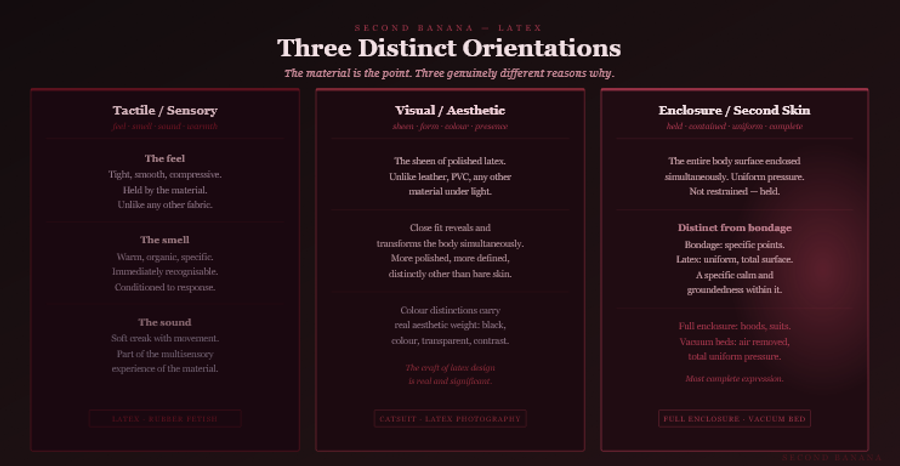
Latex worn against bare skin produces a specific tactile experience that practitioners consistently describe as unlike any other material. The combination of tight fit — latex conforms closely to the body’s surface — with the smooth, slightly resistant quality of the material creates a sensation of uniform pressure and enclosure across whatever area is covered. This is not the feeling of ordinary tight clothing: latex has a specific elasticity and surface quality that produces a sensation of being held by the material, of the skin being contained and enclosed within it.
The specific tactile properties that latex fetishists most commonly describe include: the initial sensation of the material contacting the skin and being drawn onto the body’s curves, the specific smoothness of the inner surface against skin, the way the material transmits warmth so that body heat accumulates within it, and the specific feeling of movement within latex — the way the material moves with the body while maintaining its enclosing pressure. Each of these has its own sensory character that practitioners distinguish and value specifically.
The Smell
Latex has a specific, immediately recognisable smell that is itself a significant erotic trigger for many practitioners. The organic chemistry of natural rubber latex produces a distinctive scent — warm, slightly sweet, specific to the material — that many latex fetishists describe as inseparably part of the erotic experience of the material. The smell of latex is conditioned, for practitioners who have been in the material, to their own erotic response to it, producing a powerful and immediate sensory association.
The smell is present in both natural latex and synthetic alternatives, though the specific character varies between materials and between manufacturers. Many practitioners develop strong preferences for specific latex sources partly on the basis of the olfactory profile of the material.
The Sound
Latex produces a distinctive sound when worn — a soft, smooth, creaking or squeaking sound with movement, specific to the material’s properties. For many practitioners this auditory dimension is a meaningful part of the overall sensory experience of latex — a component of the multisensory immersion in the material that full latex wear produces. The sound of latex moving with the body is, for practitioners who have spent time in the material, as much a part of its specific character as the feel or the smell.
The Visual and Aesthetic Dimension
Latex’s visual properties are among the most immediately striking of any fetish material. The sheen of polished latex — the way it reflects light with a depth and vividness unlike leather, PVC, or any other material — gives the latex-clad body a specific visual quality that is both highly visible and specifically distinctive. The material’s close fit means it reveals and emphasises the body’s form while simultaneously transforming it into something distinctly other than bare skin — more polished, more extreme, more completely defined.
For practitioners whose primary orientation is visual and aesthetic, the latex garment as an aesthetic object is the primary source of erotic charge. This includes the specific look of different styles — catsuits, corsets, gloves, hoods, full enclosure suits — each of which produces a distinct aesthetic with its own specific appeal. The craft of high-quality latex design is real and significant: latex designers who can produce garments that fit precisely, polish cleanly, and hold their form are working at a genuinely skilled level that practitioners in the community recognise and value.
The colour choices within latex are themselves part of the aesthetic language — black latex’s deep, light-absorbing sheen versus the vividness of coloured latex, the specific qualities of transparent or translucent materials, the visual effects of contrast between latex panels. For visually-oriented practitioners, these distinctions carry real erotic weight.
The Second-Skin and Enclosure Psychology
Full or extensive latex coverage produces a specific psychological experience that goes beyond the tactile and the visual: the experience of having the entire body surface enclosed within a second skin, of being uniformly contained and held from the outside simultaneously. This enclosure experience has its own psychology distinct from both the sensory and the aesthetic dimensions, connecting to the bondage and containment territory covered elsewhere in this series while being genuinely different from it.
Where bondage restrains at specific points — wrists, ankles, a binding that fixes position — latex enclosure holds uniformly and completely, from the outside of the entire body surface simultaneously. The psychological experience this produces is described by practitioners as a specific kind of completeness: not restricted in movement but held, contained, enclosed. Many describe a specific quality of calm or groundedness within full latex enclosure, a reduction of the kind of ambient physical self-awareness that attaches to uncontained bare skin, replaced by a uniform, total physical presence that is the material itself.
This enclosure psychology connects to the sensory deprivation territory when full latex coverage extends to hoods and face coverage, adding a reduction of visual input and of the ordinary sensory relationship with the environment to the enclosure of the body. Full enclosure suits and vacuum beds — which use the removal of air to press latex uniformly against the entire body surface — take the enclosure experience to its most complete expression and have their own specific and intense psychology.
The Performance and Exhibitionistic Dimension
Latex is not a private material in the way that some fetish interests are. Its visibility, its distinctive appearance, and the specific quality of presence it confers on the wearer all give latex wear a significant exhibitionistic dimension for many practitioners. Wearing latex in public — at kink events, fetish clubs, pride events, or even in more mainstream contexts — is a specific kind of self-presentation that carries its own erotic charge for practitioners drawn to this aspect.
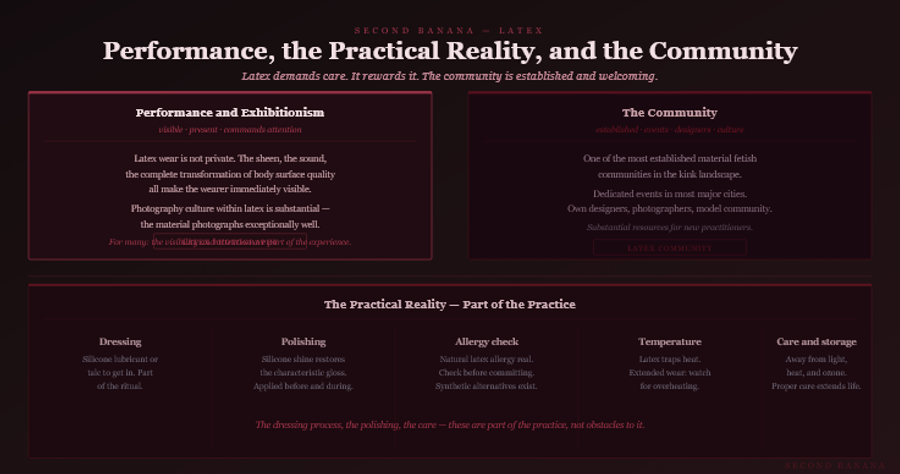
The latex-clad body commands attention in a way that other forms of fetish dress do not quite replicate: the sheen, the specific sound of movement, the complete transformation of the body’s surface quality all make the wearer immediately visible and recognisable to anyone who knows the material. For exhibitionistically-oriented latex practitioners, this visibility and the attention it draws is itself part of the experience.
The photography culture within the latex community is substantial: latex photographs exceptionally well under studio lighting, with the material’s reflective properties producing images of a distinctive and striking quality. Many practitioners engage with latex partly through photographic self-documentation and the specific aesthetic pleasures of latex imagery.
The Practical Reality
Latex is a demanding material that rewards care and attention. Understanding its practical requirements is part of engaging with it seriously rather than incidentally.
- Getting into latex: latex garments need lubricant to put on comfortably against bare skin — typically silicone-based dressing aid, talcum powder, or dedicated latex dressing agents. Attempting to put on latex without lubricant produces discomfort and risks damaging the material. This process of getting into latex is itself, for many practitioners, part of the erotic ritual of the material.
- Polishing: latex worn against the body loses its sheen quickly from contact and sweat. Silicone shine products restore the characteristic latex gloss and are typically applied before and during wear. The act of polishing — bringing the material back to its characteristic reflective surface — is another ritual dimension of latex practice.
- Latex allergies: natural latex allergy is a real medical condition. Practitioners who have not worn latex before should check for latex sensitivity before committing to significant latex wear. Synthetic alternatives (PVC, various synthetic rubbers) are available for those with latex sensitivities and have their own specific properties.
- Care and storage: latex should be stored away from light, heat, and ozone (produced by some electrical equipment) which degrade the material. Proper washing and storage significantly extends the life of latex garments.
- Temperature: latex traps body heat very effectively. Extended full-body latex wear produces significant heat retention, and practitioners should be aware of overheating risk, particularly in warm environments or during physical activity.
The Community
The latex fetish community is one of the most established and well-organised material fetish communities in the kink landscape. Dedicated latex events — fetish balls, latex club nights, latex-specific gatherings — are regular features of the kink event calendar in most major cities. The community has its own designers, photographers, model community, and online infrastructure.
This established community means that new latex practitioners have substantial resources available — both practical guidance on working with the material and social context for exploring the fetish in a supportive environment. Connecting with the community through kink events, online spaces, or dedicated latex venues is typically the most effective route into the full experience of latex fetish culture.
What This Has to Do With Second Banana
The three distinct orientations within latex fetishism — tactile/sensory, visual/aesthetic, and enclosure psychology — mean that two people who both identify with a latex interest may be seeking quite different experiences. A practitioner primarily drawn to the sensory experience of wearing latex may have little overlap with one primarily drawn to the visual aesthetic of photographing it.
The post-first model lets latex practitioners be specific about which dimension is primary, what they are looking for from a partner or an encounter, and whether their interest is in wearing, in the other person wearing, in the photographic and visual dimension, or in the enclosure and enclosure-oriented practice specifically.
The Second Banana tag system gives latex practitioners specific vocabulary:
- Latex — the material and broad orientation
- Rubber / latex fetish — for those with a fetish-level orientation to the material
- Catsuit — for those whose primary interest is the full-body garment
- Latex wearing — for those whose primary orientation is wearing the material
- Latex photography — for those whose primary engagement is visual/photographic
- Full enclosure — for those drawn to the complete second-skin experience
- Vacuum bed — for practitioners of the most complete enclosure form
- Latex community — for those engaged with the broader scene and culture