

12 Sex Myths That Are Wrong (And 3 That Are Somehow True) | Second Banana
12 Sex Myths That Are Wrong
(And 3 That Are Somehow True)
We went through the actual research so you don’t have to argue about this at a dinner party and lose
Why We’re Doing This
Every piece in this series has, at some point, had to stop and correct a piece of received wisdom that turned out to be wrong. The squirting article had to dismantle the “it’s just pee” myth. The anal play piece had to correct people’s sense of what’s actually happening down there anatomically. The desire piece had to take apart the entire cultural model of how arousal is supposed to work.
This piece is the highlight reel. Twelve things that most people believe about sex that the research does not support — some debunked decisively, some more complicated than a flat yes or no. And, because intellectual honesty cuts both ways, three things that sound like myths, that get rolled out as obviously fake whenever they come up in conversation, and that turn out to have more truth in them than the conventional wisdom gives them credit for.
Sources for everything are at the bottom. Let’s go.

Myth: Squirting Is Just Pee
Verdict: Mostly true, technically, but the framing is doing a lot of dishonest work.
The fluid expelled during squirting is, per the best available research (Salama et al. 2015; confirmed via dye-tracing by Inoue et al. 2022), primarily bladder-derived and biochemically resembles diluted urine. So far, the myth-debunkers lose this one.
But “just pee” undersells two things. First, the fluid is significantly diluted — the bladder refills at remarkable speed during arousal, and the urea concentration in squirting fluid is three to six times lower than normal urine. Second, PSA — a marker from the Skene’s glands, the so-called female prostate — was detected in the squirt fluid of the majority of participants in both major studies, indicating a genuine prostatic contribution mixed in with the bladder-derived fluid. It’s not pure urine. It’s an unusual, diluted, partially glandular fluid that happens to exit via the same plumbing.
More importantly: so what? Saliva, sweat, and semen all contain urea too. Nobody is performing biochemistry on a kiss. We wrote the full piece on this if you want the receipts.
Myth: Size Doesn’t Matter
Verdict: Mostly true, with caveats that matter more than the headline.
This one gets stated as a kindness so often that people assume it’s a lie people tell to be nice. It mostly isn’t. Multiple large surveys — including a widely cited 2015 study in the Journal of Sexual Medicine surveying over 75,000 people — found that the overwhelming majority of women report being satisfied with their partner’s penis size, and that satisfaction with a partner’s size correlates far more strongly with relationship satisfaction and technique than with actual measurements.
The nuance: size does affect specific things — comfort during certain positions, and for some people, length or girth genuinely changes the physical experience of specific kinds of stimulation (the A-spot and cervix are reachable with sufficient length; girth affects contact with the vaginal walls and, for anal play, with the prostate). But “matters for pleasure in some specific configurations” is a very different claim from the cultural anxiety the myth is built to soothe, which is about whether size determines desirability or adequacy. It does not. The research is unambiguous on that part.
Myth: Women Take Much Longer to Get Aroused Than Men
Verdict: False, and the actual finding is more interesting.
This one persists because it’s often confidently stated as established sexology. It isn’t. What the research on arousal timing (notably work using vaginal photoplethysmography and penile plethysmography to measure genital arousal directly) actually finds is that genital arousal can occur quite quickly in people of all genders — often within seconds to a couple of minutes of relevant stimulation.
What takes longer, and what the myth is actually gesturing at clumsily, is the gap between genital arousal and subjective arousal — the felt sense of being turned on. We covered this in detail in the responsive desire piece: genital and subjective arousal show only about 26% concordance in women, compared to roughly 66% in men. The body can be physiologically ready well before the mind catches up, or vice versa. “Takes longer to get aroused” conflates two different systems that don’t always move together — and assumes the slower one is universal, when it’s actually just less concordant on average.
Myth: You Lose Your Virginity the First Time You Have Penetrative Sex
Verdict: The concept barely survives contact with scrutiny.
“Virginity” as a single, definable, lose-it-once event is a remarkably recent and remarkably incoherent cultural construction. It typically refers, by unspoken default, to penile-vaginal intercourse — which immediately excludes the sexual experiences of queer people, asexual people who have other forms of intimacy, and anyone whose first sexual experiences didn’t take that specific form, as though none of those experiences count as “real” sex.
Sociologist and sex researcher Hanne Blank’s history of the concept, Virgin: The Untouched History, traces how thoroughly culturally constructed and medically unfounded the idea is — there is no reliable physical marker of “virginity loss” (the hymen myth has its own extensive debunking literature; hymens vary enormously in shape, some don’t bleed or tear at all, and many are altered by entirely non-sexual activity). The concept persists because it does cultural work — often regulatory work around women’s sexuality specifically — not because it describes a real, consistent biological or psychological event.
This doesn’t mean first sexual experiences aren’t significant. It means the “one clean before/after line, lost forever” framing doesn’t map onto how sexuality actually develops, which is gradual, varied, and doesn’t hinge on one specific act.
Myth: Men Always Want Sex More Than Women
Verdict: Confuses spontaneous desire with desire generally.
We covered this at length in the responsive vs spontaneous desire piece, but it’s worth restating crisply: the research finds that roughly 75% of men report predominantly spontaneous desire (wanting arrives unprompted) compared to roughly 15% of women, whose desire is more often responsive (arousal precedes and produces wanting, rather than following from it).
This is a difference in desire architecture, not desire quantity. A person with responsive desire is not less sexual — their wanting simply requires context to activate rather than arriving spontaneously. Conflating “desire that shows up without prompting” with “more desire overall” has caused a specific and durable kind of relational damage: spontaneous-desire partners reading a responsive partner’s lack of initiation as disinterest, when it’s often nothing of the sort.
Myth: Multiple Orgasms Are a Female-Only Phenomenon
Verdict: False — the mechanism just looks different by anatomy.
Multiple orgasms in people with vulvas are well-documented and don’t typically require the same refractory period that follows penile ejaculation. But “only women can do this” undersells the male physiology considerably.
Non-ejaculatory or “dry” multiple orgasms in people with penises — achieved through deliberately withholding ejaculation while still experiencing the orgasmic contraction sequence — are documented in the sexological literature, including the tantric and neuroscience research we covered in the tantra piece. Komisaruk and Whipple’s work on the vagus nerve’s role in orgasm (distinct from the genitally-localised pudendal nerve pathway) provides the physiological mechanism: orgasm and ejaculation are separate processes that are usually, but not necessarily, coupled. Separate them, and multiple orgasms without the refractory shutdown become physiologically available regardless of anatomy.
Myth: A Good Sex Drive Means You Always Want Sex
Verdict: False, and conflates two different things again.
“Libido” gets treated as a single dial running from low to high, with “high libido” as the aspirational setting. The dual control model — covered in detail in the desire piece — shows that sexual response is the net result of an excitation system and an inhibition system operating simultaneously. A person can have a powerful, easily activated excitation system and a highly sensitive inhibition system, which produces inconsistent, context-dependent desire that has nothing to do with how “sexual” they fundamentally are.
Desire that varies hugely by context — present on a relaxed weekend, absent on a stressful Tuesday — is not evidence of a weak libido. It’s evidence of a normally functioning inhibition system doing its job. The myth flattens a two-variable system into one number, and most of the unnecessary anxiety people carry about their own “libido” comes directly from that flattening.
Myth: Kinky People Have Experienced Trauma or Have Something “Wrong” With Them
Verdict: Backwards, per the actual research.
This is one of the most persistent and most thoroughly contradicted myths in the entire sexology literature. Multiple studies comparing BDSM practitioners to the general population — including a frequently cited 2013 study by Andreas Wismeijer and Marcel van Assen in the Journal of Sexual Medicine — found that BDSM practitioners scored higher on measures of psychological wellbeing, were more securely attached, were less neurotic, and were more conscientious and extraverted than a matched control sample of non-practitioners.
There is no consistent evidence linking kink interest to childhood trauma, abuse history, or psychopathology at rates higher than the general population. If anything, the explicit consent culture, the comfort with direct communication about needs and limits, and the practice of negotiating desire openly that characterises healthy kink communities are protective factors, not symptoms.
Myth: Sexual Shame Mostly Comes From Trauma
Verdict: Wrong starting assumption — most shame is transmitted, not earned.
People often assume that significant sexual shame must trace back to a specific traumatic event — abuse, assault, a single bad experience. Sometimes it does. But the research we covered in the sexual shame piece points to something more diffuse and, in some ways, more troubling: most sexual shame is transmitted — through family reactions to childhood curiosity absorbed before a child has the critical capacity to question them, through religious teaching, through the constant cultural drumbeat of comparison and “normal,” through partners reacting badly to a vulnerable disclosure.
This matters because it changes where people look for the source of their shame, and it changes the shape of the healing required. “What happened to me” is sometimes the wrong question. “What was I taught, by whom, before I could evaluate it” is often the more accurate one.
Myth: Foreplay Is the Warm-Up Before the “Real” Sex
Verdict: Conceptually backwards for a large proportion of people.
The architecture implied by the word “foreplay” — a preliminary phase before the main event, typically defined as penetration — treats penetrative sex as the destination and everything else as preparation for it. For many vulva-owners, this gets the anatomy backwards: the clitoris, not the vagina, is the primary site of orgasmic sensation for the majority of women, and a large body of research (notably Lloyd’s analysis of over 30 years of orgasm studies) finds that only about a quarter of women reliably orgasm from penetration alone.
Reframed accurately: for a large share of people, what gets called “foreplay” is not preparation for the main event — it frequently is the main event, or at minimum, co-equal with it. The hierarchy embedded in the vocabulary itself — “foreplay” vs. “the real thing” — has measurable consequences for whose pleasure gets prioritised and for how long, which is part of what drives the orgasm gap research consistently finds between men and women in heterosexual encounters.
Myth: If You Really Love Someone, You’ll Never Feel Jealous
Verdict: False, and the inverse myth (jealousy proves love) is equally wrong.
We gave this its own full piece, so briefly: jealousy is a threat-detection response — neurologically closer to physical pain processing than to love — and it fires based on perceived risk to a valued bond, not based on the depth of feeling involved. Securely attached people experience jealousy. Experienced ENM practitioners experience jealousy. The presence or absence of jealousy tells you about the state of someone’s threat-detection system in a given moment, not about the size or sincerity of their love.
Both the “jealousy proves you really love them” framing and the “if you loved them you’d never feel jealous” framing make the same mistake: treating a neurological alarm system as a moral or emotional verdict.
Myth: Aftercare Is a BDSM-Specific Thing
Verdict: False — the neurochemistry doesn’t check what kind of sex you had.
The term originated in BDSM communities and the need is most acute and most visible after intense scenes. But the oxytocin surge and rapid drop, the cortisol and adrenaline comedown, and the genuine vulnerability window that opens after sex are general features of human sexual neurochemistry, not BDSM-specific phenomena. Postcoital dysphoria — sadness or distress after consensual, wanted sex — affects an estimated 41% of women and 20% of men at some point, per the most rigorous available survey (Schweitzer et al. 2019), and being emotionally supported afterward measurably reduces it.
The BDSM community didn’t invent a special need. It named and built a practice around a universal one that the rest of sexual culture has mostly left unaddressed.
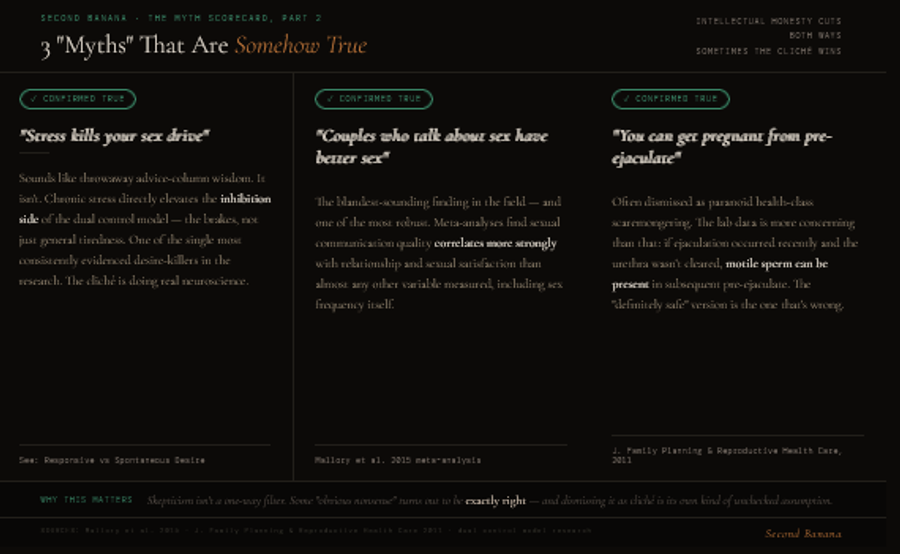
And Now, the Ones That Are Somehow True
Intellectual honesty means not just debunking things. Here are three claims that sound exactly like the kind of nonsense this article exists to dismantle — and that turn out to hold up.
“Myth”: Stress Is One of the Biggest Killers of Desire
Verdict: Completely true, and probably understated.
This sounds like the kind of soft, hand-wavy advice column wisdom that doesn’t survive contact with research. It survives contact with research extremely well. Stress activates the sympathetic nervous system and elevates the inhibition side of the dual control model directly — chronic stress doesn’t just make a person “too tired” for sex in some vague sense, it measurably raises the baseline sensitivity of the threat-detection system that suppresses arousal. It is, per the desire research, one of the single most consistent and well-evidenced desire-killers that exists. The cliché is correct.
“Myth”: Couples Who Talk Openly About Sex Have Better Sex
Verdict: True, unglamorously and overwhelmingly.
This sounds like the kind of bland, vaguely therapeutic advice that gets repeated so often it loses meaning. It is also one of the most robustly supported findings in all of sex research. Multiple meta-analyses (including a widely cited 2015 review by Mallory and colleagues) find a consistent, sizeable positive correlation between sexual communication quality and both relationship and sexual satisfaction — larger, in most analyses, than the correlation between satisfaction and almost any other single relational variable researchers have measured, including frequency of sex itself.
It’s the least exciting-sounding finding in sex research and arguably the most consequential one. Which is, not coincidentally, the entire structural premise this platform is built on.
“Myth”: You Can Get Pregnant From Pre-Ejaculate
Verdict: True often enough to matter, despite frequently being dismissed as paranoid.
This one gets treated, especially in casual conversation, as overcautious health-class scaremongering. The research is more equivocal than “definitely not” but considerably more concerning than “don’t worry about it.” Pre-ejaculate fluid itself does not reliably contain sperm in controlled lab studies of fluid collected before any ejaculation has occurred recently. But in real-world conditions — specifically, if ejaculation has occurred recently and the urethra hasn’t been fully cleared — residual sperm can be present in subsequent pre-ejaculate. Multiple studies, including a 2011 study in the Journal of Family Planning and Reproductive Health Care, have found motile sperm in pre-ejaculate samples from a meaningful minority of participants. The “definitely safe” version of this myth is the one that’s wrong.
The Pattern Underneath All of This
Almost every myth on this list survives because it does one of two things: it flattens a genuinely complex system into a single comforting (or punishing) number, or it transmits cultural anxiety dressed up as biological fact. Squirting shame, size shame, virginity shame, libido shame, kink shame — the myths cluster around exactly the topics where people are most likely to feel quietly inadequate, which is probably not a coincidence - and which is why you are part of the Second Banana family.
The corrective, in every case, is the same: go look at what the actual research says, stay skeptical of anything that resolves a complicated human experience into a tidy verdict, and notice how often “everyone knows that” turns out to mean “nobody has checked that in a while.”
If something here surprised you — or if you want the long version of any of these — most of them link out to the full pieces elsewhere in this series. The short version is fun. The long version is usually where the actually useful part lives.
Now you’re annoying at dinner parties for the right reasons. 🍌