BDSM: What It Actually Is, Why It Works, and How to Find Your Place in It | Second Banana
BDSM:
What It Actually Is, Why It Works, and How to Find Your Place in the Landscape
The Label Is a Poor Description of the Thing
BDSM stands for Bondage and Discipline, Dominance and Submission, Sadism and Masochism — an acronym assembled from the names of several overlapping practice categories that was never designed to be a precise description of what these practices actually share or why they are compelling. As a label it has the advantage of being widely recognised and the disadvantage of telling you almost nothing useful about the psychological experience of the people who practice any of these things, why those practices are erotically and emotionally significant, or what distinguishes the community of practitioners from the much larger population of people who are curious about or interested in these dynamics without having a word for it.
BDSM, in practice, describes a broad landscape of consensual erotic and relational practices organised around power exchange, sensation, role-play, and the deliberate exploration of intensity in its various forms. What unites these practices is not the specific acts they involve but a shared psychological orientation: a willingness to engage consciously and consensually with dynamics that most sexual culture either ignores or treats as inherently problematic — power, vulnerability, control, surrender, sensation at its extremes.
This piece is the map. It covers what BDSM actually is at the psychological level, what the research says about the people who practice it, how the consent architecture works and why it matters, and how to locate yourself in the landscape. The specific practices — bondage, primal play, degradation, CNC, and many others — each have their own dedicated pieces in this series. This piece is where you start.
Most people who find BDSM compelling have been finding it compelling — in fantasy, in how they respond to intensity, in what they notice about themselves in charged situations — for years before they have a word for it. The label is just the last thing to arrive.
The Psychological Core
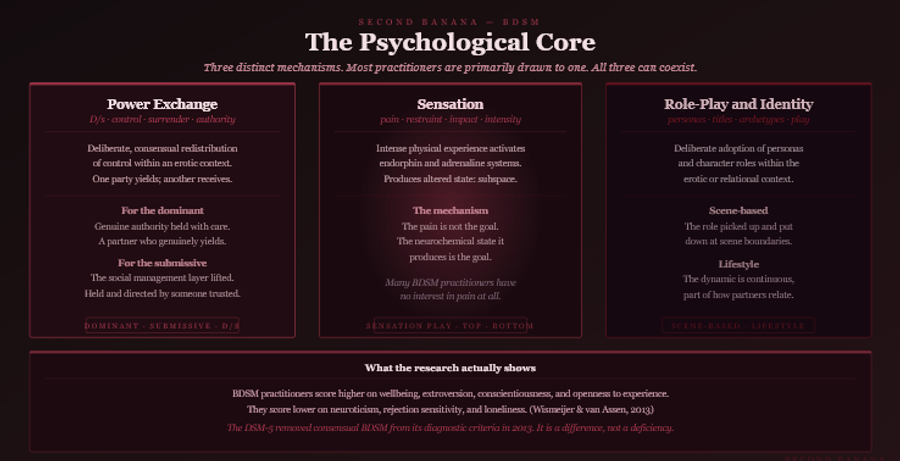
Power Exchange
The most fundamental psychological mechanism in BDSM is power exchange: the deliberate, consensual redistribution of control within an erotic or relational context. One person yields control; another receives it. The specific form this takes — physical restraint, command and obedience, role designation, emotional authority — varies enormously across the BDSM landscape. What is consistent is that the exchange is chosen and bounded, and that both parties derive something specific from their position in it.
For the dominant or top, power exchange typically offers the specific pleasure of genuine authority held with care — the experience of a partner who genuinely yields, and the responsibility of holding that yielding well. For the submissive or bottom, it typically offers the specific relief described throughout this series in various forms: the social management layer suspended, the cognitive load of ordinary adult agency temporarily lifted, the specific pleasure of being held and directed by someone trusted to do it well.
The asymmetry of positions does not reflect a judgment about the people who occupy them. Dominants are not more powerful people in any general sense; submissives are not weaker. The positions are specific to the erotic context, chosen freely by both parties, and the power in a D/s dynamic flows in both directions — the submissive’s consent is the condition on which the dominant’s authority rests.
Sensation
The sensation dimension of BDSM — pain, restraint, temperature, impact, and other intense physical experiences — is the aspect most visible in popular representations and the aspect most misunderstood. The BDSM practitioner who enjoys pain does not have a deficient pain response; they have a neurological system in which intense physical sensation produces a specific kind of arousal that ordinary sensation does not.
The mechanism is well-documented: intense physical sensation activates the body’s endorphin and adrenaline systems, producing an altered state of heightened awareness and analgesia that practitioners call subspace or flying. This state has its own specific quality of absorption and presence that many practitioners describe as among the most intense experiences available to them. The pain is not the goal; the neurochemical state it produces is.
Not all BDSM practitioners are interested in the sensation dimension. Many engage exclusively with power exchange, role-play, or psychological dynamics that involve no physical pain at all. The landscape is wide enough that sensation-focused and power-focused practices coexist within the same community, with practitioners who are drawn primarily to one rather than the other.
Role-Play and Identity
The role-play dimension of BDSM — the adoption of personas, titles, relationship archetypes, and character roles within a kink context — connects to the broader human capacity for play and narrative, and to the specific pleasure of temporarily inhabiting a version of oneself or another that is not constrained by ordinary social context. The dominant who becomes Sir or Ma’am within a scene, the submissive who becomes pet or boy, the couple who inhabit a specific power dynamic for an evening and then return to equality — these are forms of deliberate, bounded identity play that serve real psychological functions.
For some practitioners, the role is clearly separable from the self — something picked up and put down at scene boundaries. For others, particularly those who identify as lifestyle practitioners, the dynamic is more continuous, part of how they relate to specific partners in many or all contexts. Both are valid; the difference is one of degree rather than kind.
Who Practices BDSM: What the Research Actually Shows
The research on BDSM practitioners consistently produces findings that contradict the pathologising cultural narrative — and consistently produces them strongly enough that they deserve direct statement rather than hedged qualification.
Wismeijer and van Assen’s 2013 study, published in the Journal of Sexual Medicine, compared BDSM practitioners with matched non-practitioners on multiple psychological measures. BDSM practitioners scored significantly higher on measures of extroversion, conscientiousness, openness to experience, and subjective wellbeing. They scored significantly lower on measures of neuroticism, rejection sensitivity, and loneliness. The researchers concluded that BDSM practitioners were, on average, more psychologically healthy than the non-practitioner comparison group — a finding that has been replicated in subsequent research.
Correlational causality aside, the pattern is consistent: people who engage with BDSM practice tend to be self-aware, communicative, skilled at negotiating complex interpersonal situations, and comfortable with their own desires. These are not the characteristics of a population that has been psychologically damaged into this orientation. They are the characteristics of people who have done serious self-examination and arrived somewhere specific.
The DSM-5 removed BDSM practices from its diagnostic criteria in 2013 — the same revision that removed homosexuality had much earlier. Consensual BDSM between adults is not a disorder; it is a sexual and relational orientation that differs from the cultural mainstream in ways that are now officially recognised as differences rather than deficiencies.
The Consent Architecture
Safe, Sane, Consensual
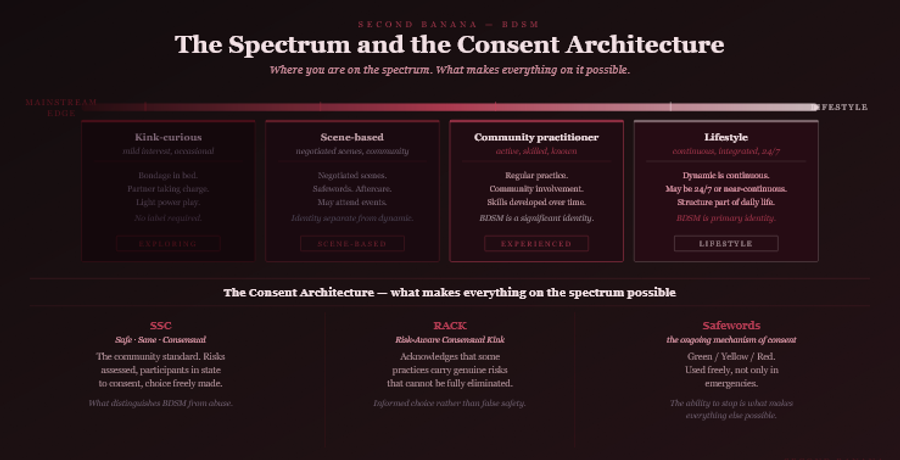
Safe, Sane, Consensual (SSC) is the most widely cited framework for BDSM ethics and has been the community standard for decades. Safe means that risks are assessed and managed to the degree possible. Sane means that both parties are in a psychological state adequate to give informed consent and participate meaningfully. Consensual means that participation is freely chosen by all parties and can be withdrawn at any time.
SSC is a philosophical position as much as a practical framework: it articulates what distinguishes BDSM from abuse. The distinction is not in the acts themselves — the same physical act can be BDSM or abuse depending on whether it is consensual, whether the participants are in a state to consent meaningfully, and whether risk is being responsibly managed. The framework makes this distinction explicit and provides a basis for the community’s own self-governance.
Risk-Aware Consensual Kink
Risk-Aware Consensual Kink (RACK) is an alternative framework that acknowledges something SSC can obscure: some BDSM practices carry genuine risks that cannot be fully eliminated, and pretending otherwise does practitioners a disservice. RACK replaces ‘safe’ with ‘risk-aware’ — the acknowledgment that participants understand the risks of what they’re doing and have chosen to accept them. This is a more honest framework for practices that carry genuine physical risk, like suspension bondage or edge play.
Safewords and Communication
Safewords — agreed-upon words or signals that immediately stop or modify a scene — are the practical mechanism through which consent operates in real time. The most widely used safeword system is the traffic light: green for continue, yellow for slow down or check in, red for stop immediately. Non-verbal equivalents — dropping a held object, two taps — serve the same function for scenes where speaking is impractical.
The safeword is not an emergency device for use only when something has gone badly wrong. It is the ongoing mechanism of consent, used actively and freely throughout a scene by practitioners who understand that the ability to stop is what makes everything else possible. A scene in which participants are afraid to use their safeword is a scene whose consent architecture has already failed.
The Spectrum: Locating Yourself
BDSM is not a binary that you are either inside or outside. It is a spectrum that most people have some relationship to, whether or not they use the label or have ever engaged in explicitly kink-identified practice.
The person who enjoys being physically held down during sex, who finds the experience of a partner taking confident charge specifically arousing, who is drawn to erotic scenarios involving power, control, or intensity — this person is somewhere on the BDSM spectrum. They may not want to use the label. They may not be interested in formal scenes, safewords, or the community infrastructure that more intensive practitioners maintain. But the psychological orientation is the same one that the dedicated BDSM practitioner is engaging with more explicitly.
Understanding this helps in two directions. It helps people who are newly encountering BDSM vocabulary locate their own experiences within the landscape rather than treating the label as marking a territory they may or may not want to enter. And it helps more experienced practitioners understand that the community they belong to is not a sealed category but a broad orientation that shades into the erotic mainstream at its edges.
Where you are on the spectrum is less important than knowing where you are. The person with mild bondage interest and the person who maintains a 24/7 D/s relationship are both somewhere on the same landscape; what matters is that each has accurate self-knowledge and a way to find partners who are oriented compatibly.
What This Has to Do With Second Banana
The Second Banana Tag system and post-first model map directly onto the BDSM community’s communication ethic. You describe who you are and what you’re looking for before anyone responds; the people who respond have already indicated alignment with the basic orientation. This is negotiation-before-scene in digital form, and BDSM practitioners recognise it immediately as the right structure.
The tag system gives the full landscape of BDSM practitioners specific vocabulary:
- BDSM — the umbrella orientation
- Dominant / Dom / Domme / Top — the directing position
- Submissive / Sub / Bottom — the yielding position
- Switch — for those who move between positions
- D/s dynamic — for those whose primary orientation is power exchange
- Sensation play — for those oriented toward the physical intensity dimension
- Scene-based / lifestyle — indicating how continuous the dynamic is
- SSC / RACK — the consent framework one operates within
- Safeword always — for those signalling specific safety commitment
- Experienced / exploring — experience level signal
The full range of specific practices — bondage, primal, degradation, CNC, and everything else covered in this series — each have their own tags that allow practitioners to represent their specific orientation within the broader BDSM landscape. The umbrella tag and the specific tags work together to give a complete picture of where someone is in this landscape and what they’re looking for within it.