The Difference Between Chemistry and Compatibility (and Why One Fades)
The Difference Between Chemistry and Compatibility (and Why One Fades)
Published by Second Banana · Relationships & Dynamics Series
Chemistry is the feeling that something is happening. Compatibility is the structure that lets it keep happening. The two are often present together early in a relationship, which is part of what makes them so easy to conflate — but they are not the same thing, they don't predict each other, and only one of them is actually load-bearing.
The reason this matters: most people optimise for chemistry when they're looking for someone. It's the thing that makes a first date feel like something, that generates the pull to see a person again, that makes the early months feel effortless and alive. Chemistry is real. It's not trivial. But it is also, in most cases, temporary in its acute form — and what's left when it settles is either compatibility or the growing realisation that there wasn't much underneath it.
Understanding the difference is not about becoming cold or transactional in how you approach new connections. It's about knowing what you're actually evaluating, and when.
What Chemistry Actually Is
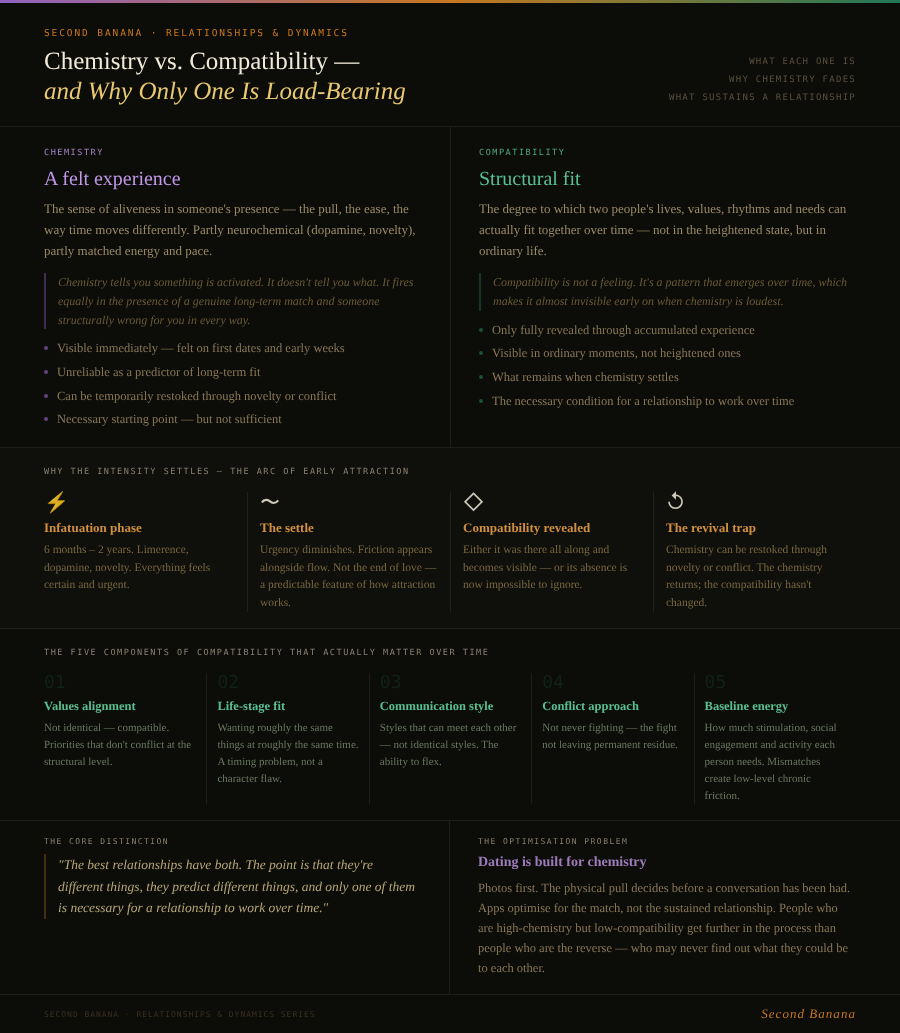
Chemistry is a felt experience. It's the sense of aliveness in someone's presence, the ease of conversation, the physical pull, the way time moves differently when you're with them. It is partly neurochemical — dopamine, norepinephrine, the same architecture as novelty and reward — and partly the result of matching energy, humour, and pace in ways that feel frictionless.
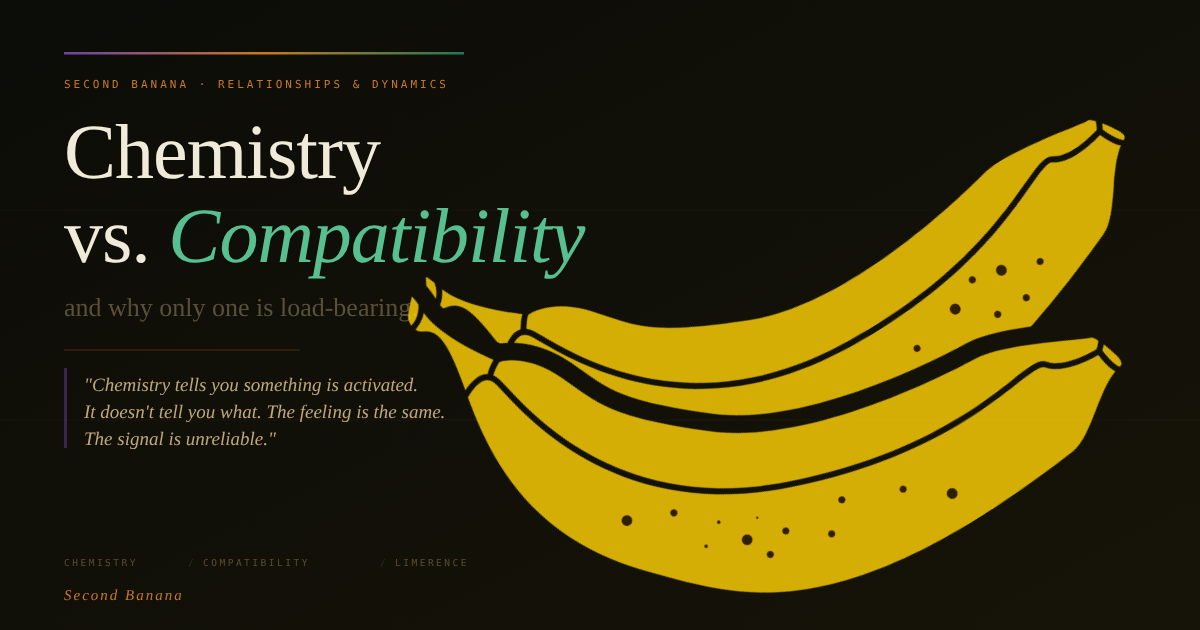
Chemistry tells you that something is activated. It doesn't tell you what. It can fire in the presence of a genuine long-term match and it can fire, with equal intensity, in the presence of someone who is wrong for you in every structural way. The feeling is the same. The signal is unreliable.
This is not a reason to dismiss it. Chemistry that's entirely absent is also information — a relationship built on compatibility alone, without any felt pull, is usually a friendship. But chemistry is a starting point, not a verdict. The mistake is treating it as evidence of something it can't actually confirm.
What Compatibility Actually Is
Compatibility is structural. It's the degree to which two people's lives, values, rhythms, and needs can actually fit together over time — not just in the heightened state of early connection, but in ordinary life. It's less visible early on because it only fully reveals itself through accumulated experience: how you handle disagreement, whether your visions of the future align, how your individual needs for space and closeness actually coexist when the novelty has worn off.
The components that tend to matter most:
- Values alignment — not identical values, but compatible ones. Two people can prioritise different things and still build a life together if those priorities don't conflict at the structural level.
- Life-stage fit — wanting roughly the same things at roughly the same time. Incompatibility here is not a character flaw in either person; it's a timing problem that doesn't resolve through wanting it to.
- Communication style — not the same style, but styles that can meet each other. One person's need to process verbally and another's need for quiet time aren't incompatible, but they require both people to be able to flex.
- Conflict approach — how each person handles friction, disagreement, and rupture. Compatibility here doesn't mean never fighting; it means the fight doesn't leave permanent residue.
- Baseline energy and pace — how much stimulation, social engagement, and activity each person needs. Significant mismatches here create low-level, chronic friction that's easy to underestimate at the start.
Why Chemistry Fades
The neurochemical intensity of early attraction — what researchers sometimes call limerence or the infatuation phase — has a natural duration. For most people it runs somewhere between six months and two years before it settles into something more stable. This is not a sign that the relationship is failing. It is a predictable feature of how attraction works in the human brain.
What it means in practice is that the felt urgency of early chemistry will almost certainly diminish. The pull becomes less acute. The ease of being together starts to include friction as well as flow. This is the point at which compatibility either becomes visible as the foundation the relationship was always resting on, or its absence becomes impossible to ignore.
Relationships that were built almost entirely on chemistry often hit this phase and mistake the settling of intensity for the end of love. Some dissolve. Some push through and discover there was more underneath than they thought. Some hold on to the form of the relationship long past the point where the underlying structure was revealed to be insufficient.
The confusion is compounded by the fact that chemistry can be temporarily restoked — through novelty, through conflict and repair, through periods of distance. This can make a structurally incompatible relationship feel revived when it has only been stimulated. The chemistry returns; the compatibility hasn't changed.
Why Compatibility Is Harder to Feel Early
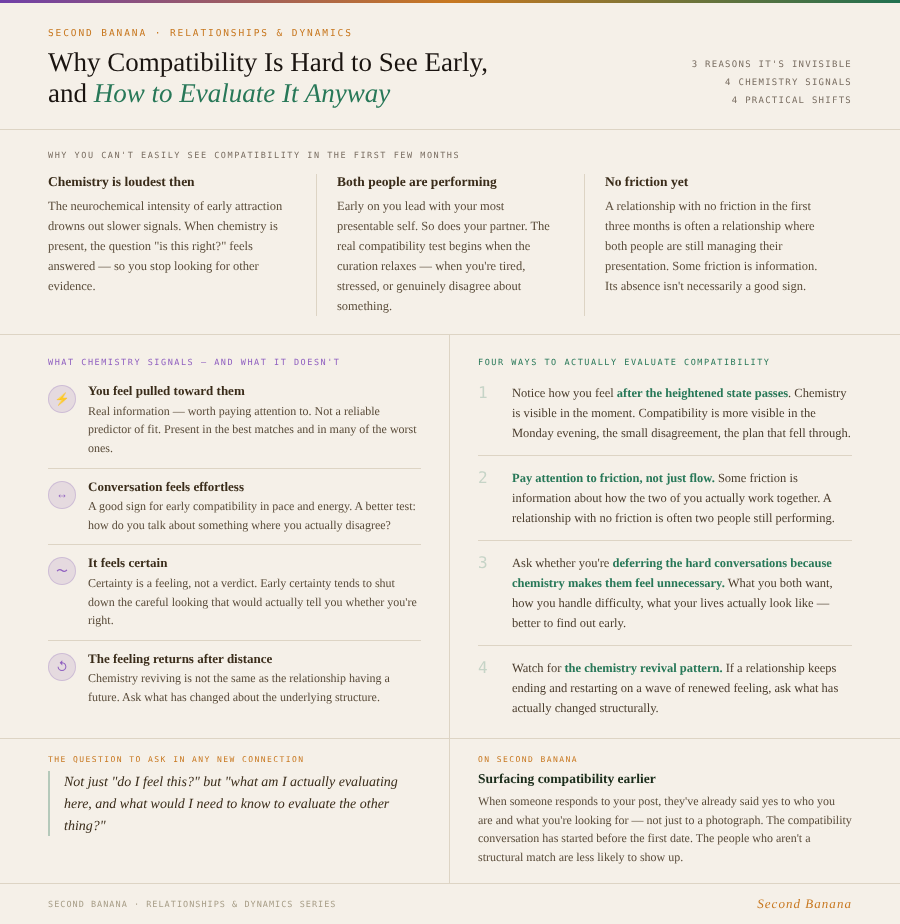
Compatibility is not a feeling. It's a pattern that emerges over time, which makes it almost invisible in the early stages of a relationship when chemistry is loudest.
Early on, you are also — inevitably — performing a version of yourself. Not dishonestly, but selectively. You lead with the parts that feel most presentable. Your partner does the same. The result is a relationship between curated selves, which can feel profoundly compatible while both people are still managing their presentation. The real compatibility test begins when the curation relaxes: when you're tired, when you're stressed, when you disagree about something that actually matters, when the daily texture of sharing a life with someone becomes visible.
This is one reason why the early rush of chemistry can actually impede compatibility assessment. If you feel certain about someone early, you're less likely to look carefully. The certainty is its own confirmation bias: you interpret ambiguous signals as positive, you overlook friction, you defer the harder conversations because everything feels so right. You find out later what you would have found out earlier if the signal had been quieter.
The Optimisation Problem
Most dating infrastructure is built to surface chemistry. Photos are the first layer of information. The physical pull — or its absence — is often the deciding factor before a conversation has been had. Apps optimise for the match, not for the sustained relationship. The incentives of the medium select for chemistry.
This isn't purely a technology problem. People have always optimised for chemistry, for the obvious reason that it's what you can feel immediately. Compatibility takes time to evaluate and requires a tolerance for uncertainty that chemistry temporarily eliminates. When chemistry is present, the question "is this right?" feels answered. Compatibility doesn't answer the question — it just makes the answer more reliable.
The downstream effect: people who are high-chemistry but low-compatibility get further in the process than people who are lower-chemistry but high-compatibility. The first group often produces intense short relationships that end badly; the second group might never get the chance to find out what they could be to each other.
Both Can Be True, and Often Are
The point is not that chemistry is bad and compatibility is good, or that you should choose one at the expense of the other. The best relationships have both. The point is that they're different things, they predict different things, and only one of them is necessary for a relationship to work over time.
A relationship with strong compatibility and modest initial chemistry can deepen into something that feels more complete than many high-chemistry relationships — because the attraction has room to grow into a life, rather than competing with one. A relationship with high chemistry and poor compatibility can be thrilling and genuinely painful, often at the same time.
The question worth asking, in any new connection, is not just "do I feel this?" but "what am I actually evaluating here, and what would I need to know to evaluate the other thing?"
What This Looks Like in Practice
Some useful shifts:
- Notice how you feel after the heightened state passes. Chemistry is most visible in the moment — after a date, after a good conversation. Compatibility is more visible in the ordinary moments: the Monday evening, the disagreement about something small, the plan that fell through.
- Pay attention to friction early, not just flow. A relationship with no friction in the first three months is often a relationship where both people are still performing. Some friction is information about how the two of you actually work together.
- Ask yourself whether you're deferring compatibility questions because the chemistry makes them feel unnecessary. The conversations about what you both want, how you handle hard things, what your lives actually look like — these are better had early, when the answers are informative rather than threatening.
- Watch for the chemistry revival pattern. If a relationship keeps ending and restarting on a wave of renewed feeling, ask what has actually changed about the underlying structure. Chemistry returning is not the same as the relationship having a future.
The Second Banana Angle
This doesn't eliminate chemistry from the equation. Someone can read your post and feel pulled toward you; the writing can generate its own kind of felt interest. But the pull is toward the actual person rather than toward a photograph and a projection. What gets matched is a closer approximation of the real thing.