You’re Not Asking for Too Much (You’re Just Asking the Wrong Person)
You're Not Asking for Too Much (You're Just Asking the Wrong Person)
Published by Second Banana · Relationships & Dynamics Series
There's a specific kind of exhaustion that comes from being in a dynamic where your needs don't land. Where you ask for something reasonable — consistency, follow-through, to feel like a priority sometimes — and the response is either silence, or a conversation about why what you're asking for is difficult, or a slow erosion of the thing you asked for until it disappears entirely. And then, eventually, you start to wonder if you're the problem. If you ask for too much. If this is just what relationships are like for people like you.
This is one of the more corrosive things a mismatched dynamic can do to a person. It takes the experience of incompatibility — a neutral fact about fit — and converts it into a character flaw. You leave the relationship (or stay in it) believing something is wrong with your needs, rather than understanding that your needs were simply never going to be met by this particular person.
The distinction matters enormously. Because the corrective for "I ask for too much" is to want less. The corrective for "I was asking the wrong person" is to ask someone else.
What "Too Much" Actually Means
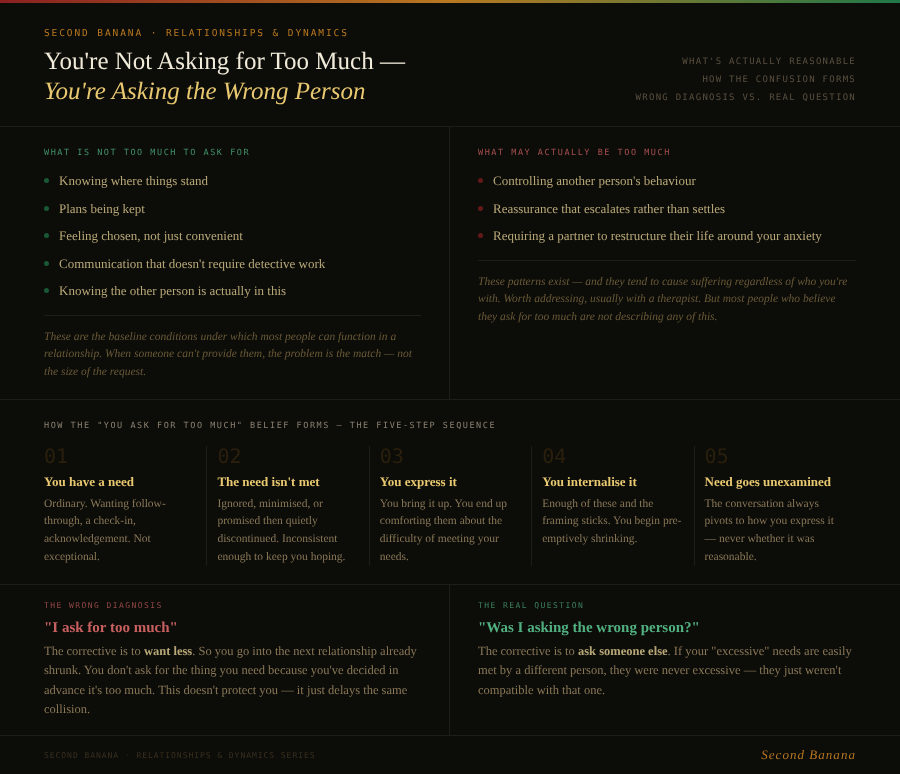
There are needs that are, in fact, too much — but they tend to be less common than people fear. Genuinely unreasonable needs usually involve controlling another person's behaviour, requiring constant reassurance in ways that escalate rather than settle, or demanding that a partner restructure their life around your anxiety. These exist. They're worth addressing, usually with a therapist, because they tend to cause suffering regardless of who you're with.
But most of the people who believe they ask for too much are not describing any of this. They're describing things like:
- Wanting to know where things stand
- Expecting that plans will be kept
- Hoping to feel chosen, not just convenient
- Wanting communication that doesn't require detective work
- Needing to know that the other person is actually in this
None of these are excessive. They are the baseline conditions under which most people can function in a relationship. When someone consistently can't or won't provide them, the problem is not the size of the request. The problem is the match.
How the Confusion Happens
The belief that you're asking for too much tends to develop through a particular sequence. It's worth naming the steps, because recognising the pattern makes it harder to repeat.
You have a need
It's ordinary. You want your partner to follow through on something they said they'd do, or to check in when they said they would, or to acknowledge when something matters to you. This is not exceptional.
The need isn't met
It might be ignored, minimised, promised and then not delivered, or met once and then quietly discontinued. The response is inconsistent enough to keep you hoping but insufficient enough to leave you unsatisfied.
You express the need
You bring it up. Maybe gently, maybe more directly after the third or fourth time. The conversation does not go the way you hoped. You're met with defensiveness, or with a counter-narrative about how much you ask for, or with a version of the conversation that ends with you comforting them about the difficulty of meeting your needs.
You internalise the framing
Enough of these conversations and the framing starts to stick. Maybe you do ask for a lot. Maybe you're too sensitive. Maybe this is just how relationships are. You begin to pre-emptively shrink: asking for less, needing less visibly, managing your own expectations downward before anyone has to tell you to.
The original need goes unexamined
The one thing that never gets looked at clearly is whether the need itself was reasonable. The conversation always pivots to whether you're expressing it correctly, or how often you bring it up, or whether you're being fair to the other person's limitations. The need becomes the problem rather than the unmet need.
The Difference Between a Hard Limit and a Bad Match
Some people genuinely cannot provide certain things — not because they're bad, but because of their own wiring, history, or capacity. Avoidant attachment, for instance, makes sustained emotional availability genuinely difficult. A person who grew up in a household where emotional needs were treated as impositions may have deeply internalised patterns that don't shift easily, or at all, without significant work.
This is not a moral failing. It is also not your problem to solve.
The version of this that becomes harmful is when the limitations of one person get reframed as the excess of the other. "I'm not good at communication" becomes "you ask for too much communication." "I need a lot of space" becomes "you're too available, too intense, too present." The person whose needs exceed what's on offer becomes the one who needs to change, rather than the relationship being recognised as a poor fit.
A hard limit and a bad match look identical from the inside of the relationship. The difference becomes clear when you leave it: if you find that your "excessive" needs are easily and naturally met by someone else, they weren't excessive. They just weren't compatible with that person.
The Cost of the Wrong Diagnosis
Diagnosing "I ask for too much" when the real issue is "I was with the wrong person" has consequences that outlast the relationship.
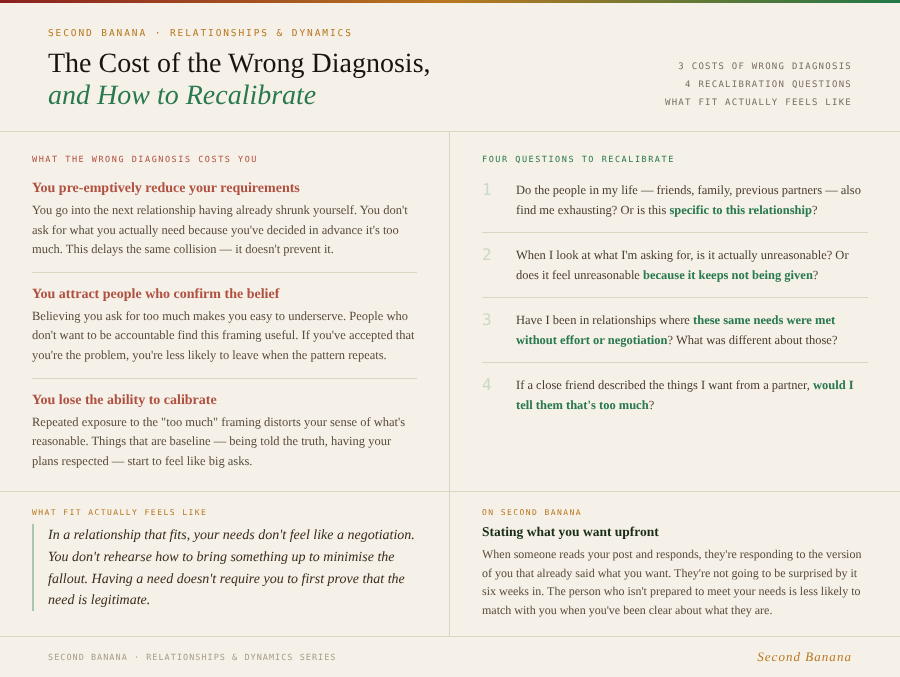
You pre-emptively reduce your requirements
If you believe your needs are the problem, the logical response is to need less. So you go into the next relationship having already shrunk yourself. You don't ask for the thing you actually need because you've decided in advance that it's too much. This doesn't protect you — it just delays the same collision.
You attract people who confirm the belief
Believing you ask for too much makes you easy to underserve. People who don't want to be accountable to a partner's needs tend to find this framing useful. If you've already accepted the narrative that you're the problem, you're less likely to leave when the pattern repeats.
You lose the ability to calibrate
Over time, repeated exposure to the "too much" framing distorts your sense of what's reasonable. Things that are, in fact, baseline — being told the truth, being introduced to someone's friends after four months, having your plans respected — can start to feel like big asks. You lose the reference point for what a relationship that actually fits looks like.
Recalibrating
The way back from this is less about affirmations and more about evidence. The questions worth asking are not "am I too much?" but:
- Do the people in my life — friends, family, previous partners — also find me exhausting? Or is this specific to this relationship?
- When I look at what I'm asking for, is it actually unreasonable? Or does it just feel unreasonable because it keeps not being given?
- Have I been in relationships, even briefly, where these same needs were met without effort or negotiation? What was different about those?
- If a close friend described the things I want from a partner, would I tell them that's too much?
The last question is often the most useful. We apply a much harsher standard to our own needs than we would to anyone else's. A friend who says "I just want them to keep their word" doesn't get told they're asking for too much. A friend who says "I want to feel like they're actually glad I'm there" gets sympathy, not a lecture about being needy. We extend to ourselves the exact standard we'd refuse to accept for people we love.
What Fit Actually Feels Like
This is worth naming, because if your only reference point is the wrong-person dynamic, you might not know what you're looking for.
In a relationship that fits, your needs don't feel like a negotiation. They don't feel like a burden you're imposing. You don't rehearse how to bring something up to minimise the fallout. You don't spend energy managing someone else's reaction to your basic requirements.
None of this means the relationship is effortless, or that both people always get what they want, or that there are no hard conversations. It means that having a need — a real, ordinary, human need — doesn't require you to first prove that the need is legitimate.
That's the baseline. Not a high bar. Just the actual floor.
The Second Banana Angle
One of the structural advantages of stating what you're looking for before you match is that it surfaces fit early rather than revealing it slowly through a series of conversations about whether your needs are reasonable. When someone reads your post and responds, they're responding to the version of you that already said what you want. They're not going to be surprised by it six weeks in.
This doesn't solve incompatibility — two people can both say they want commitment and still be mismatched in how they show up. But it does reduce the subset of bad fits that get far enough to start doing damage. The person who isn't prepared to meet your needs is less likely to match with you when you've been clear about what they are.