What Is a Soft Launch Relationship, and Is It Working For You?
What Is a Soft Launch Relationship, and Is It Working For You?
Published by Second Banana · Relationships & Dynamics Series
You know how this one goes. You've been seeing someone for six weeks — maybe eight, maybe three months. You haven't had the talk. Neither of you has brought it up. You're exclusive in practice but not in name. You spend most weekends together. You've met two of their friends, introduced as "this is my—" and then a name, no noun. You're in each other's lives in a way that clearly means something, but what that something is has never been said out loud.
This is a soft launch relationship. And if you're in one right now, the question worth asking is not whether it's real — it clearly is — but whether the undefined part is working for you, or whether it's started working against you.
What a Soft Launch Relationship Actually Is
The term borrows from product development, where a soft launch means releasing something to a limited audience before the full public rollout — testing the waters without full commitment to the concept. Applied to relationships, it means exactly what it sounds like: you're in something, but you haven't launched it. Officially, publicly, verbally, or to each other.
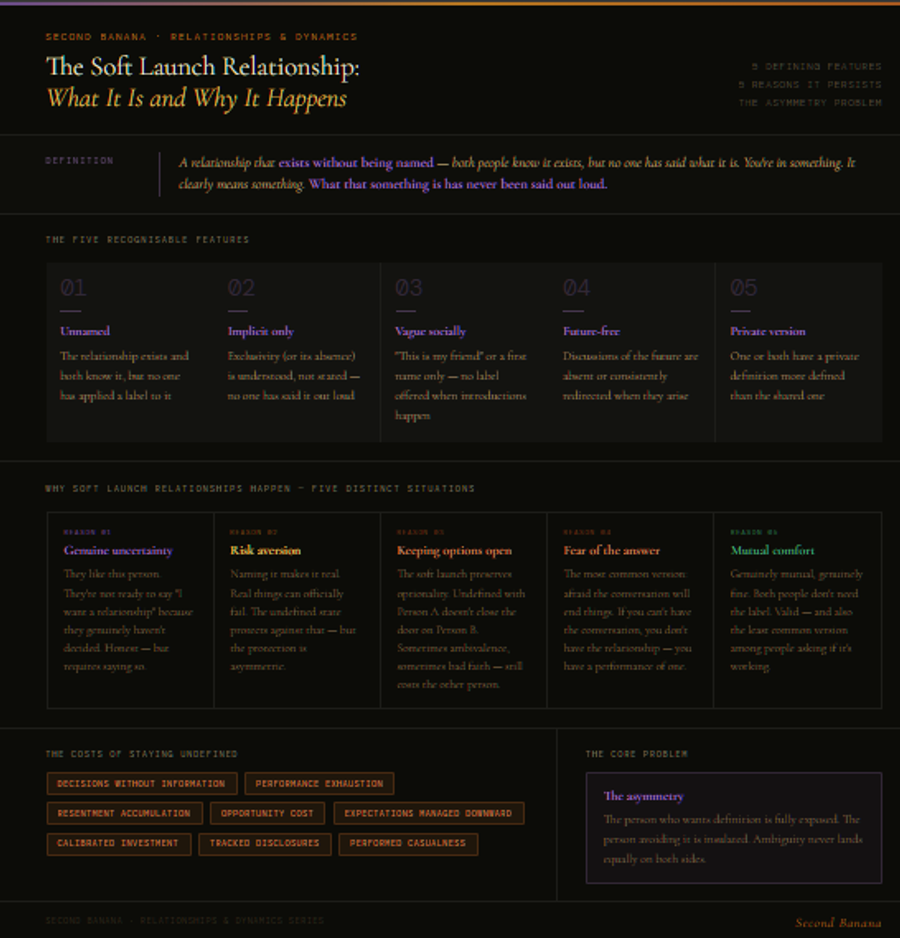
Soft launch relationships have a few recognisable features:
- The relationship exists and both people know it exists, but no one has named it
- There's an implicit understanding — you're not seeing other people, or you are and both know it, but no one has said so
- Social presentation is vague: "this is my friend" or a name without a label, or simply not introducing each other in situations where it would be natural to
- Discussions of the future are either absent or consistently redirected
- One or both people have a private version of the relationship that is more defined than the shared version
None of these things are automatically a problem. Some relationships develop slowly and naturally into something named. Some people find that the absence of a label creates freedom rather than anxiety. Some dynamics genuinely work better without the weight of a formal definition.
The issue is when the softness isn't mutual — when one person is in a soft launch and the other is waiting for the full rollout that may never come.
Why Soft Launch Relationships Happen
It's worth being clear-eyed about the different reasons people end up here, because they're not all the same situation.
Genuine uncertainty
Some people are soft-launching because they genuinely don't know yet. They like this person. They want to keep spending time with them. They're not ready to say "I want a relationship with you" because they haven't decided, or because saying it out loud feels like a commitment they can't yet make. This is honest, and it's not inherently unkind — but it requires saying so, rather than leaving the other person to interpret the ambiguity as they wish.
Risk aversion
Naming a relationship makes it real in a new way. It creates expectations, and expectations can be disappointed. The soft launch protects against this: if nothing is defined, nothing can officially fail. The problem is that this protection is asymmetric — the person who wants definition is still fully exposed while the person avoiding it is insulated.
Keeping options open
Sometimes — and this deserves to be said plainly — the soft launch is a strategy for maintaining optionality. The undefined relationship with Person A doesn't close the door on Person B, who might materialise. This isn't always malicious; sometimes it reflects genuine ambivalence rather than bad faith. But the person being soft-launched is still carrying the costs of the uncertainty.
Fear of the answer
Some soft launches persist because one person is afraid that having the conversation will end the relationship. This is the most common version, and also the one that most clearly needs to be addressed: if you can't have the conversation, you don't have the relationship — you have a performance of one.
Mutual comfort with ambiguity
And then there are people for whom the soft launch is genuinely mutual and genuinely fine. They're not avoiding anything; they just don't need the label. This is valid. It's also the least common version, and less common still among people who are reading an article titled "Is It Working For You?"
The Costs of Staying Undefined
Ambiguity has costs. They accrue quietly, and they're easy to dismiss individually while the overall balance tips slowly in the wrong direction.
Decision-making without information
Every choice you make inside an undefined relationship is made without knowing what you're choosing for. Do you turn down a work opportunity in another city? Do you decline a date with someone else? Do you start planning your summer around this person? You're making real decisions based on a relationship that hasn't been agreed to. When the soft launch doesn't convert, those decisions look different in retrospect.
The performance tax
Maintaining ambiguity requires work. You track what you've said and to whom. You calibrate how much to invest in front of their friends. You manage your own expectations downward to protect yourself. You perform a version of casualness you don't entirely feel. This is exhausting, and it compounds over time.
The drift toward resentment
If you want definition and you're not getting it, the longer it goes on, the more resentment accumulates. Not necessarily toward the other person — sometimes toward yourself, for continuing to accept the situation. That resentment poisons things even when nothing explicitly bad happens.
Opportunity cost
Time in a soft launch is time not spent on something that might actually be what you want. This isn't a reason to rush toward definitions or blow up something good — but it's worth factoring in, especially if the ambiguity has been going on long enough to qualify as a pattern.
![Is It Working For You? An infographic on a warm paper background with a purple-amber-terracotta top bar. Two columns. Left column — “Five questions to ask yourself first”: (1) Am I here because neither of us needs a label, or because I’m afraid of what happens if I ask for one? (2) Do I have a private definition I haven’t shared? (3) Is the softness protecting me from something real, or a conversation I need to have? (4) If this stayed undefined for another six months — another year — would I be okay? (5) Am I making real decisions based on this relationship in ways I haven’t acknowledged? Right column — “How to have the conversation”: a quoted script in a green-bordered box reading “I’ve been thinking about what’s happening between us, and I realise I don’t know what you’d call it. I think I’d call it [your honest answer]. I wanted to know if that matches what you’re thinking, or if you see it differently.” Below: four possible outcomes listed — alignment you didn’t know you had, a difference you can negotiate, a dealbreaking difference, clarity that this person isn’t ready for what you want. Bottom strip: pull quote “The person who treats the conversation as a threat to the relationship was already treating the relationship as something to manage rather than something to be in,” alongside a Second Banana connection note.](https://cdn.sanity.io/images/x0ze1ns9/production/d9a9ac2a035909793580a078d593689edba81b76-555x435.png?w=900)
The Questions Worth Asking Yourself
Before any conversation with the other person, there are a few questions worth sitting with honestly.
- Am I in a soft launch because neither of us needs a label, or because I'm afraid of what happens if I ask for one?
- Do I have a private definition of this relationship that I haven't shared? What would it mean if the other person's private definition is different?
- Is the softness protecting me from something real, or protecting me from a conversation I actually need to have?
- If this stayed undefined for another six months, would I be okay with that? What about a year?
- Am I making decisions — about other people, about my own life — based on this relationship in ways I haven't acknowledged?
The answers to these questions don't necessarily point toward demanding a label. They point toward knowing where you actually stand — which is the prerequisite for any honest conversation.
Having the Conversation
If you've decided the ambiguity isn't working for you, the conversation is worth having, and it's simpler than the anxiety around it usually suggests. The goal isn't to issue an ultimatum or to demand a specific outcome. It's to share your actual state and find out theirs.
Some version of: "I've been thinking about what's happening between us, and I realise I don't know what you'd call it. I think I'd call it [your honest answer]. I wanted to know if that matches what you're thinking, or if you see it differently."
This is not a trap. It's not a pressure test. It's information exchange between two people who are already in something. The person who treats it as a threat to the relationship was already treating the relationship as something to manage rather than something to be in.
What comes out of this conversation will be one of a few things: alignment you didn't know you had, a difference you can negotiate, a difference that turns out to be dealbreaking, or clarity that this person isn't ready for what you want. All of these outcomes are better than continued ambiguity, because all of them let you make actual decisions about your actual life.
The Second Banana Angle
The soft launch relationship is, in a sense, the anti-Second Banana. The Second Banana Tag System is built on the premise that you state what you're looking for before you match — that the conversation about what this is happens upfront, not after three months of ambiguity have calcified into a dynamic that's hard to shift.
That's not a guarantee of clarity. But it's a structural advantage over meeting someone, sliding into something undefined, and hoping the trajectory becomes obvious before someone gets hurt.
The Short Version
A soft launch relationship is one that exists without being named. It's common, it's often mutual, and it's not automatically a problem. It becomes a problem when the softness is asymmetric — when one person is waiting for a definition the other isn't planning to give — or when the ambiguity has started generating costs (resentment, bad decisions, performance exhaustion) that outweigh whatever comfort the undefined state was providing.