Demisexuality Is Not a Personality — It's a Wiring Difference
Demisexuality Is Not a Personality — It's a Wiring Difference
Published by Second Banana · Desire & Identity Series
There is a particular kind of frustration that demisexual people describe when they try to explain themselves to someone who doesn't get it. Not anger, usually. Something more like exhaustion. The explanation gets dismissed as "just being old-fashioned," or collapsed into "picky," or treated as a preference — like preferring brunettes, or liking someone who's funny — rather than what it actually is: a fundamentally different relationship between attraction and emotional bond.
This article is not going to validate that dismissal. It's going to do the opposite: look at what demisexuality actually is, what the research says about how arousal and attachment interact, and why most dating platforms — including almost every mainstream app — are structurally built for people demisexual users are not.
What Demisexuality Actually Is
Demisexuality is a sexual orientation on the asexual spectrum, characterised by experiencing sexual attraction only after an emotional bond has formed. Not "I prefer to know someone before sleeping with them." Not "I'm not into hookups." A structural absence of primary sexual attraction until emotional connection establishes it.
The distinction matters. Most people experience primary sexual attraction — the immediate draw toward someone based on physical appearance, voice, presence — with no prior knowledge of them. This is what makes browsing photos functional as a matching mechanism: you see someone, you feel something, you message them. For demisexual people, this mechanism is either absent or very muted. They can recognise that someone is physically attractive the way you might recognise a painting is technically accomplished — as an intellectual observation, without a felt pull toward it.
Secondary sexual attraction, which develops from emotional intimacy, interest, and shared experience, is where demisexual desire lives. That bond can form in weeks or months; it can form through deep friendship, through sustained intellectual connection, through vulnerability exchanged over time. But it cannot be manufactured by looking at a good photo or exchanged in a first-date performance.
The Spectrum, and Where Demisexuality Sits on It
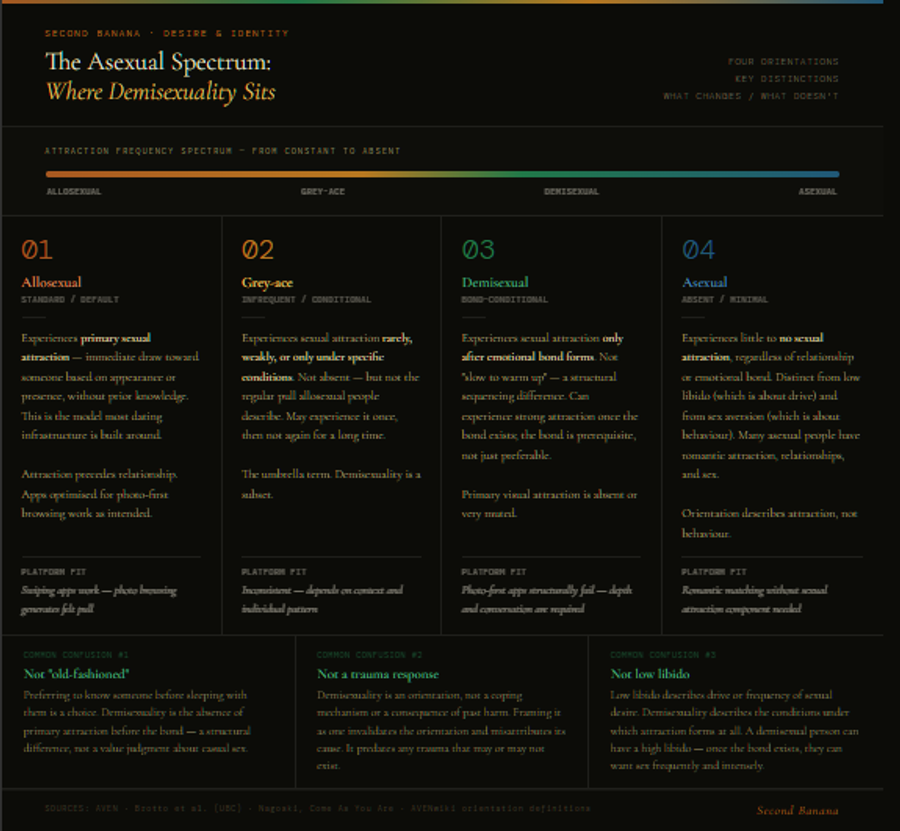
Demisexuality sits between allosexuality (experiencing sexual attraction regularly and without preconditions) and asexuality (experiencing little to no sexual attraction regardless of relationship). It belongs to the "grey-ace" or greyromantic space: not absent, not standard, but conditional in a specific way.
A few distinctions worth being precise about:
- Demisexual people can and do experience strong sexual attraction — once the bond is there. This is not low libido. This is not sex aversion. This is sequencing.
- Demisexuality is about attraction, not about behaviour. A demisexual person can choose to have casual sex; their demisexuality describes what they feel, not what they do.
- Demiromanticism (developing romantic attraction only after emotional bond) is adjacent but distinct — you can be one without the other.
- Demisexuality is not a response to trauma, and framing it as one is both incorrect and harmful. It is an orientation, not a coping pattern.
What the Research Actually Says
Direct research into demisexuality specifically is still limited — the term entered popular use only in the early 2000s and wasn't formally included in AVEN (Asexuality Visibility and Education Network) vocabulary until around 2006. Broader asexuality research is more established, and the findings extend meaningfully to the demisexual population.
Key findings worth knowing:
Asexuality research confirms neurological and physiological differences
Studies by Lori Brotto and colleagues at UBC have found that asexual participants show reduced genital-arousal concordance — the match between physiological arousal and subjective desire — compared to sexual participants. This suggests the absence or conditionality of attraction in ace-spectrum individuals is not simply a preference or a trauma response; there are measurable differences in how arousal is processed.
Emotional bond as arousal pathway is documented
Research on what's sometimes called "responsive desire" — as opposed to "spontaneous desire" — maps closely to the demisexual experience. Emily Nagoski's work in Come As You Are documents that a significant portion of people (disproportionately but not exclusively women) experience desire primarily as a response to the right context, the right relationship, the right emotional safety — rather than as a spontaneous drive preceding context. Demisexuality can be understood as this pattern taken to a structural level: the emotional bond isn't just context; it's prerequisite.
The label matters for self-understanding
Research on sexual minority identity generally shows that having a name for one's experience correlates with improved wellbeing, reduced shame, and better communication with partners. For demisexual people, who have often spent years being told their attraction patterns are broken, prudish, or damaged, finding a word that accurately describes them is not trivial.
Why Most Dating Apps Fail Demisexual Users Structurally
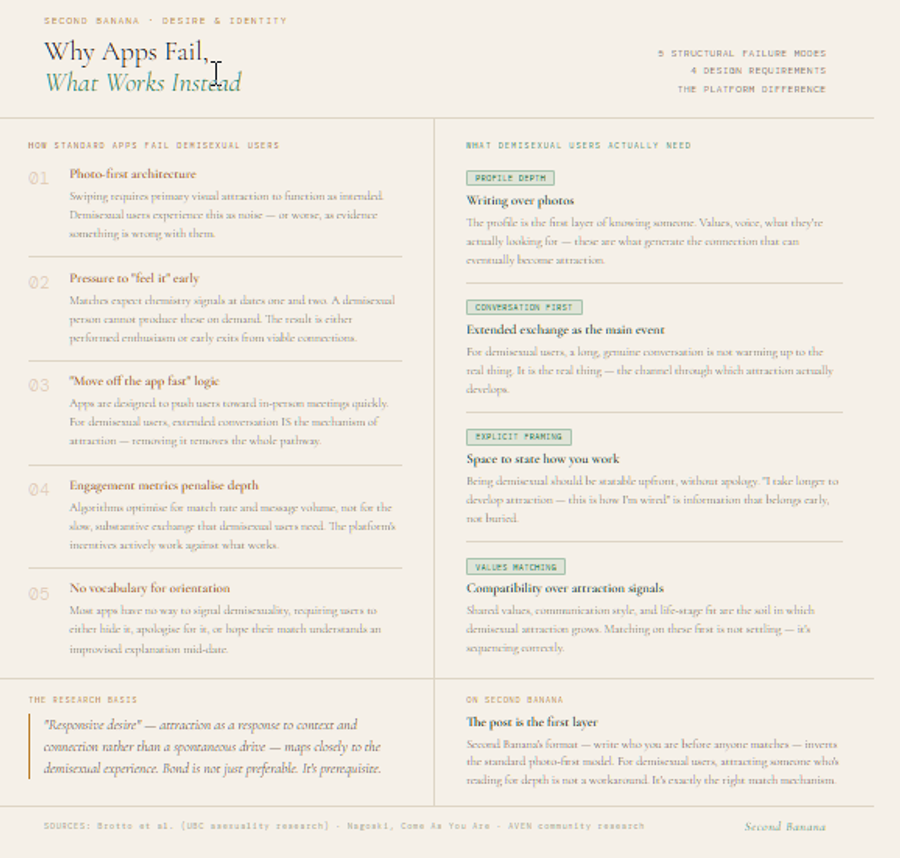
This is not a minor design oversight. Most dating applications are engineered around a specific model of attraction: you see someone, you feel something, you express interest. The entire architecture — photos as primary asset, swipe mechanics, match-rate optimisation, algorithmic exposure based on engagement signals — assumes that primary visual attraction is the mechanism driving connection.
For demisexual users, this produces a specific failure mode:
- Profile browsing generates no felt pull, so the activity itself is aversive or meaningless rather than engaging.
- Matches based on mutual photo attraction don't indicate compatibility; the demisexual user has not actually experienced attraction to this person yet.
- Early dates become high-stakes performances — both people evaluating whether "something is there" when the demisexual person genuinely cannot know yet.
- The pressure to "feel it" early leads either to faking enthusiasm or to concluding (incorrectly) that there's no chemistry when in fact there hasn't been enough time or depth.
- The apps' recommendation of "keep conversations short and meet quickly" is actively counterproductive — the emotional bond that enables demisexual attraction develops in the kind of extended, genuine conversation that apps are designed to move you past.
This is a structural mismatch. The platform shape says: decide fast. The demisexual user's wiring says: this is not how I work.
What Demisexual Users Actually Need
A platform that works for demisexual users looks different at nearly every layer:
Profile depth over profile aesthetics
If attraction requires knowing someone, then the profile is the first layer of knowing — not a shop window. Writing, expressed values, specific interests, the quality of thought in how someone describes what they're looking for. Photos are not irrelevant, but they're not the decision.
Extended conversation as a feature, not a bottleneck
The instinct of most apps is to get people off the app and into a date as fast as possible. For demisexual users, this removes the very thing that builds attraction. Conversation — long, unhurried, genuine — is not foreplay to the real thing. It is the real thing.
Explicit orientation and expectation-setting
Demisexual users need to be able to state, without stigma, that they take longer to develop attraction and that this is not a sign of disinterest. The platform needs to treat this as a normal variation — because it is — rather than something that needs to be explained apologetically.
Matching based on stated compatibility, not just attraction signals
Shared values, communication style, relationship structure, and life-stage compatibility are the foundation on which a demisexual person can develop attraction. Algorithmic matching that weights these over swipe rates would serve this population far better.
The Conversation Worth Having With a Partner
If you are demisexual — or you think you might be — the most important practical thing this article can offer is that this is worth explaining to someone you're genuinely interested in, and that the explanation is simpler than it might feel.
Something like: "I should tell you something about how I work. I don't experience attraction the way most people describe it — it doesn't come from seeing someone or even from a great first conversation. It takes real time and real connection. That's not me being difficult or slow. It's just how I'm wired. I'm telling you because I'm interested enough to want you to understand that."
The person who hears that and leans in is showing you something. The person who treats it as a problem to solve — or suggests you might feel differently after you sleep together — is also showing you something.
This is, incidentally, the pre-negotiation conversation in practice. Knowing how you work, and telling someone before expectations calcify, is not a liability. It's information that belongs in the room.
The Second Banana Angle
Second Banana is built around the premise that you write your post before you match — that you state your desires, your parameters, and your expectations upfront, rather than improvising under social pressure after the fact. This structure is not neutral between different kinds of users. It favours people whose attraction requires knowing someone, because it builds knowing into the process.
When a demisexual user writes a Second Banana post, they're not constrained to the photo-first model. They can tell you who they are. They can describe what connection looks like to them. They can attract matches who are reading for depth — who are, in turn, the people most likely to be the kind of person a demisexual user can eventually develop genuine attraction for.
This is not a workaround. It's a design choice that turns out to serve a population that most platforms structurally fail.
The Short Version
Demisexuality is a real orientation, not a preference or a personality trait. It describes people for whom emotional bond is not just preferable before sexual attraction — it's prerequisite. The research on asexuality spectrum experience supports this as a distinct pattern with physiological correlates, not a response to trauma or a cultural artefact.
Most dating platforms are built on a model of primary visual attraction that demisexual users do not share. The result is structural failure: platforms that generate aversion and confusion rather than connection.
What works instead: depth over aesthetics, conversation as the main event, explicit framing of how you work, and matching based on values and compatibility rather than mutual swipe signals.