Why Long-Term Relationships Kill Desire (And What Actually Helps) | Second Banana
The Desire That Changes.
Not the One
That Disappears.
On the neuroscience of long-term desire, what Esther Perel got right, and what actually works
The Conversation Nobody Wants to Have
At some point in most long-term relationships, there is a moment — or a stretch of months, or a quietly accumulating year — when one or both partners notice that the desire that once felt automatic has become something else. Not gone, necessarily. But different. Quieter. Requiring more from the context and less reliably arriving on its own. The sex that used to initiate itself now needs initiating. The wanting that used to be constant now seems intermittent.
The cultural script for this moment is not helpful. It offers two choices: either accept that this is what long-term relationships are (desire fades; that’s just the price of security) or treat it as a crisis requiring intervention (try new things; book a hotel; go to couples therapy). Both framings misunderstand what is actually happening neurologically, which is not that desire is disappearing but that it is changing structure. The question worth asking is not “how do we get back what we had” but “what is desire in a long-term relationship, and how do the conditions that produce it differ from the conditions that produced it at the beginning?
This piece is the honest version of that conversation. What the neuroscience of habituation actually shows. What Esther Perel’s “erotic distance” thesis holds up to under research scrutiny. What the difference is between desire that has faded and desire that has changed structure. And what the evidence — as opposed to the clichés — actually supports in terms of sustaining or recovering erotic vitality over time.
New Relationship Energy: What It Actually Is and Why It Ends
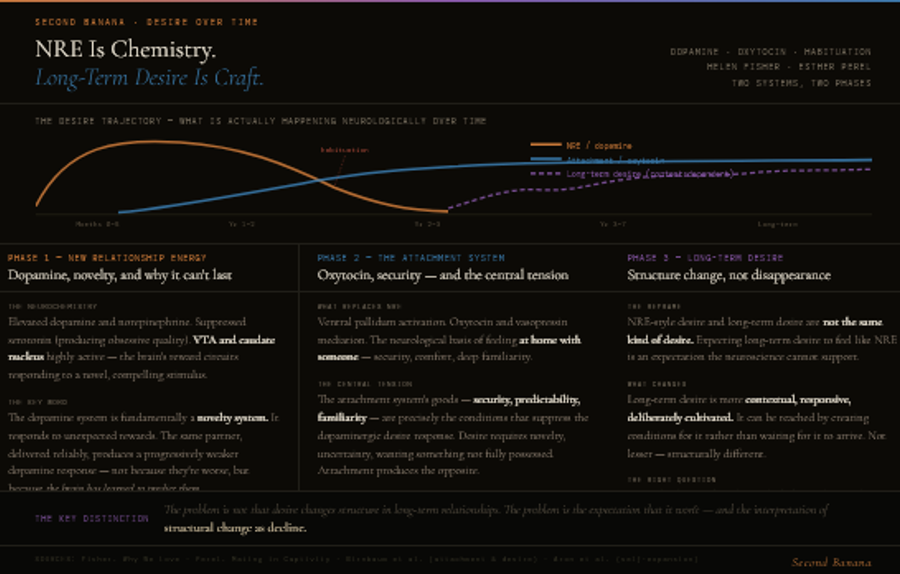
New Relationship Energy — NRE — is the intense, intrusive, often slightly destabilising rush of desire and connection that characterises early romantic and sexual relationships. It has a well-documented neurological signature: elevated dopamine and norepinephrine, suppressed serotonin (which produces the obsessive quality of early love), heightened amygdala activation that makes everything feel charged and significant, and reduced prefrontal activity that accounts for the characteristic impaired judgment of new relationships.
NRE is, in neurological terms, a stress response. A pleasurable one, but a stress response: the body is in a state of sustained arousal, novelty-seeking, and threat-sensitivity that it cannot maintain indefinitely. The neurochemical cocktail of early love is calibrated for acquisition, not maintenance. Helen Fisher’s research on the neuroscience of romantic love found that the intense early phase — what she called the lust and attraction stages — is associated with activity in the ventral tegmental area and caudate nucleus: the brain’s reward circuitry, running at high activation in response to a new and compelling stimulus.
The key word is new. The dopamine system is fundamentally a novelty system. It responds to unexpected rewards and to stimuli that have not yet been fully categorised and habituated. The same reward — the same partner, the same kind of sex, the same kind of emotional intimacy — delivered repeatedly and reliably, produces a progressively weaker dopamine response. Not because the reward is worse. Because the brain has learned to predict it, and the dopamine system doesn’t fire strongly for predicted rewards.
This is habituation. And it is not a failure of the relationship. It is the nervous system doing exactly what nervous systems are built to do.
The Attachment System Fills the Gap
When NRE fades — typically somewhere between 18 months and three years into a relationship, though this varies considerably — a different neurological system becomes dominant. Fisher’s research identified what she called the attachment stage: characterised by activity in the ventral pallidum and related regions associated with pair-bonding, and mediated by oxytocin and vasopressin rather than dopamine and norepinephrine.
The attachment system produces a felt sense of security, comfort, and deep familiarity with a partner. It is the neurological basis of what we mean when we talk about feeling at home with someone. And it is, structurally, almost the opposite of the novelty-and-uncertainty that drives the dopamine system’s desire response.
Here is the central tension: the attachment system’s goods — security, predictability, comfort, familiarity — are precisely the conditions that tend to suppress the dopaminergic desire response. Desire, neurologically, is activated by novelty, by tension, by uncertainty, by wanting something not yet fully possessed. Attachment, neurologically, is activated by exactly the opposite. The partner who has become fully known, fully safe, fully present is neurologically less equipped to trigger the dopamine system’s desire cascade than a stranger across a room.
This is not a flaw in the architecture of long-term relationships. It is the architecture of long-term relationships. The question is what to do with it.
Esther Perel and the Erotic Distance Thesis
Esther Perel’s Mating in Captivity (2006) is the most widely read popular treatment of long-term desire, and its central argument — that desire requires distance, that the very conditions that create security tend to suppress eros, and that maintaining erotic vitality over time requires some degree of preserved separateness and mystery — has become the dominant framework in the cultural conversation about long-term sex.
The thesis is neurologically well-grounded, and the research largely supports its central claim. Studies on long-term couples — including work by Birnbaum and colleagues on the relationship between attachment security and sexual desire, and research by Sprecher and others on the trajectory of desire over time — consistently find that the merging and enmeshment that characterise some long-term couples is associated with lower sexual desire, while couples who maintain clearer individual identities, more varied activity independent of the partnership, and some degree of unpredictability in the relationship tend to report higher desire levels.
What Perel identifies as “distance” is, in neurological terms, the partial preservation of the conditions that activate the dopamine system: uncertainty, novelty, the experience of a partner as someone not entirely possessed or fully known. This doesn’t require mystery in some contrived or theatrical sense. It requires that both partners remain genuinely, recognisably other to each other — that the relationship not collapse into a single merged identity in which each partner is a predictable extension of the other.
Where the Thesis Has Limits
Perel’s framework is less useful in certain specific contexts, and worth examining critically as well as receptively.
First, it is primarily derived from clinical observation rather than controlled research, and the couples who present in therapy are not representative of long-term couples generally. The thesis is most compelling for couples in which desire has been specifically suppressed by enmeshment or loss of individuality; it is less applicable to couples in which desire has faded for other reasons (health, stress, medication, mismatched desire architectures, unresolved conflict).
Second, the “distance” prescription can be misapplied as an argument for emotional unavailability or for deliberately withholding intimacy as a desire-maintenance strategy. The research on attachment and desire is more nuanced: while very high enmeshment is associated with lower desire, very high anxiety about the relationship is also associated with lower desire. Optimal desire conditions appear to be secure-but-differentiated, not anxiously distant.
Third, Perel’s framework is primarily heterosexual in its examples and framing, and the desire trajectories in same-sex long-term relationships, while broadly similar in their neurological basis, have some distinct features. The “lesbian bed death” phenomenon — frequently cited as an example of similarity-suppressing desire — has been significantly complicated by more recent research suggesting it reflects measurement artefacts and definitional differences rather than a reliable structural feature of female same-sex relationships.
What the Research Says About What Actually Helps
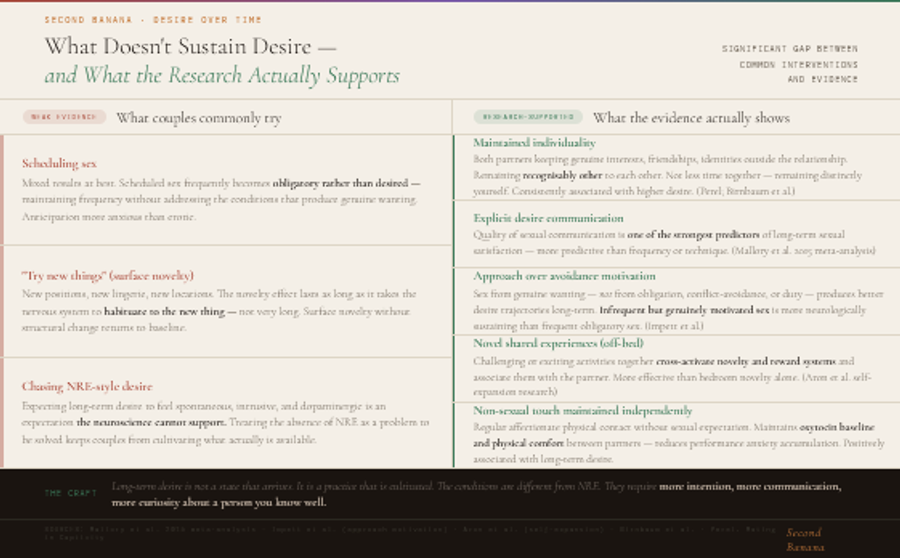
There is a significant gap between the interventions that couples commonly attempt when desire fades and the interventions that the research finds actually work. The gap is not small.
What Doesn’t Work (Or Doesn’t Work Well Enough)
What the Evidence Supports
The research converges on several factors that are more robustly associated with sustained desire in long-term relationships:
- Maintained individuality and outside investment. Couples in which both partners maintain genuine individual interests, friendships, and identities outside the relationship — who are, in Perel’s terms, genuinely other to each other — consistently report higher desire than couples who have collapsed into each other. This is not about spending less time together. It is about remaining recognisably yourself.
- Explicit desire communication. The research on sexual communication (including the Mallory et al. 2015 meta-analysis we cited in the myths piece) finds that the quality of sexual communication is one of the strongest predictors of long-term sexual satisfaction — more predictive than frequency, than technique, than novelty. Couples who can talk honestly about what they want, what they’re not getting, and what they’re noticing in their desire are significantly more likely to maintain satisfying sexual relationships over time.
- Approach motivation vs avoidance motivation. Research by Impett and colleagues found that couples who engage in sex primarily from positive motivation — because they want the experience, because it brings them closer, because it’s genuinely pleasurable — report better desire trajectories over time than couples who engage primarily from avoidance motivation (to avoid conflict, to avoid disappointing a partner, out of obligation). Scheduled sex tends to produce avoidance motivation. Sex initiated from genuine desire, however infrequently, is neurologically more sustaining.
- Responsive desire conditions. For the substantial portion of people who have primarily responsive rather than spontaneous desire (covered in the desire architecture piece), long-term relationship conditions can actually be better for desire than new relationship conditions, because responsive desire activates in response to context and stimulation rather than arriving spontaneously. Creating reliable conditions for responsive desire — the right environment, sufficient non-goal-oriented touch, adequate lead time — can be more sustaining than chasing NRE.
- Genuine novelty at the level of experience, not technique. The distinction that matters is not between new and old sexual techniques but between experiences that engage genuine uncertainty and aliveness. Research by Aron and colleagues on “self-expansion” in relationships found that couples who regularly engage in novel, challenging, or exciting activities together — not in the bedroom specifically, but as a shared experience — report higher desire and relationship satisfaction. The mechanism is cross-activation of the novelty and reward systems, which then become associated with the partner.
- Non-sexual physical affection maintained independently. Several studies on long-term couples find that regular non-sexual physical affection — touch, holding, physical closeness without the expectation of sex — is positively associated with long-term sexual desire. The mechanism involves oxytocin and the maintenance of physical comfort between partners, which reduces the performance anxiety that can accumulate when every physical gesture becomes a potential sexual initiation.
The Desire That Changes Structure
Here is the frame that the cultural conversation about long-term desire rarely offers, and that the research increasingly supports: NRE-style desire and long-term desire are not the same kind of desire. The expectation that long-term desire should feel like NRE — that desire in a five-year relationship should have the same spontaneous, intrusive, dopaminergic quality as desire in a five-week relationship — is an expectation that the neuroscience cannot support.
Long-term desire, when it exists and is functional, tends to be more contextual, more responsive, more deliberately cultivated and less automatically occurring. It is desire that can be reached by creating the conditions for it rather than desire that arrives unbidden. This is not lesser desire. It is structurally different desire, appropriate to the neurological phase the relationship is in.
The problem is not that desire changes structure in long-term relationships. The problem is the expectation that it won’t — and the interpretation of structural change as decline. A long-term couple whose desire requires more cultivation, more communication, more deliberate context-setting than it did in year one has not failed. They have entered the phase of erotic life that requires skill rather than just chemistry.
NRE is chemistry. Long-term desire is craft. We don’t expect musicians to sound the same at thirty years of practice as they did at the beginning. We shouldn’t expect desire to either.
What This Means for Second Banana
Second Banana’s community is predominantly oriented toward desire as something specific, communicable, and worth pursuing honestly. This is, as it turns out, exactly the orientation that the research on long-term desire most supports.
For people in long-term relationships navigating desire drift: the Second Banana community contains people who are asking the same questions, who have developed language for what they want that their current relationship may not provide a context for, and who are looking for connections that engage the novelty and aliveness that long-term familiarity tends to suppress. The platform is not only for people who are single. It is for people who are serious about their erotic lives at every stage.
The Second banana tags that belong in this piece’s conversation: “long-term,” “erotic connection,” “communication first,” “curiosity,” “gentle pace,” “the whole experience.” People who know that desire requires tending. People who have stopped expecting chemistry to do all the work and have started doing the craft.
The Question Worth Asking
The right question in a long-term relationship where desire has changed is not what happened to what we had? It is what are the conditions under which desire is available to us now, and are we creating them?
The conditions are different from what they were at the beginning. They require more intention, more communication, more willingness to stay curious about a person you know well. They require treating desire as something that, in the long-term, is a practice rather than a state — something cultivated rather than something that arrives.
None of this is as automatic as NRE. None of it is as involuntary or as intoxicating. But the desire that is deliberately cultivated between two people who know each other well, who have invested in understanding each other’s desire architecture, who can talk honestly about what they want and what they need — this is not a consolation prize for the loss of early-stage chemistry. It is a different kind of erotic life. One that requires more, and in some ways offers more, than what came before.