Why You Read Smut (And What It’s Actually Telling You) | Second Banana
Why You Read Smut.
And What It’s Actually
Telling You.
The psychology of erotic fiction, sexual fantasy, and what BookTok got right before the researchers caught up
The Thing That Happened on TikTok
Something shifted around 2020 and 2021, and if you’ve been anywhere near BookTok — the corner of TikTok devoted to book recommendations, reviews, and an increasingly specific and enthusiastic conversation about which novels contain the most emotionally devastating slow-burn romance and the most memorably explicit sex scenes — you already know what it was.
Erotic fiction went mainstream. Not quietly or apologetically. Loudly, proudly, in short-form video format, with millions of people holding up their dog-eared copies of Sarah J. Maas or Penelope Douglas or Katee Robert to the camera and saying, with audible relief: yes, I read this, yes it has explicit sex in it, yes I loved it, and no I am not particularly embarrassed about any of that.
The publishing industry noticed. “Spicy” as a genre descriptor exploded. Dark romance — a subgenre that goes considerably further than the conventional romance novel in its exploration of morally complicated, often explicitly transgressive, power-asymmetric, and sometimes genuinely dark erotic territory — became one of the fastest-growing fiction categories in the English-language market. Bookshops created dedicated sections. Publishers green-lit content that would have been unsellable a decade earlier. And a very large number of people who had been quietly reading this material in private for years experienced the specific relief of watching the conversation go public.
This piece is about why. Not in a hand-wringing way — not why would anyone want to read that but genuinely: what is the psychology underneath erotic fiction and sexual fantasy, what does the research say about what it’s doing for the people engaging with it, and what does the specific appeal of dark romance in particular reveal about desire that the culture has been slow to acknowledge honestly.
And because this is Second Banana: what does all of this mean for understanding your own desire well enough to actually find the person who shares it?
The Scale of the Thing: What the Research Knows About Fantasy
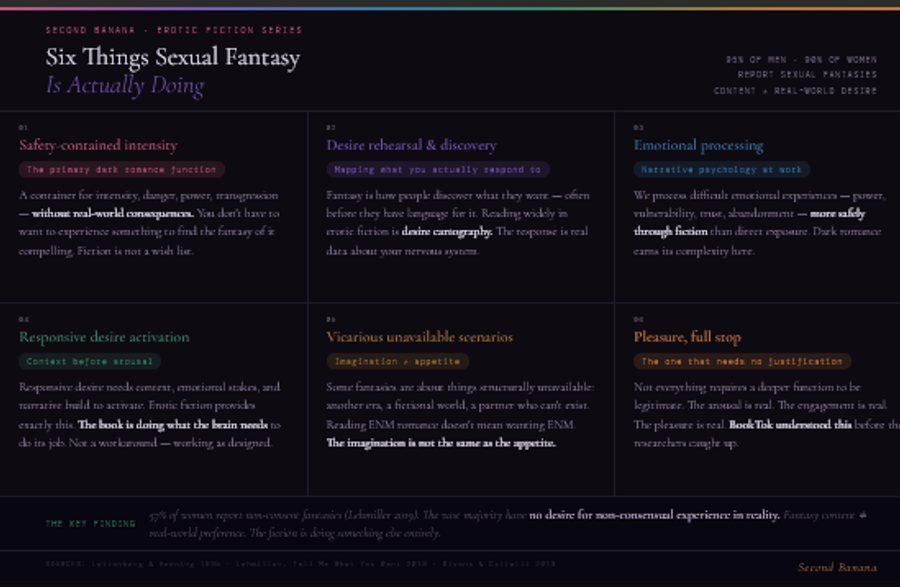
Sexual fantasy is close to universal. Research by Harold Leitenberg and Kris Henning, published in Psychological Bulletin in 1995 and still the most comprehensive review of the fantasy literature, found that approximately 95% of men and 90% of women reported having sexual fantasies, with the vast majority reporting fantasies during masturbation, during sex with a partner, and at various points throughout daily life. More recent surveys have confirmed these figures and, if anything, found fantasy to be even more prevalent than the earlier research suggested.
Erotic fiction is fantasy with a delivery mechanism. The reader does not need to generate the images, the scenario, the characters from scratch. The writer provides them. What the reader provides is the emotional engagement, the imaginative inhabitation of perspective, the arousal response that is produced by the specific combination of narrative elements the writer has assembled. It is collaborative fantasy — a form of shared imagination that is also, as it turns out, a remarkably efficient way of accessing desire states that daily life rarely provides the conditions for.
The specific market for erotic fiction skews heavily female. Multiple surveys of romance and erotic fiction readers find that 80-90% identify as women, with a meaningful further proportion identifying as non-binary. This is consistent with findings on the relative prevalence of sexually explicit written material (more popular with women) versus sexually explicit visual material (more popular with men) — a distinction that appears to be at least partly driven by the degree to which narrative context, emotional stakes, and relational dynamics are integrated with the explicit sexual content. Women, on average, report needing more context for the erotic to land. Written fiction is extremely good at providing context. Pornography, by design, is not.
Fantasy vs Reality: The Most Important Distinction Nobody Makes
The most common and most damaging misunderstanding about sexual fantasy — and about erotic fiction by extension — is the assumption that fantasy content reflects desire for real-world experience. It doesn’t, or at least not straightforwardly. The relationship between fantasy and reality is considerably more nuanced, and getting it wrong produces both unnecessary shame and genuinely bad interpretive errors about what people actually want.
Leitenberg and Henning’s review found that many of the most common sexual fantasies — particularly among women — involve scenarios that the person would explicitly not want to experience in reality: forced or coerced encounters, sex with strangers, scenarios involving power asymmetry or explicit transgression. In a widely cited 2019 survey by Justin Lehmiller published in Tell Me What You Want, 57% of women reported having had fantasies involving some element of non-consent. The vast majority of these women had no desire to experience non-consensual sex in reality. The fantasy was doing something other than expressing a real-world preference.
Understanding what fantasy is actually doing requires letting go of the content-equals-desire assumption entirely and asking a different question: not what does this person want but what is this fantasy providing that the person needs?
What the Smut Fantasy Is Actually Doing: Six Functions
Research on the psychology of sexual fantasy has identified several distinct functions that fantasies serve, which operate more or less independently of the specific content. Most fantasies serve more than one function simultaneously.
1. Safety-Contained Intensity
Fantasy provides a space in which intense emotional and physiological experiences — desire, fear, power, vulnerability, transgression — can be accessed without the real-world consequences those experiences would carry. This is particularly relevant for fantasies involving scenarios that would be dangerous, ethically complex, or simply unavailable in reality. The fantasy is a container. The intensity is real; the consequences are not.
This is the primary function of most dark romance content, and it is why the genre’s most ardent readers are typically among the people with the clearest understanding of the distinction between fiction and reality. You do not have to want to be kidnapped by a morally ambiguous Italian crime lord in order to find the fantasy of it compelling. The genre is trafficking in a specific emotional and physiological experience — intensity, danger, being wanted so much that ordinary rules dissolve — not in endorsement of the actual scenarios.
2. Desire Rehearsal and Discovery
Fantasy is one of the primary ways people discover what they actually want, in sexual contexts and in relational ones. The scenario that produces arousal in imagination is data about the nervous system’s response to specific combinations of elements: power dynamics, emotional stakes, physical specifics, relational configurations. Reading widely in erotic fiction is, among other things, a form of desire cartography — a way of mapping your own responses across a much wider range of scenarios than real-life experience typically provides.
Many people report discovering desires through erotic fiction that they had no language for before encountering them on the page. The kink or dynamic or relational configuration that produces an unexpected response in the reader is providing genuine information about what that reader’s nervous system finds compelling. This is the piece that Second Banana is most directly relevant to: that discovery has to go somewhere.
3. Emotional Processing
Erotic fiction, particularly romance with significant emotional content, functions as emotional processing material in ways that researchers of narrative psychology have documented across fiction genres generally. We process difficult emotional experiences, social dynamics, and psychological states more safely through fiction than through direct exposure. The reader who is working through complicated feelings about power, vulnerability, trust, or abandonment in their own life may find that emotionally resonant erotic fiction provides a structured, distanced form of processing.
This is one of the more sophisticated functions of dark romance specifically. The genre frequently engages with trauma, with complicated trust dynamics, with the experience of being vulnerable to someone who may not be safe — and for readers who have their own experiences with these themes, the fictional processing space can be genuinely useful. This is not the same as saying the fiction is therapy. It is saying that the emotional function fiction serves is real and not trivial.
4. Responsive Desire Activation
We covered the distinction between spontaneous and responsive desire at length in the desire piece. Responsive desire — the kind that requires context and stimulation to activate, rather than arriving spontaneously — is the predominant desire style for a substantial proportion of people, particularly women. Erotic fiction is one of the most effective available activators of responsive desire, because it provides exactly what responsive desire requires: context, emotional stakes, narrative build, and the gradual establishment of conditions under which desire becomes available.
Many responsive desire people find that reading erotic fiction before or during sexual activity — solo or with a partner — produces arousal and desire that wouldn’t have arrived on its own. This is not a workaround for a deficiency. It is the responsive desire system being given what it needs. The book is doing what the brain needs in order to do its job.
5. Vicarious Experience of Unavailable Scenarios
Some fantasies are about things that are genuinely unavailable: a historical period, a fictional world, a relationship configuration that doesn’t exist in reality, a partner with characteristics that can’t be combined in a single real person. Fantasy and fiction provide access to these experiences in a way that reality structurally cannot. A person in a happy monogamous relationship can vicariously experience the erotic charge of a new relationship, or multiple partners, or a fantasy partner who embodies specific characteristics, without any of that constituting a desire to actually change their real-world situation.
This is one of the reasons that reading erotic fiction with content that doesn’t reflect a person’s real-world relationship structure or orientation is so common and so misunderstood. The gay man who reads heterosexual erotica, the lesbian who reads gay male fiction, the happily monogamous person who reads ENM romance — all of these are accessing something the fiction provides that is not straightforwardly about real-world preference. The imagination is not the same as the appetite.
6. Pleasure, Full Stop
The risk of all this functional analysis is making erotic fiction sound like it needs justification beyond the obvious one: it’s pleasurable. The experience of reading well-written erotica or erotic romance is, for many people, genuinely, simply enjoyable. The arousal is real. The engagement is real. The pleasure is real. Not everything requires a deeper function to be legitimate.
One of the things BookTok did, without necessarily theorising it, was give public permission for this simple justification. People read spicy books because they enjoy spicy books. The rest — the psychology, the functions, the research — is interesting context. It’s not required to make the thing okay.
Dark Romance: Why the Most Transgressive Content Has the Most to Say
Dark romance as a genre — variously defined but generally encompassing romance with morally compromised heroes, explicit power asymmetry, non-consent or dubious consent elements, villain love interests, stalker dynamics, and other content that conventional romance deliberately excludes — is worth treating as its own phenomenon, because its popularity tells us something specific about desire that lighter romance content doesn’t.
The Appeal of the Morally Compromised Hero
The villain hero or anti-hero of dark romance is a remarkably consistent figure across the genre: powerful, dangerous, operating outside ordinary ethical constraints, capable of violence or manipulation — and yet entirely, obsessively devoted to the specific heroine. The fantasy is not simply power or danger. It is power and danger combined with singular fixation: being the one person who matters to someone who matters to no one else.
This is attachment-relevant in ways that the attachment research makes legible. The fantasy of complete, unambiguous, slightly overwhelming devotion — of being wanted by someone who is not ordinarily interested in wanting anyone — speaks directly to the anxious attachment system’s core hunger: certainty of being chosen, being irreplaceable, being the one who finally made someone stay. Dark romance is, among other things, anxious attachment fantasy with the volume turned up.
This doesn’t mean that only anxiously attached people enjoy dark romance — the genre’s readership is too broad and too varied for that. But the specific emotional chord the morally compromised devoted hero strikes — the particular intensity of chosen by someone who never chooses anyone — is a chord that the attachment system finds compelling regardless of the specific content that surrounds it.
Consensual Non-Consent Fantasy: The Research
The non-consent or “dubious consent” element in dark romance is the one that attracts the most external anxiety and requires the most careful treatment. The research is actually clarifying if you look at it directly.
A 2019 study by Bivona and Critelli in Journal of Sex Research found that approximately 52% of women in their sample had experienced forced-sex fantasies, with the majority reporting these as pleasant and arousing. Crucially, the study also found that these fantasies were not associated with genuine desire for non-consensual experience, with history of sexual victimisation, or with lower self-esteem. They were, in the language of the researchers, “erotic fiction” — scenarios in which the fantasy serves the subjective experience of the person fantasising, not a script for real-world behaviour.
The key mechanism appears to be what researcher Jenny Wade and others have called the “imagined irresistibility” function: the fantasy of being so desired that the other person loses control, cannot wait, cannot stop, cannot resist — which is, fundamentally, a fantasy about the self’s desirability rather than about non-consent per se. It is the experience of being wanted beyond restraint, delivered in a fictional container that removes the actual danger.
Reading dark romance with non-consent elements is not evidence of damaged psychology, confused values, or secret desire for assault. The research doesn’t support that reading. The readers themselves, who typically have extremely sophisticated understandings of the fantasy/reality distinction, don’t support it either.
BookTok and the Community Function
One of the things BookTok did that the erotic fiction market had not previously managed at scale was create a community around the reading experience. Not just recommendation — though that too — but shared vocabulary, shared reference points, shared enthusiasm for specific tropes, and — critically — shared permission.
The “smut reader” had previously been a figure of minor cultural embarrassment: the assumption being that you read romance novels because you couldn’t get a real relationship, or because you had unsophisticated literary taste, or because there was something compensatory about your engagement with fictional desire. BookTok, by sheer force of numbers and enthusiasm, dismantled this. When millions of people are on camera saying they loved the stalker romance with the red flags and the explicit chapter twelve, the “something wrong with you” framing becomes very difficult to sustain.
This is the community function operating: the same mechanism that makes kink community valuable (discovering you’re not alone, not aberrant, not broken) applied to the reading of erotic fiction. The shame around desire requires isolation to sustain. Community — even a TikTok community organised around book recommendations — disrupts isolation and, with it, shame.
The Specific BookTok Tropes Worth Knowing
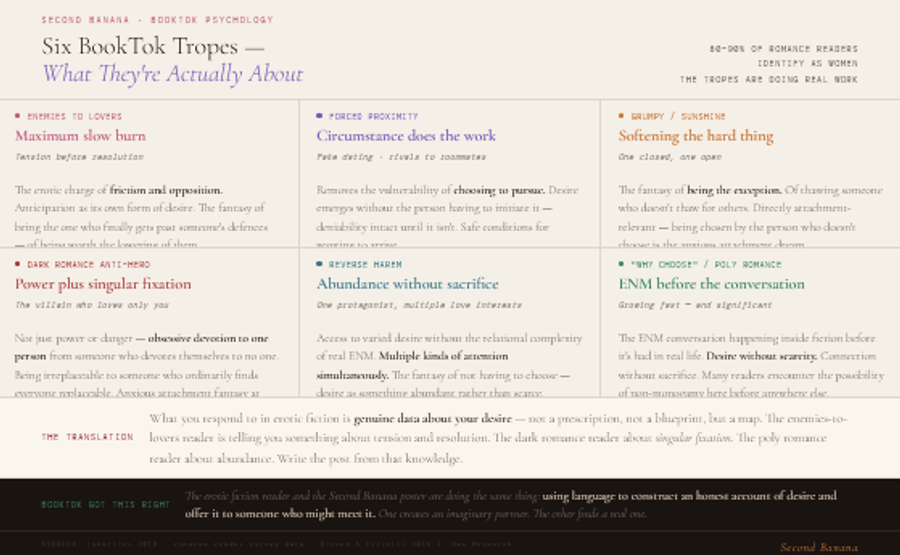
For readers who’ve been adjacent to BookTok but not deep in it, a few of the defining tropes — each of which maps onto specific psychological functions:
- Enemies to lovers — the slowest of slow burns, maximum tension before resolution. Functions: anticipation, the erotic charge of opposition and friction, the fantasy of being the one who finally gets past someone’s defences.
- Forced proximity — characters who would not choose each other are thrown together by circumstance (fake dating, rivals-to-roommates, marriage of convenience). Functions: removes the vulnerability of initiation, provides deniability, creates conditions for desire to emerge without being chosen.
- Grumpy/sunshine — one emotionally closed or difficult character, one who is open and warm. Functions: the fantasy of thawing someone, of being the exception, of softening something hard. Directly attachment-relevant.
- Dark romance anti-hero — as discussed above. Functions: singular fixation, being chosen by someone who doesn’t choose people, power-plus-devotion combination.
- Reverse harem — one protagonist, multiple love interests. Functions: access to varied desire without the relational complexity of real ENM, variety within safety, multiple kinds of attention simultaneously.
- “Why choose” and polyamorous romance — a growing subgenre in which the character doesn’t choose between love interests but builds a relationship that includes multiple partners. Functions: the fantasy of abundance, of not having to sacrifice one connection for another, of desire without scarcity. This is, notably, the ENM conversation happening inside fiction before it’s had in real life for many readers.
From Fantasy to the Post: What Erotic Fiction Can Teach You About What You Actually Want
Here is the most practically useful thing this piece has to offer, and it’s something the Second Banana model is built to receive: what you respond to in erotic fiction is genuine information about your desire.
Not a prescription. Not a blueprint. Not a demand that reality replicate fiction, which it cannot and should not. But information: the emotional and physiological response produced by specific tropes, dynamics, power configurations, and character combinations is the nervous system signalling what it finds compelling. The enemies-to-lovers reader is telling you something about how they relate to tension and resolution. The dark romance reader is telling you something about the specific quality of attention they crave. The reverse harem reader is telling you something about abundance and variety. The slow-burn reader is telling you something about anticipation and the erotic charge of delay.
Second Banana’s post-first model is, among other things, an invitation to translate these signals into language. Not “I like romance novels” — though that’s a start — but: what specifically compels you in the fiction you love, and how does that translate into what you want from a real connection? The person who can answer that question, specifically and honestly, is the person most likely to find someone whose answer to the same question fits.
The Second Banana tags that emerge from this: “slow burn,” “tension first,” “intensity,” “being chosen,” “power exchange,” “emotional depth before physical,” “the whole thing not just the parts.” The BookTok reader knows exactly what they want. They’ve been reading it for years. Writing the post is just translating the library into a conversation.
A Note on Shame
People carry shame about the erotic fiction they read that is, by any reasonable measure, unwarranted. Shame about the explicitness of it. Shame about specific tropes — particularly the morally complex or transgressive ones. Shame about using fiction for arousal, as though this were a lesser or more embarrassing form of desire than whatever the alternative might be. Shame, sometimes, about how much they love it, as though the strength of the response were itself suspicious.
None of this shame is doing useful work. The research doesn’t support it. The psychology doesn’t support it. The fact that reading erotic fiction produces arousal, provides emotional processing, activates responsive desire, and gives pleasure is not evidence of anything problematic. It is evidence of a functioning imagination and a nervous system doing exactly what nervous systems are built to do.
BookTok, for all its chaos, got something right that the shame culture around erotic fiction had been getting wrong for decades: the reading is fine, the desire it expresses or activates is fine, the pleasure it provides is fine, and you don’t owe anyone an apology for your library.
Second Banana Is Already the Story
The erotic fiction reader and the Second Banana poster are, functionally, doing the same thing: using language to construct a specific, emotionally honest account of desire and then offering it to someone who might be ready to meet it.
The difference is that fiction creates an imaginary partner. Second Banana creates the conditions for a real one. The post you write about what you want — the dynamic, the pacing, the specific quality of attention, the emotional stakes you need before the physical ones — is a chapter one. Someone’s going to read it and recognise themselves in it.