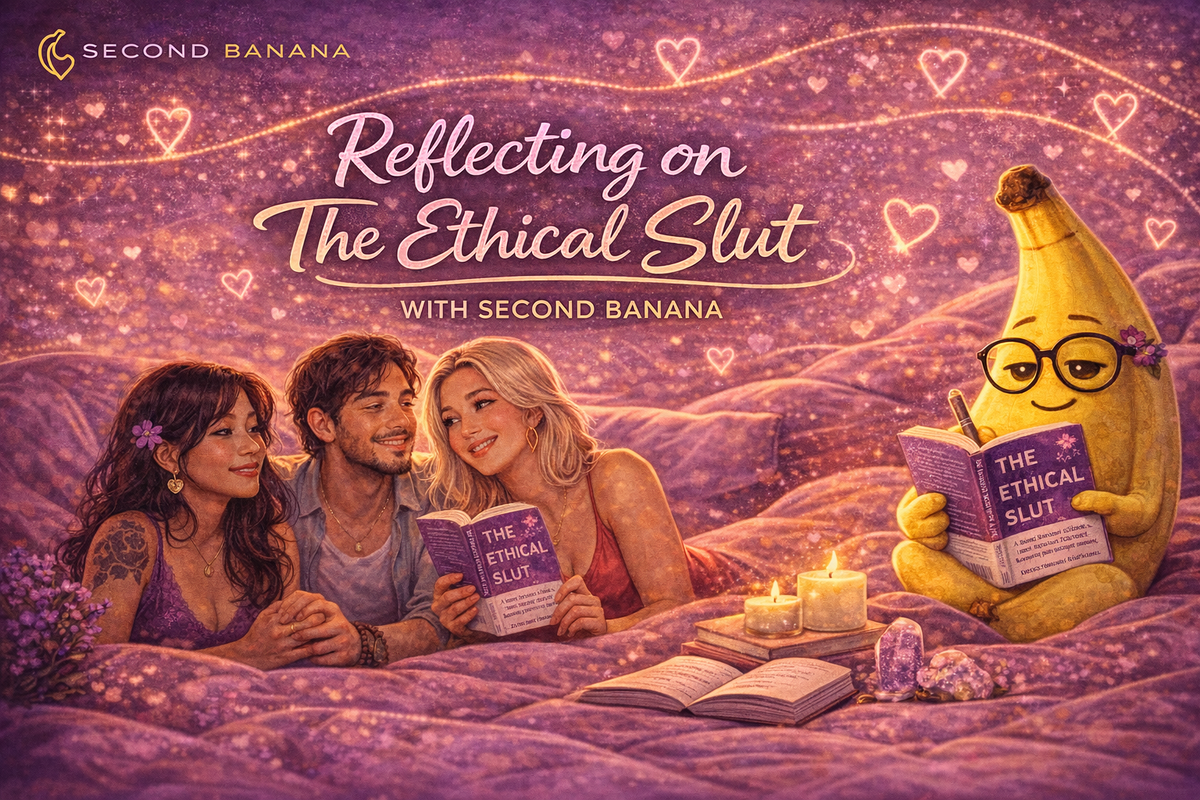
Reflecting on The Ethical Slut with Second Banana
The Book That Started Everything: Reflecting on The Ethical Slut with Second Banana
Permission, in Print
There are a handful of books that don't just describe a world — they help create one. The Ethical Slut, first published in 1997 by therapist Dossie Easton and publisher Janet Hardy, is one of them, and is a foundational text regarding sexual sovereignty.
It didn't invent ethical non-monogamy. People had been loving more than one person simultaneously, openly and honestly, long before anyone put a name to it. But The Ethical Slut did something no book before it managed quite as well: it made the practice legible. It gave language to people who'd been living outside the standard relationship template, from the polyamorous to the demisexual, with no map and no community. It said, plainly and joyfully, that wanting more than one loving connection is not pathology, not immaturity, not a character defect. It is a valid, considered, deeply human way of being.
More than 200,000 copies later — across three editions, from an indie press in San Francisco to Penguin Random House — the book remains the most common entry point for people exploring ethical non-monogamy. It's been called the Poly Bible. It's been recommended by sex therapists, passed between friends, left conspicuously on nightstands. Margaret Cho said it made her the ethical slut she is today. Annie Sprinkle called it one of the most useful relationship books you could ever read, regardless of your lifestyle choices.
On Second Banana, we take the book seriously. We also take it honestly. Which means acknowledging both what it got magnificently right and where the community it helped build has grown beyond it.
The Radical Bet at the Centre of the Book
Everything in The Ethical Slut flows from one foundational claim: that human capacity for love and connection is not scarce.
Easton and Hardy named the cultural assumption they were arguing against the "starvation economy" — the deeply ingrained belief that love is a finite resource, that intimacy given to one person is necessarily withheld from another, that desire itself is something to be rationed and controlled. This model, they argued, is the source of enormous unnecessary suffering. It treats relationships as zero-sum competitions. It generates possessiveness dressed up as devotion. It insists that the only way to prove you truly love someone is to love no one else.
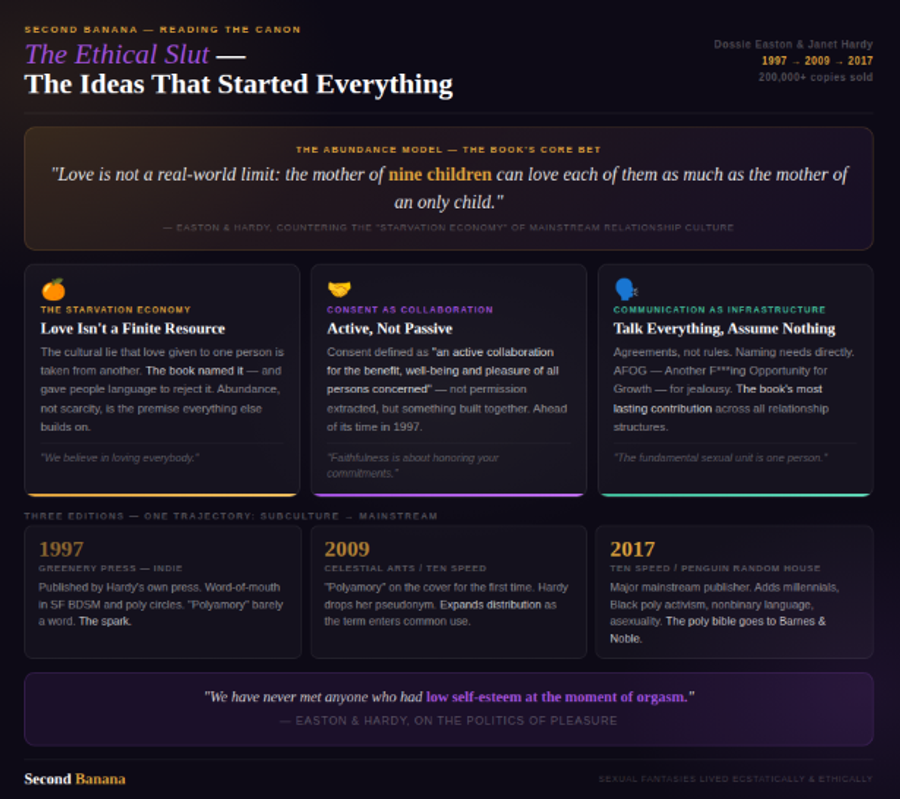
Against this, the book proposes an abundance model. The authors put it simply: love is not a real-world limit. A parent of nine children can love each of them as much as a parent of one. Giving love freely does not deplete it. Sharing intimacy honestly does not diminish it.
This reframe — radical in 1997, still resonant now — is the book's most enduring contribution. It didn't just give people a new relationship structure to try. It gave them a new way of understanding desire itself.
From that foundational premise, everything else follows. If love is abundant, then the task isn't to restrict it but to share it well — honestly, carefully, with genuine regard for everyone involved. Which is where the ethics come in.
What an Ethical Slut Actually Is
The title is a provocation, and a deliberate one.
Easton and Hardy define an ethical slut as "a person of any gender who has the courage to lead life according to the radical proposition that sex is nice and pleasure is good for you." The reclamation of the word "slut" is intentional — it's a challenge to the shame culture that surrounds sex and desire, and an assertion that people who love pleasure and pursue it honestly deserve respect, not contempt.
They compare ethical sluts to philanthropists: people who have a lot of something good and share it generously, because sharing makes the world better. The comparison is partly playful, but the underlying point is serious. There is nothing inherently wrong with having a lot of love to give and finding many people to give it to — as long as you do it with honesty, care, and the genuine consent of everyone involved.
That last part is the whole thing. Honesty. Care. Genuine consent. The "ethical" in The Ethical Slut isn't decorative. It's the load-bearing word.
On consent specifically, the Ethical Slut goes considerably further than the cultural standard of its time. Easton and Hardy define consent not as the mere absence of refusal but as "an active collaboration for the benefit, well-being and pleasure of all persons concerned." That framing — consent as something built together, not extracted — was ahead of where mainstream culture was in 1997, and remains worth taking seriously now.
And on faithfulness, the book offers a quiet redefinition that lands harder than you might expect: faithfulness, they write, has very little to do with who you have sex with. Faithfulness is about honouring your commitments and respecting the people you love. That reframing challenges monogamy's monopoly on the concept — and implicitly asks what we're actually trying to protect when we invoke it.
The Practical Architecture: Communication, Jealousy, Community
Beyond philosophy, The Ethical Slut is genuinely practical. This is part of what made it so influential — it didn't just argue for a way of living, it tried to help people actually do it.
On communication, the book teaches what amounts to a philosophy of radical vulnerability: name your needs directly ("I need to feel loved," "I need to know you find me attractive"), distinguish collaborative agreements from imposed rules, and resist the urge to fix a partner's difficult emotions rather than simply hearing them. The authors introduce frameworks for conflict that have become standard in ENM communities: scheduling hard conversations in advance, taking time-outs when feelings flood, and approaching disagreements with the understanding that a resolution where someone loses is no resolution at all.
On jealousy, the book's contribution is significant and its limits are real, in roughly equal measure. Significant: Easton and Hardy take jealousy seriously as a human experience rather than dismissing it or treating it as evidence that the non-monogamous person has failed. They normalize the emotion while insisting it can be examined and worked through. They popularised the wry acronym AFOG — Another F***ing Opportunity for Growth — for the moments when jealousy ambushes you. Their practical advice on unpacking jealousy (asking what specifically you're afraid of, distinguishing the emotion from the story you're telling about it) remains useful.
But the limits are equally real. The book's core jealousy principle — that no one "makes" you feel jealous, that the feeling is always ultimately yours to manage — can, in less careful hands than Easton and Hardy's, become a tool for avoiding accountability. If every difficult feeling a partner expresses is reframed as their personal growth project, the framework stops describing healthy emotional independence and starts describing something considerably more convenient for the person who'd rather not hear hard feedback. Post-Veaux (more on that shortly), the ENM community has grown acutely aware of this gap.
On community, the book is at its most visionary. Easton and Hardy advocate for extended chosen families — networks of current and former lovers, friends, and connections who form genuine support structures for each other. This isn't just a nice idea. For people whose relationship structures place them outside the nuclear family's legal and social architecture, community infrastructure matters enormously. Easton has spoken in interviews about recovering from an injury in her late seventies surrounded by a community of past and present lovers and friends who signed up to care for her. That's not a metaphor. That's the book's vision made real.
Three Editions: A Book Growing Up With Its Community
The publishing trajectory of The Ethical Slut maps almost perfectly onto the mainstreaming of its subject matter.
The 1997 first edition was published by Greenery Press — Hardy's own small press, focused on adult sexuality. Hardy wrote under the pseudonym Catherine A. Liszt. The book circulated primarily in San Francisco's overlapping BDSM, queer, and polyamory communities, passed from hand to hand in a subculture that was doing the thing the book described long before any mainstream institution paid attention.
By 2009, when the second edition arrived at Celestial Arts (a Ten Speed Press imprint), enough had changed to put "polyamory" on the cover for the first time. Hardy dropped her pseudonym. Easton's decade of clinical work as a licensed marriage and family therapist shaped new content, including guidance for single people exploring ENM and practical advice for couples considering opening up. The subtitle shifted from "Infinite Sexual Possibilities" to "Practical Guide to Polyamory, Open Relationships and Other Adventures" — a book finding its way from the subcultural to the accessible.
The 2017 third edition landed at Ten Speed Press, a Penguin Random House imprint, which is a genuinely remarkable journey for a book that started at an indie press focused on kink. This edition added interviews with poly millennials, sections addressing Black polyamorous activism, updated language around nonbinary gender, sidebars on asexuality and LGBTQ terminology, and expanded guidance on consent. It acknowledged dating apps and social media. It attempted — with mixed success — to address the intersectional gaps that critics had identified in earlier editions.
The trajectory from indie kink press to Penguin Random House tells you everything about what happened to the conversation in those twenty years.
What the Book Got Right That Still Holds
Some of what The Ethical Slut argued in 1997 has become so widely accepted in ENM communities that it's stopped feeling like an argument and started feeling like common sense. That's not a criticism — that's what successful advocacy looks like.
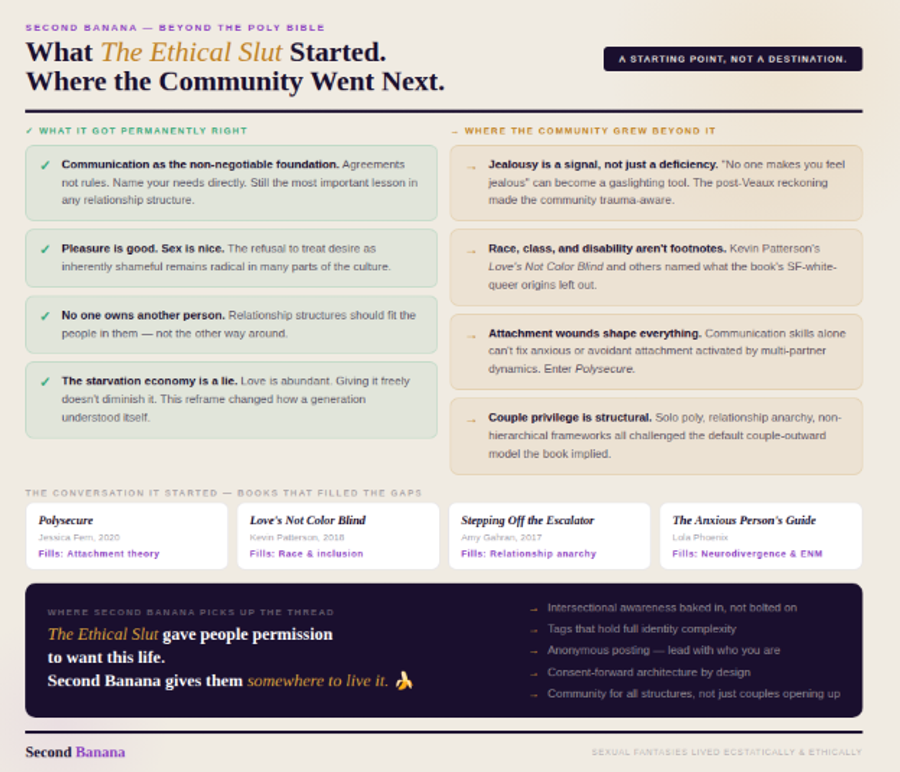
Communication as the non-negotiable foundation of ethical relationships. Every serious practitioner of ENM, regardless of their specific structure or philosophy, would put this on the list. The book's insistence on naming needs, making explicit agreements, and keeping the conversation going even when it's difficult is the single most transferable piece of wisdom it contains — and it applies far beyond ENM.
Pleasure is good. Sex is nice. Desire is not shameful. This sounds obvious stated plainly, but the cultural context in which the book was written — and the context in which many of its readers encountered it — made it anything but. For people raised in shame-based cultures around sexuality, the book's cheerful insistence that wanting pleasure is not a moral failing has been genuinely life-changing.
No one owns another person. Relationships should be designed to fit the people in them, not the other way around. Structures, agreements, and expectations should serve everyone involved — not be imposed as defaults that people are expected to conform to.
The abundance model itself. The starvation economy framing remains one of the most useful tools in the ENM conceptual toolkit for helping people understand why jealousy and possessiveness feel so natural (they've been culturally trained) and why there's an alternative that doesn't require suppressing human emotion but does require reexamining its premises.
Where the Community Has Grown Beyond the Book
Honouring The Ethical Slut's genuine contributions means also being honest about its limits. The community it helped build has had nearly three decades to identify them, and the conversation has moved.
Jealousy as signal, not just as growth opportunity. The most significant evolution in ENM thinking since the book's publication is a more nuanced understanding of jealousy — one that doesn't only ask "how do I manage this feeling?" but also "what might this feeling be telling me about this relationship?" Sometimes jealousy is a personal growth project. Sometimes it's legitimate information about a partner who is violating agreements, withholding affection, or behaving in ways that deserve scrutiny. The framework in The Ethical Slut doesn't always help you tell the difference. Post-Veaux — the community reckoning that followed multiple former partners of More Than Two author Franklin Veaux coming forward with accounts of manipulation and abuse in 2019 — the ENM community has grown considerably more attuned to how the language of personal emotional responsibility can be weaponized by people who'd rather not be accountable. Jessica Fern's Polysecure (2020), which brought attachment theory into the ENM conversation, represents the field's most influential response: recognising that communication skills alone cannot address attachment wounds, and that some of what looks like jealousy is actually an attachment system in distress.
Race, class, and disability. The Ethical Slut was written by two white queer women from San Francisco's BDSM community, and those origins are visible in the text. The book's third edition made genuine attempts to address this — but critics have noted that adding sections doesn't fully address structural gaps. Kevin Patterson's Love's Not Color Blind (2018) named what the book couldn't: that polyamorous communities are overwhelmingly white in their visible representation, that people of colour face fetishization, ambient racism, and erasure of their everyday experiences within those communities, and that a book aimed at liberating people from cultural defaults around relationships should reckon with the fact that different people start from very different positions of cultural privilege. Class and disability remain similarly underaddressed.
Couple privilege. The book implicitly treats an existing couple as the starting unit from which non-monogamy radiates outward. Solo polyamory and relationship anarchy developed partly in response to this — explicitly challenging the assumption that dyads deserve default structural priority, and advocating for relationship forms that centre individual autonomy rather than couple units.
The conversations the book opened but didn't finish. Attachment theory and ENM (Fern). Race and representation in poly communities (Patterson). The relationship escalator and its alternatives (Amy Gahran's Stepping Off the Relationship Escalator). Neurodivergence and non-monogamy (Lola Phoenix). These books exist because The Ethical Slut created a conversation large enough that its gaps became visible.
From the Poly Bible to Second Banana
Here is what we think the honest assessment of The Ethical Slut looks like from where we're standing in 2026.
It is a classic and an essential starting point. Its core claims — abundance over scarcity, honesty as infrastructure, pleasure as inherently good, no one owns anyone — remain foundational. The community it helped create is real, large, and living lives that its authors imagined and advocated for before mainstream culture had any idea how to hold that conversation.
It is also a product of its origins, and those origins leave real gaps. It centres a particular demographic, a particular set of relationship structures, and a particular moment in the history of both feminist thought and sexual politics that the community has continued to evolve beyond. The post-Veaux reckoning in particular has made it clear that good values and good language can be separated from each other — that the tools the book provides can be used ethically or not, and that the book itself doesn't fully equip readers to tell the difference.
The community's consensus view of the book is clear: read it, but don't stop there. It is a starting point, not a destination.
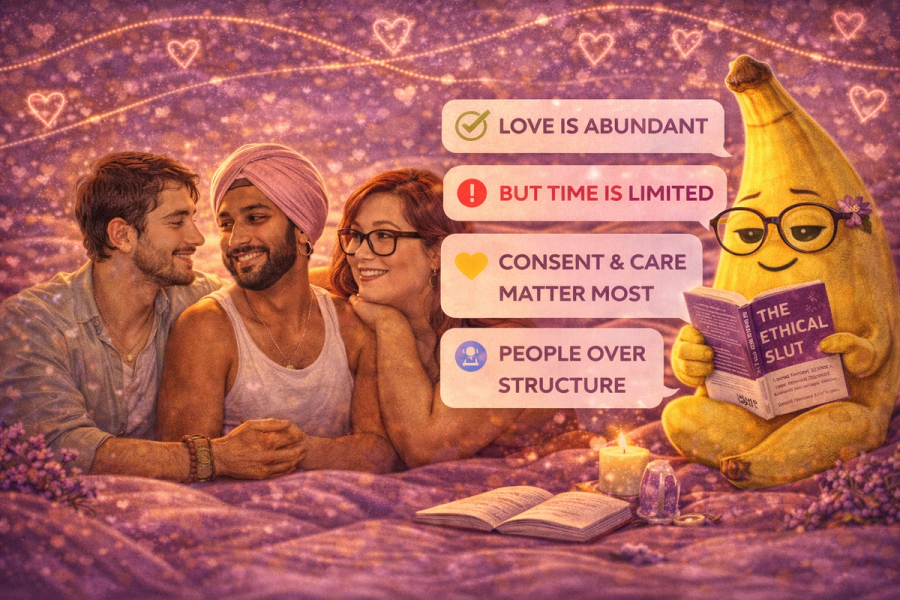
Second Banana was built in exactly that spirit. The permission Easton and Hardy gave — to love freely, to pursue pleasure honestly, to design relationships that fit the actual people in them — is the permission we stand on. The structural and intersectional awareness that the book's critics and successors brought is what we build into the platform: a tag system that holds the full complexity of who people are, anonymous posting that removes the cost of honesty for people navigating complicated social contexts, a community built on consent and genuine care for every member, and an explicit commitment to trans inclusion and anti-racism that isn't a footnote.
The Ethical Slut gave a generation permission to want this life.
Second Banana is somewhere to live it. 🍌
Second Banana: Sexual Fantasies Lived Ecstatically and Ethically. An inclusive, sex-positive community for adults of every relationship structure — built for connection that starts with honesty.