
Bareback: The Psychology of Skin-to-Skin, Trust, and Why the Absence of Barrier Carries Such Specific Erotic Charge | Second Banana
Bareback:
The Psychology of Skin-to-Skin Contact, Trust, and Why the Absence of Barrier Carries Such Specific Erotic Weight
What This Is Actually About
Bareback — condomless penetrative sex — carries a specific erotic charge for many people that goes well beyond the purely physical. The sensation difference between sex with and without a condom is real and consistently reported, but it does not fully account for why bareback sex is so frequently the subject of intense fantasy, why people describe it as feeling qualitatively different even before any physical sensation has occurred, or why for some practitioners the erotic charge attaches to the category itself rather than simply to the experience.
What bareback sex is actually about — psychologically, for the people for whom it is an explicit erotic orientation rather than simply a preference — is a specific combination of physical intimacy, vulnerability, and trust that the presence of a barrier forecloses. The condom is not merely a physical intervention; it is a symbol and a mechanism of managed distance — a reduction in the completeness of the contact between two bodies. Its absence means something specific, and what it means is the core of the bareback erotic orientation.
This piece covers that psychology honestly: the physical dimension, the intimacy and vulnerability dimension, the trust dimension, and the risk dimension that for some practitioners is itself part of the appeal. It also covers the contemporary landscape in which bareback sex is practiced — PrEP, testing, U=U — not just as a disclaimer but as context that is genuinely part of how this kink operates today. And it covers what Second Banana’s tag system offers practitioners who are specific about this orientation.
A condom is managed distance. Its absence is the choice to close that distance completely. That choice — made together, deliberately — is where most of the erotic charge actually lives.
The Physical Dimension
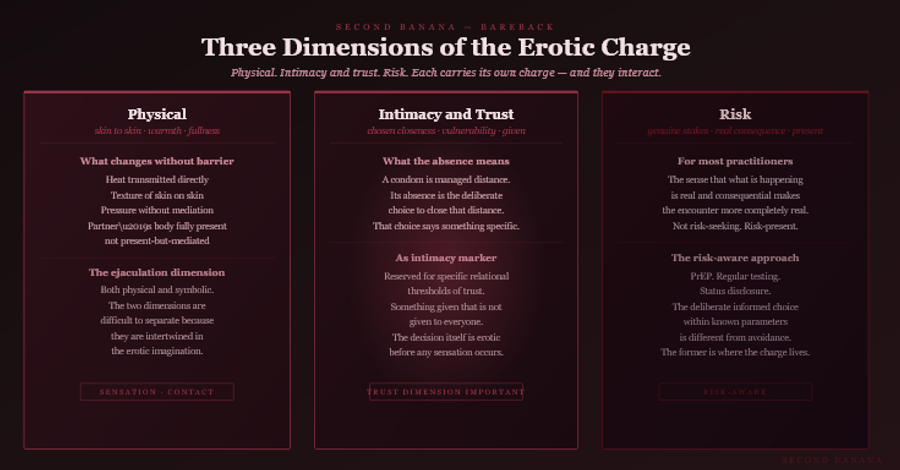
The physical sensation difference between sex with and without a condom is real, consistent across research, and worth naming directly without embarrassment. Skin-to-skin contact transmits warmth, texture, and pressure in ways that a latex or polyurethane barrier reduces. The specific sensations of direct contact — the heat of another person’s body, the specific texture of skin against skin, the complete transmission of pressure and movement without the mediating layer — are experienced differently from condom-mediated contact, and this difference is consistently reported as significant by people who have experienced both.
For the receptive partner specifically, the physical experience of receiving someone without barrier is described in terms that go beyond generic sensation: a quality of fullness that is specific to unmediated contact, a specific awareness of the other person’s body as genuinely present and in contact rather than present-but-mediated. These descriptions are not universally shared — some people report little or no subjective difference — but they are consistent enough across accounts to be taken seriously as descriptions of a genuine physical experience.
The ejaculation dimension is a separate physical layer that for many bareback practitioners is central rather than incidental. The specific physical experience of receiving ejaculation — or of ejaculating inside a partner without barrier — carries an erotic charge that is partly physical and partly symbolic, and the two dimensions are difficult to separate because the physical experience and the symbolic meaning of the act are so closely intertwined in the erotic imagination.
Intimacy and Vulnerability
The psychological charge of bareback sex is, for most practitioners, primarily about intimacy rather than sensation. Choosing to have sex without a condom with a specific person is a specific form of trust — a deliberate, bodily act of closeness that has no precise equivalent in other forms of sexual engagement. The choice says something specific: I am willing to be this completely present with you, without the managed distance that a barrier provides, and you are someone with whom that level of closeness feels right.
This is why bareback sex is so frequently connected to relationship milestones and to the specific experience of trust deepening in a connection. The first time two people who have been practicing safer sex together decide to stop is often experienced as significant in ways that are explicitly emotional rather than purely physical — as a form of commitment, of choosing closeness, of saying something with the body that words have not yet said. The erotic charge of this moment is partly about the physical sensation to come and mostly about the decision itself and what it represents.
The vulnerability dimension is equally important. Sex without a condom requires a form of physical openness — particularly for the receptive partner, but for both — that is specifically and deliberately chosen rather than managed. The body is more completely given rather than given-with-reservation. For people whose erotic orientation involves genuine vulnerability and genuine trust, this specific form of bodily openness is an erotic experience in its own right, not merely a precondition for physical sensation.
Bareback as Intimacy Marker
For many practitioners, bareback sex functions as an intimacy marker — something reserved for relationships or encounters that have reached a specific threshold of trust and closeness, and therefore something that carries the weight of that threshold when it occurs. The person with whom one has bareback sex is, in this framework, a different category of person from those with whom one does not — not morally different, but relationally different, in the same way that other forms of physical intimacy mark specific relational thresholds.
This framework gives bareback sex its specific erotic charge in a relationship context: the sense that something is being given that is not given to everyone, that the encounter is marked by a specific quality of chosen closeness. It also explains why the bareback fantasy — the imagination of choosing this level of closeness with a specific desired person — carries erotic weight even before any physical encounter has occurred.
The Trust Dimension and Modern Risk Reduction
The trust dimension of bareback sex has changed substantially in the past decade, and understanding the contemporary landscape is important for understanding how this kink is actually practiced by people who take both their erotic lives and their health seriously.
PrEP and the Transformed Risk Profile
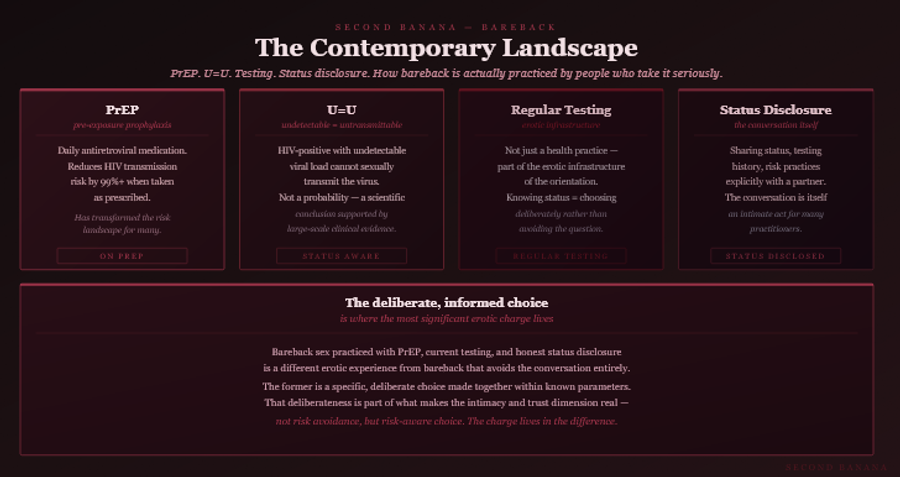
Pre-exposure prophylaxis (PrEP) — the daily antiretroviral medication that reduces HIV transmission risk by 99% or more when taken as prescribed — has transformed the risk landscape of bareback sex for many practitioners, particularly gay and bisexual men for whom HIV risk was historically the primary concern. PrEP does not eliminate all STI risk, but it removes the specific concern that made bareback sex between HIV-negative or untested partners categorically different from other sexual risk decisions. For many PrEP users, the erotic orientation toward bareback sex is no longer accompanied by the specific anxiety that historically attached to it.
This shift is part of the contemporary erotic landscape for bareback practitioners, and it is worth naming directly rather than treating bareback as though the risk profile of 1990 still applies. The specific trust dynamic of bareback sex has always been present; PrEP has changed the specific risk calculation that trust is required to navigate.
U=U and Status Disclosure
Undetectable = Untransmittable (U=U) is the scientifically established principle that a person living with HIV who has achieved and maintained an undetectable viral load through antiretroviral treatment cannot sexually transmit the virus. This is not a harm reduction message or a probabilistic statement — it is a conclusion supported by large-scale clinical evidence. For bareback practitioners who navigate HIV status as part of their sexual decision-making, U=U is directly relevant context: an HIV-positive partner with undetectable viral load poses no HIV transmission risk.
Status disclosure — the explicit conversation about HIV status, testing history, and current risk reduction practices — has become part of the erotic landscape for many bareback practitioners, not as a clinical requirement but as part of the trust negotiation that makes the encounter specifically charged. The conversation itself — the specific act of sharing this information, of choosing a level of transparency with a specific person — is for many practitioners part of what makes the subsequent bareback encounter intimate rather than merely physical.
Testing as Part of the Dynamic
Regular STI testing — HIV, gonorrhoea, chlamydia, syphilis, and others depending on sexual practices — is for many bareback practitioners not just a health practice but part of the erotic infrastructure of the orientation. Knowing one’s own status, knowing a partner’s status, and choosing to be bareback within that context of mutual knowledge is a different erotic experience from bareback sex that avoids rather than addresses the risk question. The former is a specific choice with specific information; the latter is an avoidance. For many practitioners, the specific quality of the former — the deliberate, informed choice to close the distance — is where the most significant erotic charge lives.
The Risk Dimension
For some bareback practitioners, the erotic charge is not merely incidentally connected to risk but is specifically located in it — the specific charge of doing something that carries genuine consequences, of choosing exposure, of the specific vulnerability of a body that is not merely open but open to potential harm. This is not pathology. It is the same mechanism that makes other high-stakes erotic experiences compelling: the specific quality of being fully present to something real and consequential.
Bug chasing — the specific erotic orientation toward deliberately seeking HIV exposure — is the most extreme form of this risk-as-erotic-charge dynamic, and it is worth naming as a real orientation that some practitioners hold without being dismissive or alarmist about it. It is a minority orientation within the broader bareback interest, it is not fully understood, and the relationship between the fantasy (which is common) and the actual pursuit of infection (which is much rarer) is complex. The piece does not advocate for it, but neither does it treat it as something that cannot be named.
For many more practitioners, the risk dimension is less specifically about infection and more about the general charge of genuine stakes — the sense that what is happening is real in a way that fully risk-managed sex sometimes is not. This is a specific quality of erotic experience that connects to the vulnerability and trust dimensions described above: the awareness that something genuine is being risked and given makes the encounter more completely real. Full informed consent is thus both complicated and necessary for this kink.
What This Has to Do With Second Banana
Bareback as an explicit erotic orientation — rather than simply as a preference in established relationships — is genuinely difficult to communicate in conventional dating contexts. The interest is specific, the conversations it requires are specific, and the social judgment around naming it explicitly as something one actively seeks is disproportionate to what the interest actually involves.
The post-first model gives bareback practitioners the vocabulary to represent their orientation before anyone has responded. A person who is specifically drawn to bareback encounters, who is on PrEP and tests regularly, who is looking for partners who approach the risk conversation the same way they do — all of this can be stated clearly in a post and will find responses from people who are similarly oriented rather than responses from people who are surprised by what they’re being asked.
The Second Banana tag system gives practitioners specific vocabulary:
- Bareback — the orientation itself
- On PrEP — current prevention status
- Regular testing — testing practice signal
- Status aware / status disclosed — for those who have had or want the explicit conversation
- Fluid bonding — for those in established relationships where bareback is a relationship marker
- Raw only — for those whose preference is consistent and non-negotiable
- Risk-aware — for those who engage with the risk dimension explicitly
- Trust dimension important — for those for whom the intimacy and trust psychology is central