Bottom Fantasy: The Psychology of Receptivity, the Power of the Receiving Position, and Why Bottoming Is One of the Richest Erotic Experiences Available | Second Banana
Bottom Fantasy:
The Psychology of Receptivity, the Paradox of Bottom Power, and Why This Is One of the Richest Erotic Experiences Available
The Position That Deserves Better Analysis
The bottom position — the receiving, responsive, receptive party in a sexual encounter — is one of the most consistently underanalysed erotic experiences in sexual content, which is ironic given that it is one of the most widely experienced. Whether in the anatomical sense specific to gay male culture (the receptive partner in anal sex), the BDSM sense (the receiving or submissive position in a power exchange or sensation dynamic), or the broader relational sense (the party who is attended to, responded to, centred in an encounter), bottoming has a specific and rich psychology that popular sexual culture has almost entirely failed to examine seriously.
What bottoming feels like from the inside — the specific quality of being the receiving party, the specific psychological experience of presence and responsiveness, the specific charge of being the person that a partner’s attention is entirely directed at — is almost never the subject of detailed analysis. Topping, dominance, and direction get the analysis. Bottoming gets, at best, a description of the physical experience and, at worst, a set of cultural judgments about what preferring the receiving position implies about a person.
This piece is the analysis bottoming deserves. The psychology of receptivity. The specific and real power that the bottom position holds. The relationship between bottoming and submission and where the two diverge. The shame patterns specific to this orientation and their cultural origins. And what finding the right partner for this specific erotic orientation looks like in practice.
The bottom’s consent is the condition on which the top’s experience depends. The bottom controls the encounter even while being controlled in it. This is not a paradox. It is how power actually works.
What Bottoming Actually Is
Bottom, as a term, operates in several related but distinct registers that are worth distinguishing before examining the psychology.
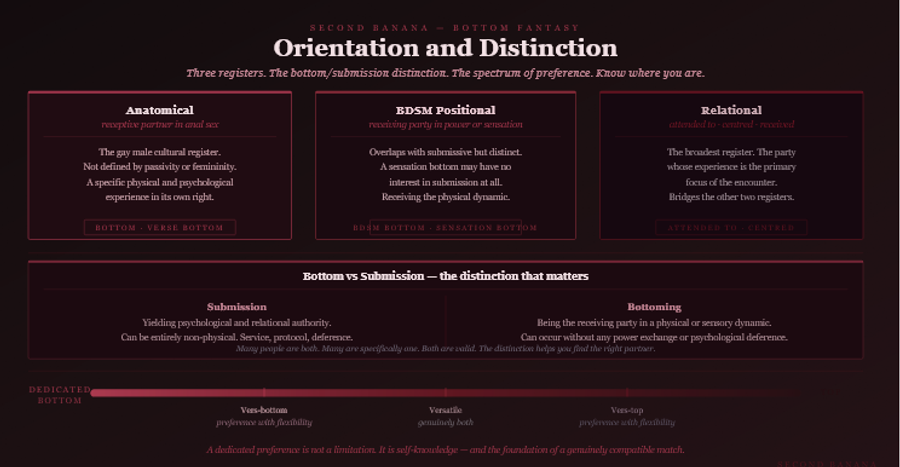
In gay male sexual culture, bottom refers specifically to the receptive partner in anal sex — the person being penetrated rather than the person penetrating. This is the most commonly understood meaning and the one that has generated the most cultural discourse, most of it unhelpful. The bottom in this sense is not defined by passivity, femininity, or submission — those associations are cultural overlays with no basis in the actual experience. Being the receptive partner in anal sex is a specific physical and psychological experience that has nothing intrinsic to do with any of those categories.
In BDSM, bottom refers to the receiving party in a power exchange or sensation dynamic — the person who is restrained, directed, or subjected to sensation rather than the one applying it. This use of the term overlaps significantly with ‘submissive’ but is not identical to it. A bottom in a sensation context may have no interest in submission at all; they are simply the receiving party for a specific physical experience. Conversely, a submissive may not be interested in physical sensation and may experience their submission entirely in psychological and relational terms.
The broader relational sense — the party who is being attended to, whose experience is the primary focus of the encounter, who receives rather than directs — is the most expansive use and the one that bridges the others. In this sense, bottoming describes an orientation toward receptivity that can express itself in many different specific forms depending on the context.
The Psychology of Receptivity
Being the Object of Full Attention
One of the most significant and least discussed aspects of the bottom experience is the specific quality of being the object of a partner’s complete, focused attention. The top in any encounter is, by definition, directing their attention toward the bottom — attending to their responses, calibrating their actions to the bottom’s experience, focused on the bottom’s body and state. This sustained, focused attention is itself a specific erotic experience, distinct from the physical sensation that accompanies it.
Many bottoms describe the experience of being truly attended to — of a partner whose entire focus is on them, who is reading their responses in real time and adjusting accordingly, who is genuinely interested in what they are experiencing — as among the most intimately pleasurable experiences available to them. This is not mere passivity. Being attended to well requires the bottom to be genuinely present, responsive, and communicative — and a bottom who is fully present and genuinely responsive is giving their partner something that makes the top’s experience possible.
Enforced Presence
The bottom position, particularly in contexts involving physical restraint or the explicit giving-over of direction, enforces a quality of present-moment attention that the directing party does not necessarily experience. The bottom cannot be elsewhere, cannot be planning or anticipating or managing. They can only be present to what is happening to them, which for many practitioners is the most genuinely absorbed state they access.
This enforced presence connects directly to the primal play, bondage, and pup play dynamics covered elsewhere in this series — in each case, the mechanism is the same: the removal of the option to direct or manage produces a quality of presence that other states do not. The bottom who is fully in their experience, without the option of directing it, is often more completely present than almost anyone else in the room.
The Relief of Not Directing
For many people whose daily lives involve sustained direction — professional authority, responsibility for others, the continuous management of complex situations — the experience of genuinely not being the directing party is among the most specifically pleasurable experiences available. This is the same mechanism described in the submission and D/s sections of this series, but bottoming connects it to something more specifically physical: it is not merely that someone else is making the decisions, but that someone else is doing something to your body and you are only receiving it.
This relief is not passivity. Many experienced bottoms describe their experience as intensely active — the activity of deep responsiveness, of genuine attention to sensation, of communicating their experience in real time through their body’s responses. What they are not doing is directing. The specific relief is precisely this: all of the cognitive load of direction is absent, and what remains is the full-bodied attention to experience that the direction normally prevents.
The Power of the Bottom
The power of the bottom is real, consistent, and almost entirely unacknowledged in popular sexual culture. Understanding it is essential to understanding why the bottom position is not a lesser or diminished erotic experience but a specific and richly powered one.
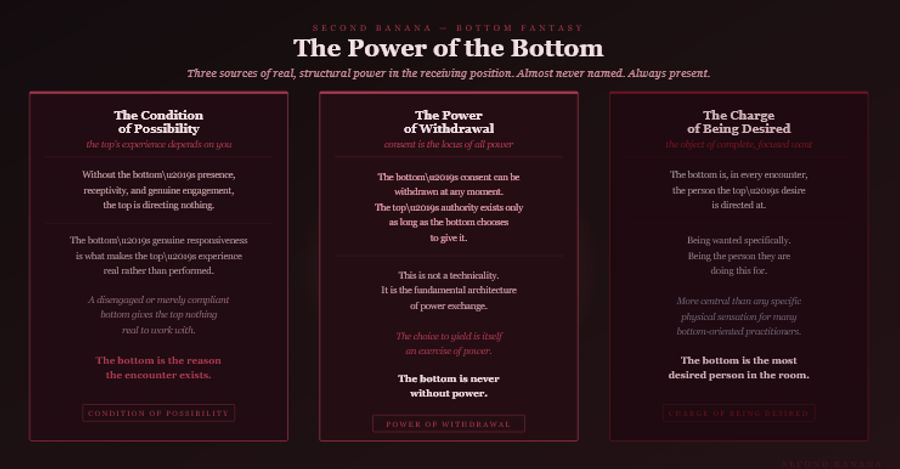
The Condition of Possibility
The top’s experience in any encounter depends entirely on the bottom’s participation and response. Without the bottom’s presence, receptivity, and genuine engagement, the top is directing nothing. The bottom’s responsiveness — genuine, present, embodied — is what makes the top’s experience real rather than performed. A bottom who is genuinely in their experience gives the top something that a disengaged or merely compliant bottom cannot: the actual reality of an encounter that is happening to someone who is truly there.
This means the bottom is the condition on which the top’s experience depends. The power flows both ways. The top has the power of direction; the bottom has the power of being the person whose experience the direction is for, and whose genuine response is the only thing that makes the direction meaningful.
The Power of Withdrawal
The bottom’s consent — which can be withdrawn at any moment through a safeword or simply by choosing not to continue — is the structural foundation of every encounter. The top’s authority exists only as long as the bottom chooses to give it. This is not a technicality. It is the fundamental architecture of power exchange, and it means that the bottom is never without power — they are, in a specific sense, the locus of the power that the top appears to hold.
Experienced BDSM practitioners are well aware of this dynamic. The submissive or bottom who understands their own power — who chooses to yield it rather than having it taken — is in a fundamentally different position from someone who is genuinely without choice. The choice to yield is itself an exercise of power, and many experienced bottoms describe the full, deliberate giving-over of direction as among the most powerful experiences they access.
The Specific Charge of Being Desired
The bottom is, in every encounter, the person that the top’s desire is directed at. This is an erotic experience in its own right — being wanted specifically, being the object of a partner’s focused desire, being the person they are doing this for — that is distinct from and in addition to whatever physical sensation accompanies it. The bottom is simultaneously the most attended-to and the most specifically desired person in the encounter.
Many bottoms describe this quality of being specifically desired and specifically attended to as central to their erotic experience — more central, sometimes, than any specific physical sensation. The fantasy of being wanted so completely that someone takes you with full attention and full desire is, in many accounts, the core of what the bottom fantasy is actually about.
Bottom and Submission: The Distinction
Bottoming and submission are related but not identical, and the distinction matters for people trying to understand and communicate their specific orientation.
Submission in the BDSM sense involves the deliberate yielding of psychological and relational authority to a dominant partner — the giving-over of the right to direct, the choice to be in a position of deference, the specific erotic charge of being under someone’s authority. Submission can be entirely non-physical. A submissive can experience their submission entirely through words, protocols, service, and the psychological dynamic of the relationship without any specific physical acts.
Bottoming, in the BDSM sense, is more specifically about being the receiving party in a physical or sensory dynamic — the person to whom sensation is applied, in whose body the physical dimension of the encounter is located. A bottom in a sensation scene may have no interest in the submission dimension at all; they want the physical experience of being on the receiving end of intensity, but they are not interested in psychological deference or relational authority dynamics.
Many people are both — they are most fulfilled when they are simultaneously submitting and bottoming, when the physical receptivity and the psychological deference reinforce each other. Others are specifically oriented to one but not the other: the service-submissive who is not particularly interested in physical sensation, or the sensation-bottom who switches freely between top and bottom roles but has no interest in power exchange. Both are valid; the distinction helps people locate themselves accurately.
The Shame Architecture
The shame around preferring the bottom position — particularly for men, and most specifically for heterosexual men or men in communities with strong masculinity norms — has a specific structure that is worth naming directly.
The Feminisation Association
In most cultural contexts, receptivity has been coded as feminine and direction as masculine. This coding has nothing to do with the actual experience of either position and everything to do with cultural systems in which the feminine is valued less than the masculine. The association of bottoming with femininity, and femininity with diminishment, produces a specific shame for people who prefer the receiving position — particularly those who do not identify as feminine and feel that their preference is somehow at odds with their gender identity.
This association is false and the shame it produces is not warranted. The bottom position is not feminine. Femininity is not diminishment. And the specific pleasures of receptivity — being attended to, being desired, being present to sensation rather than managing it — are not less than the pleasures of direction. They are different pleasures that the cultural hierarchy has incorrectly ranked.
The Versatility Pressure
In gay male culture specifically, there is a well-documented pressure toward versatility — the expectation that an adult sexual person should be capable of and interested in both positions, and that a preference for one over the other represents some kind of incompleteness or limitation. This pressure produces its own shame: the dedicated bottom who feels they should be more flexible, or who is made to feel that their consistent preference reveals something about them.
Dedicated preferences are not limitations. A person who knows clearly what they want and what they do not want is better positioned to find compatible partners and have genuinely satisfying encounters than someone who is performing flexibility they do not feel. The bottom who is clear about their preference is offering their partners something more valuable than vague availability: they are offering genuine self-knowledge and the specific quality of presence that comes from being exactly where you want to be.
What This Has to Do With Second Banana
The bottom position is one of the most specific erotic orientations in the landscape and one of the most poorly served by general dating platforms. The person who is specifically oriented to bottoming — in any of the senses described above — needs a partner who is specifically and genuinely oriented to the complementary position: someone who wants to be the attending, directing, topping party not as a default or a favour but as their genuine erotic preference.
The Second Banana tag system and post-first model gives bottom-oriented practitioners the ability to represent their orientation clearly before anyone responds. A post can describe the specific form of bottoming that matters — anatomical, sensory, relational, or some combination — what one brings to the position, what one needs in a partner, and what the encounter looks like at its best. The people who respond are already oriented compatibly.
The tag system gives bottom-oriented practitioners specific vocabulary:
- Bottom — the orientation itself
- Verse bottom / soft bottom — for those with a preference but some flexibility
- Dedicated bottom / bottom only — for those with a consistent, clear preference
- BDSM bottom / sensation bottom — for those whose orientation is specifically in the kink context
- Submissive bottom — for those who combine bottoming with the submission dynamic
- Bottom without submission — for those who want the physical receptivity without the power exchange
- Attended to / centred in encounter — for those whose orientation is relational rather than specifically anatomical or kinky
- Experienced bottom / new to bottoming — experience level signal