Dom: The Psychology of Holding Authority Well, and What Skilled Dominance Actually Requires | Second Banana
Dom:
The Psychology of Holding Authority Well, and What Skilled Dominance Actually Requires
The Missing Half of the Conversation
Most writing about BDSM, including most of the genuinely good writing, is built from the submissive’s vantage point. What does it feel like to yield, to be directed, to surrender control — these questions get serious treatment. The dominant’s interior experience, by contrast, tends to get either a how-to manual (commands, technique, safety checklists) or a cultural cliche (effortless command, unwavering confidence, control as its own simple reward). What is missing is a genuine account of what dominance actually feels like from the inside, what it requires, and why people who are good at it describe it the way they do.
This piece is that account. It treats the Dom role as a specific psychological position with its own genuine complexity — not the absence of vulnerability that popular culture often implies, but a different and in some ways more demanding form of it. It covers what dominance actually requires, the real labor involved in doing it well, the different psychological profiles that fall under the single word ‘Dom,’ and the responsibility that holding someone’s trust well genuinely carries.
One clarification before anything else: Dom is not a gendered role. The cultural default image of a Dom skews male, but dominant women, nonbinary dominants, and dominants of every gender occupy this position with the same range and the same psychological depth as their male counterparts. Nothing in this piece assumes a particular gender, and nothing about genuine dominance requires one.
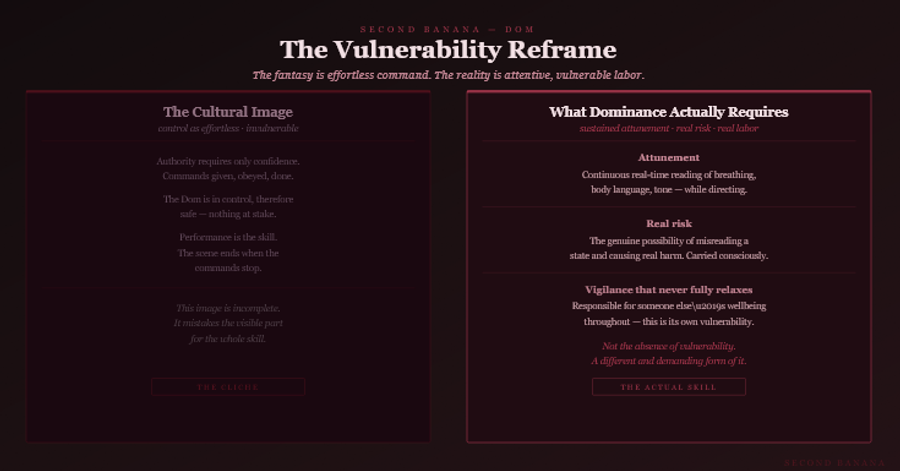
The fantasy is effortless command. The reality is attentive labor. The Dom who is actually good at this is working harder, not less hard, than the version of dominance the culture likes to imagine.
What Dominance Actually Requires
Attunement, Not Just Authority
The defining skill of effective dominance is not the capacity to give commands — that is trivial. The defining skill is sustained, accurate attunement to another person’s state: reading their physical and emotional responses in real time, calibrating intensity and direction against what is actually happening for them rather than against a predetermined script, noticing the difference between resistance that is part of the dynamic and resistance that signals something has gone wrong.
This attunement is cognitively and emotionally demanding in a way that the cultural image of effortless command obscures completely. A skilled Dom is running continuous assessment throughout an encounter — watching breathing, body language, vocal tone, the quality of responses — while simultaneously directing the scene and managing their own state. This is real-time, high-stakes, sustained attention. It is not effortless. It is a skill that takes real development.
The Risk of Getting It Wrong
Popular culture tends to treat the dominant as the party with nothing at stake — in control, therefore safe, therefore invulnerable. This is inaccurate. The Dom carries the real and serious risk of getting it wrong: of misreading a partner’s state, of pushing past a limit that should have been respected, of causing harm — physical or emotional — to someone who has trusted them with real vulnerability. This is not a minor professional hazard. It is a significant emotional weight that skilled Doms carry consciously throughout every encounter.
Many experienced Doms describe a specific and persistent quality of vigilance that accompanies the role — a part of their attention that never fully relaxes into the fantasy of the scene because it is responsible for the actual wellbeing of the person in front of them. This vigilance is a form of vulnerability. It is the vulnerability of being responsible for someone else’s experience and knowing that getting it wrong has real consequences for both people.
The Different Psychological Profiles Within ‘Dom’
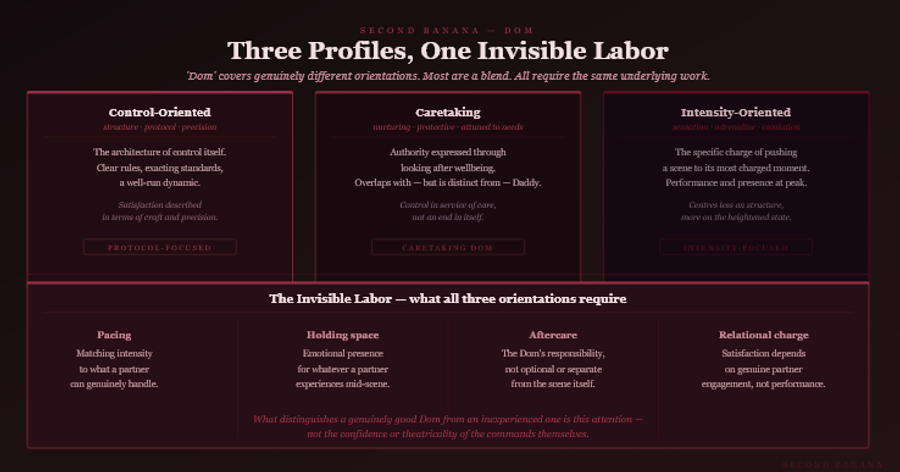
‘Dom’ is a single word covering several genuinely distinct psychological orientations, and conflating them is one of the most common sources of mismatched expectations in D/s matching. Understanding the differences helps practitioners locate their specific orientation and communicate it accurately.
The Control-Oriented Dom
For some Doms, the primary draw is structure, protocol, and the specific satisfaction of precise authority — the pleasure of a well-run dynamic, clear rules, exacting standards consistently held. This orientation centres on the architecture of control itself: the rituals, the protocols, the specific quality of a partner who responds correctly to direction. This is closer to the formal, structured end of BDSM practice, and Doms with this orientation often describe their satisfaction in terms of craft and precision.
The Caretaking Dom
For others, the primary draw is the nurturing and protective function that dominance can serve — overlapping significantly with the daddy dynamic covered elsewhere in this series, but not identical to it. The caretaking Dom’s authority is expressed through looking after a partner’s wellbeing, anticipating their needs, taking pleasure in their partner’s contentment and security within the dynamic. The control here is in service of care rather than an end in itself.
The Intensity-Oriented Dom
For others still, the primary draw is intensity — the specific charge of pushing a scene, of sensation and adrenaline, of the heightened state that intense D/s play produces in both parties. This orientation centres less on structure or care and more on the experience of a scene at its most charged moment — the performance and presence of commanding an intense, escalating dynamic.
Most Doms are not purely one of these three; most combine elements of all three in proportions that are specific to them. But practitioners who can identify which orientation is primary for them are better positioned to communicate what they’re actually looking for, and to find submissive partners whose desires complement their specific style rather than a generic idea of ‘a Dom.’
The Service the Dominant Provides
Skilled dominance is, in a specific sense, a service — not in the formal D/s sense of service submission, but in the sense that a good Dom is doing real work to create an experience for their partner. This work is largely invisible in popular portrayals of dominance, which tend to show only the commands and the control, never the labor that makes those commands trustworthy.
This labor includes: the ongoing assessment described above, the management of pacing and intensity to match what a partner can genuinely handle and wants, the holding of emotional space for whatever a partner experiences during an intense scene, and aftercare — the attentive process of bringing a partner back to a grounded state after an intense experience, which is as much the Dom’s responsibility as the scene itself. A Dom who directs a scene well but disappears immediately afterward, leaving a partner to manage their own comedown, has not completed the job.
Many experienced submissives report that what distinguishes a genuinely good Dom from an inexperienced or self-styled one is precisely this invisible labor — the quality of attention before, during, and after a scene, rather than the confidence or theatricality of the commands themselves. The performance is the least difficult part. The attunement and care are where the real skill lives.
The Dom’s Own Erotic Experience
Beneath the labor and responsibility, dominance is also, for the people drawn to it, a genuine source of erotic and psychological satisfaction in its own right — not merely a service performed for a partner’s benefit. Holding real authority that a partner has genuinely and freely yielded produces a specific quality of presence and fulfilment that many Doms describe as among the most complete experiences available to them.
This satisfaction is relational rather than purely self-directed: it depends on and is produced by the partner’s genuine response, not merely by the exercise of control in the abstract. A Dom directing a partner who is performing compliance without genuine engagement is having a fundamentally different and less satisfying experience than a Dom directing a partner who is genuinely, responsively present. The quality of the submissive’s engagement is what makes the Dom’s authority feel real rather than merely theatrical — a dynamic that connects directly to the ‘power of the bottom’ concept covered elsewhere in this series.
What This Has to Do With Second Banana
Because ‘Dom’ covers genuinely different psychological orientations, generic self-description — simply labelling oneself ‘a Dom’ — provides very little actual information to a potential partner. The post-first model gives Doms the space to be specific: which orientation is primary, what their style of attunement and care looks like, what kind of submissive engagement they are looking to be matched with, and what their approach to aftercare and emotional labor actually involves.
This specificity matters considerably for matching quality. A submissive seeking a caretaking dynamic who matches with a control-oriented Dom focused purely on protocol, or a submissive seeking high-intensity scenes who matches with a Dom whose primary draw is gentle, nurturing structure, will both likely find the dynamic unsatisfying despite both parties genuinely being ‘a Dom’ and ‘a submissive’ on paper.
The Second Banana tag system gives Dom practitioners specific vocabulary:
- Dom / Dominant — the role itself
- Control-oriented — for those whose primary draw is structure and protocol
- Caretaking Dom — for those whose primary draw is nurturing authority
- Intensity-oriented — for those whose primary draw is sensation and escalation
- Experienced / new to topping — honest experience signalling
- Aftercare committed — explicit signal about post-scene attentiveness
- Switch — for those who move between dominant and submissive positions
- Female Dom / nonbinary Dom — explicit signalling against the cultural default assumption