Drag and Attraction: The Psychology of Persona, Performance, and the Specific Magnetism of Drag — Honestly, and With Respect | Second Banana
Drag:
The Psychology of Persona, Performance Magnetism, and Why This Conversation Has to Start With Respect for the Art Form
Art Form First
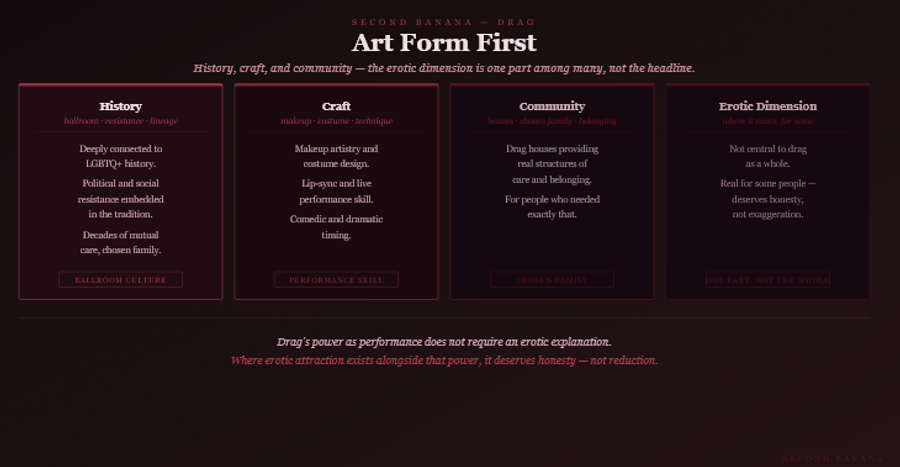
Before anything else: drag is not primarily a kink. Drag is a performance art form and a cultural practice with its own history, craft, technique, and community, the vast majority of which has nothing to do with eroticism at all. Drag emerged from and remains deeply connected to LGBTQ+ history — ballroom culture, the political and social resistance embedded in queer performance traditions, decades of community-building, mutual care, and chosen family that drag houses and drag communities have provided for people who needed exactly that. Reducing drag to a kink category would misrepresent something much larger and much more significant than any erotic dimension within it.
This piece exists because, for some people — both as performers and as audience members — there is a genuine erotic dimension connected to drag, and that dimension deserves honest treatment rather than embarrassed silence or, in the other direction, an exaggeration that reduces drag’s significance to sex appeal. The piece holds both things at once: drag is art, culture, and craft first; and for some people, genuine erotic attraction is also part of how they experience it. Neither truth cancels the other.
What follows covers the psychology of that erotic dimension specifically — the persona, the performance magnetism, what distinguishes attraction to drag from crossdressing kink — written with the respect the broader art form and its history deserve.
Drag’s power as performance does not require an erotic explanation. Where erotic attraction exists alongside that power, it deserves honesty rather than either silence or reduction.
Drag and Crossdressing Kink: A Necessary Distinction
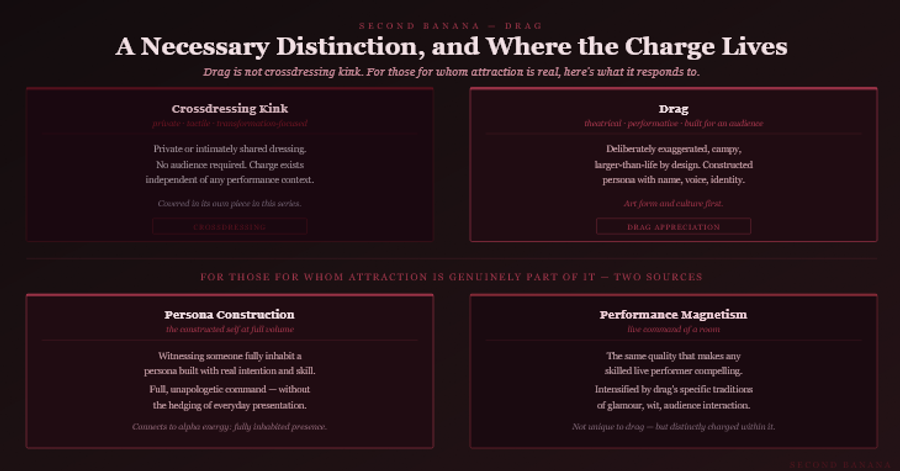
Drag and crossdressing kink are frequently conflated, and the conflation does a disservice to both. Crossdressing kink, covered elsewhere in this series, centres on private or intimately shared gender-nonconforming dressing, often with a strong tactile and transformation-focused erotic charge that exists independently of any audience or performance context.
Drag operates differently. It is fundamentally theatrical and performative — built for an audience, often deliberately exaggerated, campy, and larger-than-life by design rather than aiming for passing or private intimacy. Drag personas are constructed characters with names, voices, and performance identities distinct from the performer’s everyday self. The craft involves makeup artistry, costume design, lip-sync and live performance skill, comedic and dramatic timing, and a relationship to audience and community that crossdressing as private erotic practice simply does not involve, and which is not solely associated with the trans community.
This distinction matters because attraction to drag, where it exists, is attraction to something specifically theatrical and performative — not necessarily the same psychological mechanism as crossdressing-specific erotic charge, even though the two can coexist in the same person or overlap in some individual cases. Conflating them flattens both into something neither fully is.
The Psychology of Persona
The Constructed Self at Full Volume
A drag persona is a deliberately, skillfully constructed identity — amplified, confident, and often built around qualities the performer has chosen to express at a register that ordinary life does not typically allow. This construction is a genuine creative and psychological achievement, and part of what can be magnetic about drag performance is witnessing someone fully inhabit a persona they have built with real intention and skill.
For some audience members, the specific appeal connects to this quality of full, unapologetic self-construction and command — a performer who has built a persona and inhabits it completely, without the hedging or self-management that governs most everyday social presentation. This connects to the alpha energy psychology covered elsewhere in this series: genuine, fully inhabited presence is magnetic, and a skilled drag performer in full command of their persona is a concentrated demonstration of exactly that quality.
Gender as Deliberate Construction
Drag makes the constructed nature of gender presentation visible and deliberate in a way that ordinary gender presentation, which most people experience as simply natural or given, does not. Watching a performer build and inhabit an exaggerated, intentional version of femininity or masculinity — with full awareness of and command over every element of that construction — can be erotically and aesthetically compelling for people who are specifically drawn to gender as performance, artifice, and craft rather than as something taken for granted.
This is a different psychological register from straightforward attraction to femininity or masculinity as such. What is being responded to is the visible skill and intention behind the construction — the same quality that makes any virtuosic performance compelling, applied specifically to the deliberate performance of gender.
Performance Magnetism
Beyond the persona itself, drag performance carries a specific kind of magnetism connected to live performance and command of a room — the same quality that makes any skilled performer compelling, intensified by drag’s specific traditions of glamour, wit, and audience interaction. The performer who can hold a room, deliver a lip-sync with full commitment, work a crowd with confidence and timing, is demonstrating a real skill, and that skill itself is part of what some audience members find specifically attractive.
This performance magnetism is not unique to drag — it is present in any skilled live performance tradition — but drag’s specific combination of glamour, humour, confrontation of gender norms, and direct audience engagement gives it a particular charge that some fans describe as genuinely distinct from attraction to performers in other contexts.
For Performers
For drag performers themselves, the relationship between performance and any erotic dimension of their work varies enormously and should not be assumed. Many performers experience drag primarily as art, craft, comedy, and community — with little or no erotic dimension to their own relationship with their persona. Others do experience their drag persona as connected to a real sense of confidence, command, and embodied power that has its own erotic significance for them personally, separate from how any audience member responds.
What should not be assumed is that a performer’s drag persona is an invitation to erotic attention from audiences or partners, or that finding a performer’s drag persona attractive says anything reliable about how that performer wants to be approached, related to, or desired. Drag performers, like anyone else, set their own terms for how attraction toward them is welcome or unwelcome, and respect for those terms matters considerably more than any framework this piece can offer about the general psychology of drag attraction.
What This Has to Do With Second Banana
For people whose attraction does include a genuine drag-specific dimension — whether to drag performers, to drag aesthetics and persona work, or to incorporating drag-adjacent performance and persona into their own erotic life — naming this specifically and respectfully is difficult on platforms that have no vocabulary for it beyond crude reduction or none at all.
The post-first model allows practitioners to describe this specific attraction with the nuance it deserves — distinguishing it from crossdressing kink where relevant, being clear about what is being sought (attending performances together, persona-inclusive role-play, appreciation of drag culture and community, or something else entirely), and finding partners who share or understand this specific orientation rather than partners who reduce it to something cruder.
The Second Banana tag system gives practitioners specific vocabulary:
- Drag appreciation — general interest in and respect for the art form
- Drag attraction — for those for whom genuine erotic charge is part of the picture
- Persona play — for those interested in performance and persona-inclusive dynamics
- Drag performer — for performers signalling their own practice and its place in their identity
- Ballroom / drag community — for those embedded in or seeking connection within these communities
- Not crossdressing-specific — for those clarifying the distinction explicitly