Feminisation: The Psychology of Directed Transformation, Why the Agency Structure Is the Whole Point, and What the Full Range Actually Covers | Second Banana
Feminisation:
The Psychology of Directed Transformation, Why the Agency Structure Is the Whole Point, and What the Full Range Actually Covers
The Specific Thing That Makes This Its Own Dynamic
Feminisation kink is covered in this series as its own piece, separate from crossdressing, because the defining feature is not the clothing or the presentation itself but who is directing it. Crossdressing, as the earlier piece in this series established, is typically self-initiated — a person’s own relationship to feminine presentation, explored on their own terms. Feminisation in the kink sense is specifically about a dominant directing, prescribing, or imposing feminine elements on a partner. The agency structure is inverted, and that inversion is the psychology.
This distinction is not minor. A person who dresses in women’s lingerie because they find it erotically compelling is having a categorically different experience from a person who is dressed in women’s lingerie because their dominant has required it of them. The garments may be identical. The erotic charge is coming from entirely different sources: from the person’s own relationship to the clothing in the first case, and from the dominant’s authority over their presentation in the second. The feminisation piece is about the second.
The clothing is not the point. Who chose it, and why, and what that choice means about the dynamic between these two people — that is the point.
The Three Distinctions This Piece Needs to Make
Feminisation kink overlaps with three other dynamics in this series — crossdressing, Fem Dom, and the broader degradation and praise kink landscape — and the distinctions between feminisation and each of these are worth stating clearly before the piece moves forward.
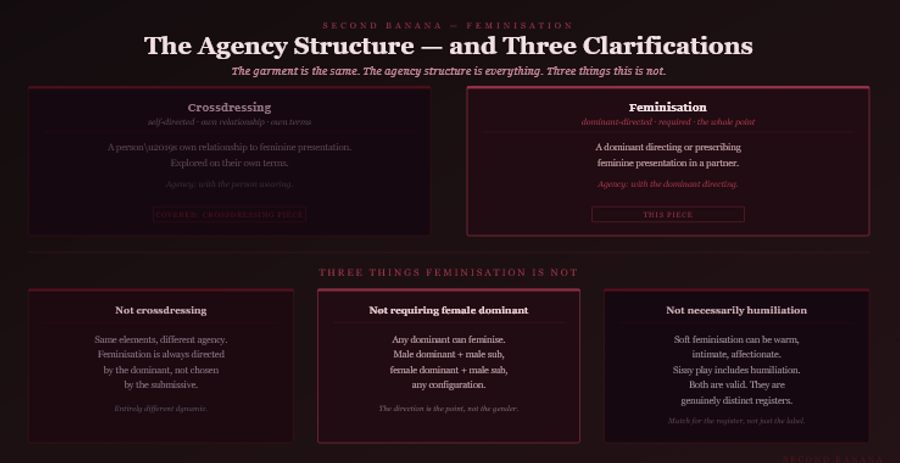
Feminisation is not crossdressing. Crossdressing is self-directed. Feminisation is dominant-directed. The same elements of presentation can be involved, but the agency structure makes them fundamentally different erotic experiences. This piece covers feminisation specifically as a power exchange dynamic in which the dominant’s direction of the submissive’s presentation is the organising feature.
Feminisation does not require a female dominant. The Fem Dom piece covers female dominants whose authority is expressed in various ways. Feminisation specifically is about directing feminine presentation — and this can be practiced by dominants of any gender. A male dominant who feminises a male submissive is practicing feminisation kink. A female dominant who does the same is also practicing feminisation kink. The gender of the dominant is not what defines the dynamic.
Feminisation does not necessarily involve humiliation. This is the most important distinction within the dynamic itself, and it deserves its own section below. But the short version is: some feminisation kink includes a deliberate humiliation or degradation charge; much of it does not. The range is genuine and the distinction matters considerably for matching.
The Psychology of the Person Directing
The feminising dominant’s psychology is the underexamined half of this dynamic, and it deserves serious treatment in its own right.
The Authority Over Presentation
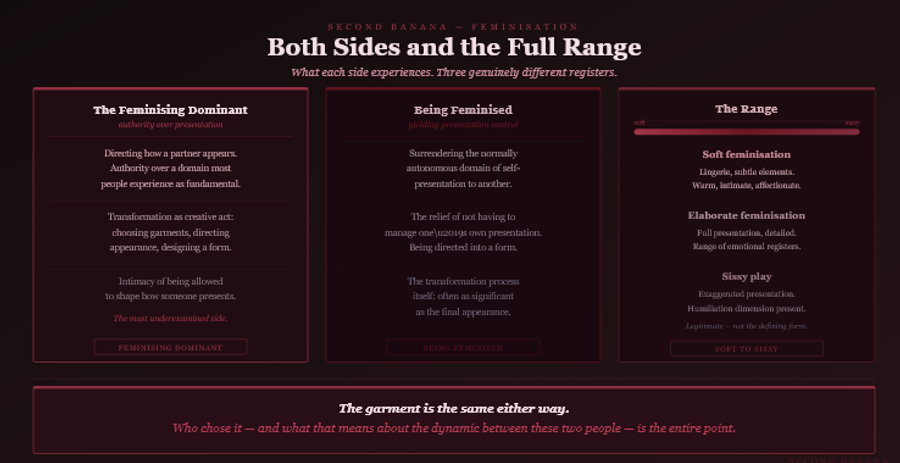
Directing a partner’s gender presentation is a specific and particularly intimate form of authority. This is not authority over acts or position or sensation — it is authority over how someone appears, how they present themselves to the world, which elements of self-expression they inhabit during the dynamic. Many dominants who practice feminisation describe this as among the most personally significant forms of control they exercise, precisely because it reaches into something that most people experience as fundamental to identity and self-presentation.
The pleasure this produces for the feminising dominant varies. Some describe it primarily in terms of transformation — the aesthetic satisfaction of creating a specific appearance in a partner, directing their presentation toward a desired form. Some describe it in terms of intimacy — the specific closeness of being allowed to shape how someone presents, the trust that requires. Some describe it in terms of authority pure and simple — the exercise of control over a domain that carries particular weight.
The Creative and Aesthetic Dimension
Many dominants who practise feminisation describe a specifically creative and aesthetic dimension to the practice: choosing specific garments, directing makeup and hair, designing an overall presentation. This aesthetic investment — the pleasure of having a specific vision of how a partner should present and directing them toward it — is distinct from the authority dimension but often coexists with it. Some practitioners describe feminisation as one of the most genuinely creative expressions available to them within their erotic practice.
The Psychology of the Person Being Feminised
Yielding Presentation Control
For the person being feminised, the specific charge typically centres on surrendering control over their own self-presentation — having this normally autonomous domain managed by someone else’s direction. This is a specific and intimate form of submission: not yielding authority in general, but yielding the authority to decide how one appears. Many practitioners describe this as producing a particular quality of completeness to the submission — something that feels more personally reaching than yielding in other domains.
The experience can involve a specific relief — the relief of not having to manage one’s own presentation, of it being taken care of, of being directed into a specific form without having to choose it. This connects to the psychology of submission more broadly — the freedom of having a clear purpose and clear direction — but applied to the domain of appearance, which carries its own specific weight.
The Transformation Itself
Many people who enjoy being feminised describe a specific charge in the process of transformation itself — being dressed, being made up, being assembled into a different presentation. This transformation process, directed and managed by the dominant, is often described as among the most erotically significant parts of a feminisation dynamic — as significant as, or more significant than, the final appearance.
This connects to the broader psychology of transformation kink: the specific charge of becoming something different, of the self being reshaped by another’s hands and direction. In feminisation, this transformation is specifically toward feminine presentation, but the transformation psychology itself is part of what makes it compelling independent of any specific relationship to femininity.
The Range: Soft Feminisation to Sissy Play
Soft Feminisation
At one end of the range, feminisation is gentle, aesthetic, and often intimate in register: lingerie selected by the dominant, subtle makeup, specific clothing choices. The feminisation here is present but not exaggerated, and the emotional register is often warm and affectionate rather than humiliating. Many practitioners describe soft feminisation as a form of intimate attention — a dominant taking care with and interest in the submissive’s appearance in a way that carries real tenderness alongside the power exchange.
Aesthetic and Elaborate Feminisation
Further along the spectrum, feminisation becomes more elaborate: full feminine presentation, detailed attention to appearance, longer scenes or sustained dynamics. This is the territory where feminisation most overlaps with the crossdressing kink domain, except that the directing is always the dominant’s rather than the submissive’s own choice. The register here can range from warm and celebratory to more formal and authoritative.
Sissy Play
At the end of the spectrum that explicitly incorporates humiliation, sissy play involves exaggerated, often deliberately absurd or caricatured feminine presentation combined with a humiliation or degradation dynamic. The ‘sissy’ framing is itself part of the dynamic — the term names a specific combination of feminine presentation and the submissive’s role in ways that carry a particular charge for practitioners who are specifically drawn to this register.
Sissy play deserves the same honest treatment as other humiliation-inflected kinks in this series: for practitioners who are specifically drawn to this dynamic, the humiliation dimension is not incidental but central, and it is a legitimate and consensual erotic orientation. It requires the same explicit consent architecture and aftercare attentiveness as other degradation-adjacent kinks. And crucially, it does not describe all feminisation kink or even most of it — naming it clearly as one point on the range, rather than treating it as the defining form, serves practitioners at all points better.
Feminisation and Gender Identity: The Same Careful Distinction
As the crossdressing piece established in this series, feminisation kink — being directed into feminine presentation as an erotic dynamic — does not imply anything about the submissive’s gender identity. Many people who enjoy being feminised are cisgender and have no interest in feminine presentation outside the erotic context. Some have a more complex relationship to gender and find feminisation connects to genuine gender exploration. Some are transgender and find specific erotic charge in the feminisation dynamic that is separate from but not unrelated to their gender identity.
All of these are valid. The piece does not assume any of them and does not pathologise any of them. The principle established in our crossdressing piece applies here directly: what someone wears or is directed to wear in an erotic context says nothing definitive about their gender identity, and assuming otherwise is both inaccurate and unhelpful.
What This Has to Do With Second Banana
Feminisation kink’s specific matching requirements — finding a dominant who is genuinely drawn to this specific expression of authority, or finding a submissive who specifically wants to yield this particular domain — make the post-first model particularly valuable. The range within feminisation also means that ‘feminisation’ as a label communicates very little about which specific dynamic someone is looking for without additional specificity.
A post that describes the register — soft and intimate, elaborate and aesthetic, sissy and humiliation-inflected, or somewhere specific between these — finds the right match rather than the nearest approximation.
The Second Banana tag system gives feminisation practitioners specific vocabulary:
- Feminisation — the dynamic itself
- Soft feminisation — gentle, intimate, aesthetic register
- Sissy play — for those drawn to the exaggerated humiliation variant
- Feminising dominant — for those who want to direct the transformation
- Being feminised — for submissives seeking this specific dynamic
- Any gender welcome — for dominants open to feminising submissives of any gender
- Aesthetic focus — for those whose primary draw is the creative and visual dimension
- No humiliation — explicit signal for those who want the transformation without degradation