Fisting: The Psychology of Fullness, Trust, and What Makes This Act Genuinely Unlike Any Other | Second Banana
Fisting:
The Psychology of Fullness, Trust, and What Makes This Act Genuinely Unlike Any Other
Not More. Different.
Fisting — the insertion of a hand into the vagina or rectum — is an act that practitioners consistently describe in terms that resist reduction to ‘more’ of anything else. It is not simply more intense penetration. It is not more of what a toy or a penis provides. The specific fullness, the specific quality of presence, the specific psychological weight of this degree of physical entry produce an experience that many practitioners locate in a category of its own — and the research on why people find it compelling, combined with the physiology of what is actually happening, supports this as more than personal perception.
This piece treats fisting with the same anatomical and psychological seriousness that the CBT and electro pieces in this series gave to their subjects: a direct, knowledgeable account of what is physiologically occurring, why the psychological appeal is genuine and specific, the important differences between vaginal and anal fisting, and what safe, patient, skilled practice actually requires. The safety dimension is not segregated into a disclaimer section because in fisting practice, the preparation and communication are not preliminary to the experience — they are part of it.
The preparation is not the obstacle to the experience. It is the beginning of it. The trust established in the approach is the same trust that makes the arrival possible.
The Physiology: What Is Actually Happening
Sphincter Muscles and Accommodation
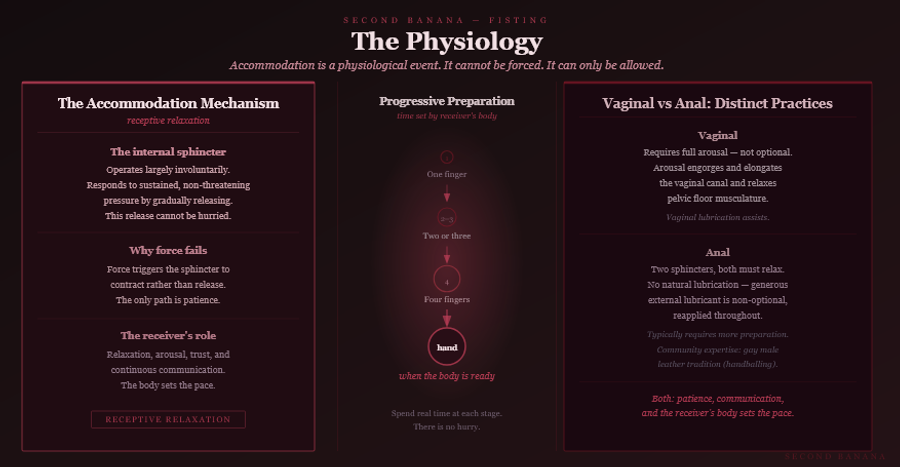
Both anal and vaginal fisting involve the progressive relaxation and accommodation of sphincter or muscular ring structures that are under involuntary as well as voluntary control. The anal sphincter complex consists of two distinct muscles: the external sphincter, which is under voluntary control, and the internal sphincter, which operates largely involuntarily and responds to sustained pressure by gradually relaxing — a phenomenon called receptive relaxation. This involuntary relaxation cannot be forced; it occurs when the internal sphincter perceives sustained, non-threatening pressure and responds by releasing.
The vaginal opening, while not a sphincter in the strict anatomical sense, similarly involves the relaxation of the pubococcygeus and surrounding pelvic floor musculature. In a fully aroused state, with appropriate progressive preparation, these muscles are capable of considerably more accommodation than is often assumed — the same muscular architecture that accommodates childbirth is capable of progressive, consensual stretching in an erotic context.
The key word in both cases is progressive. Neither anal nor vaginal accommodation of a hand occurs through force or speed. It occurs through sustained, patient, graduated preparation — fingers added one at a time over a period of time that varies by individual, by session, and by experience level. The internal structures accommodate at their own pace and on their own terms, and attempts to accelerate this process by force produce tissue damage rather than accommodation.
What the Receiver Feels
The sensation of fisting — when approached correctly — is genuinely unlike other penetration. The specific fullness of a hand, particularly after insertion of the widest point at the knuckles, produces a quality of complete internal presence that practitioners consistently distinguish from dildo or penile penetration: more total, more encompassing, more internally present. At the point where the hand is fully inside, a gentle fist or cupped hand presses against multiple internal structures simultaneously in a way that no other form of penetration replicates.
The pressure against internal structures — the anterior vaginal wall and cervix in vaginal fisting, the rectum and sigmoid colon junction in anal fisting — produces sensations that many receivers describe as deeply pleasurable in a specific, almost diffuse way: less local than clitoral or penile stimulation, more pervasive, sometimes described as feeling the pleasure throughout the abdomen or pelvis rather than in one specific site. This diffuse, encompassing quality is part of what produces the altered state that experienced fisting practitioners frequently describe.
Vaginal and Anal Fisting: Distinct Practices
Vaginal Fisting
Vaginal fisting is typically approached with the hand in a cone or taper position — fingers together, thumb tucked in — and inserted progressively during high arousal, when the vaginal canal is fully engorged and elongated and the pelvic floor musculature is most relaxed. Full arousal is not optional for vaginal fisting; it is the physiological precondition for the accommodation that makes the practice possible without discomfort or injury.
The specific anatomy of individual practitioners varies considerably — vaginal depth, pelvic floor tone, and the history of penetrative experience all affect how accessible vaginal fisting is for a given person at a given time. Many practitioners find that fisting becomes more accessible with experience as they develop better ability to consciously relax pelvic floor musculature and as their nervous system’s threshold for this degree of input adjusts over time. Others find that it is accessible from the beginning; others never pursue it. None of these is more or less valid than the others.
Anal Fisting
Anal fisting — sometimes called handballing in gay male communities, where it has a particularly significant cultural history — involves the same principle of progressive accommodation through patient graduated preparation, with anatomy-specific considerations. The rectum curves and the anal canal has two distinct sphincters, both of which need to relax progressively. Anal fisting typically requires more extensive preparation than vaginal fisting for most practitioners, and significant lubrication — more than might be expected — is essential throughout.
The gay male leather and kink community has developed a substantial body of practical knowledge around anal fisting over decades of practice and community education — this community context is worth acknowledging because it represents a genuine tradition of embodied expertise and mutual care that has been refined through real experience rather than abstracted theory.
Unlike vaginal fisting, anal fisting is not facilitated by arousal-produced lubrication — the rectum produces no natural lubrication in the way the vagina does during arousal — making generous, appropriate lubricant application throughout the session a non-optional safety requirement rather than an enhancement.
The Psychology of Fisting
Fullness and Presence
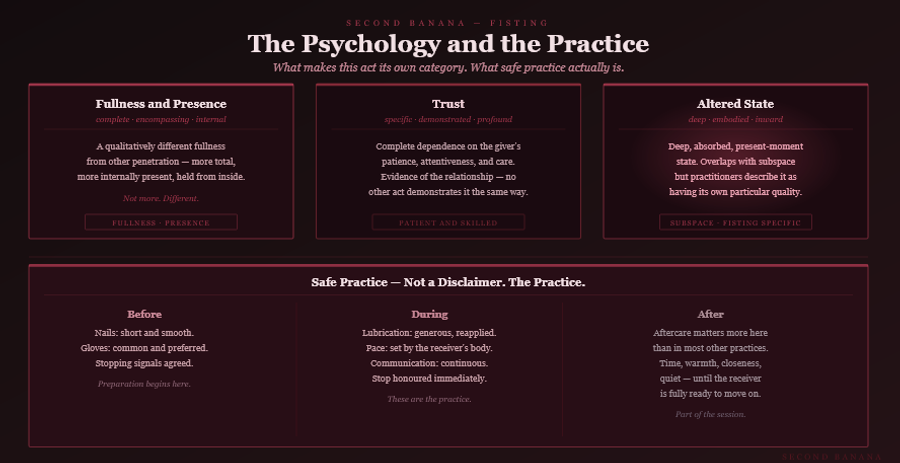
The specific psychological appeal of fisting for receivers most commonly centres on fullness — a quality of complete, encompassing internal presence that other forms of penetration approach but do not replicate. This is not simply a preference for more size; practitioners specifically describe fisting’s fullness as qualitatively different from size in conventional penetration, more total and more internally present. The hand’s specific shape, and the specific way it presses against internal structures from multiple directions simultaneously, produces a quality of being held from the inside that many receivers find uniquely significant.
The Trust Dimension
Fisting requires a degree of trust in the giving partner that exceeds most other physical acts. The receiver is entirely dependent on the giver’s patience, their attentiveness to feedback, their willingness to stop or slow in response to any signal, and their genuine skill and care. This dependency produces a specific quality of trust that many fisting practitioners describe as among the most significant dimensions of the practice — not just trusting someone with one’s body in general, but trusting them with this specific degree of physical entry, this specific level of internal access, this specific vulnerability.
For many practitioners, the trust dimension of fisting is inseparable from its erotic significance — the practice is specifically meaningful partly because of the depth of trust it requires and expresses. A fisting session that goes well is not just physically significant; it is evidence of something about the relationship between the people involved that other activities do not demonstrate in the same specific way.
The Altered State
Experienced fisting practitioners, particularly on the receiving end of extended sessions, frequently describe reaching a specific altered state that has real overlap with the subspace described elsewhere in this series but is also described as having its own particular quality — a deep, embodied, inward-turned state produced by sustained intense internal stimulation. The combination of the physical sensation, the trust required, and the specific physiology of internal pressure on multiple structures simultaneously can produce a profoundly absorbed, present-moment state that many receivers describe as among the most significant altered states they access through any erotic practice.
Safe Practice: Woven In, Not Added On
The following are not precautions layered onto the practice from outside. They are the practice.
- Nails must be short, smooth, and free of sharp edges throughout — not just short, but smooth. A nail file is part of fisting preparation, not an optional extra.
- Gloves are common in fisting practice — both for hygiene and because they eliminate concerns about nails and provide a smoother surface. Many experienced fisting practitioners prefer them specifically.
- Lubrication must be generous, reapplied throughout, and appropriate to the context — water-based or silicone-based depending on whether toys or latex gloves are involved.
- Preparation is progressive and cannot be rushed — begin with one finger, add gradually, spend real time at each stage. The timeline is set by the receiver’s body, not by any external agenda.
- Communication throughout is not optional — the receiver should be providing continuous verbal or agreed non-verbal feedback, and the giver should be asking and attending rather than inferring.
- Stopping signals must be established clearly before beginning and must be respected immediately and without question. ‘Slow’ and ‘stop’ are different instructions and both must be honoured precisely.
- Aftercare matters more than in many other practices because of the specific physical and psychological intensity of the experience. The receiver may need time, warmth, physical closeness, and quiet before they are ready to move on from the experience.
Tissue damage from inadequate preparation, insufficient lubrication, or inadequate communication is a real and avoidable risk. The practices above are not cautious add-ons to an otherwise simple act; they are what distinguishes fisting practice from an act that causes harm.
What This Has to Do With Second Banana
Fisting has specific matching requirements that make the post-first model particularly valuable. The giving partner needs real skill, patience, and genuine attentiveness — not just willingness. The receiving partner needs to be specific about their experience level, their preparation requirements, and what they need from a giving partner in terms of pace and communication. The mismatch between a receiver expecting careful, experienced progression and a giver who is enthusiastic but inexperienced is not merely disappointing — it can cause real harm.
Being specific in a post about what one brings and what one needs removes this risk at the matching stage rather than leaving it for discovery mid-session.
The Second Banana tag system gives fisting practitioners specific vocabulary:
- Fisting — the practice itself
- Vaginal fisting / anal fisting — for those who want to specify
- Handballing — the gay male community’s traditional term for anal fisting
- Fisting — giving — for those who want to be the giver
- Fisting — receiving — for those who want to receive
- Experienced fisting — for those with established practice
- Patient and skilled — explicit signal about what a giving partner must bring
- New to fisting — honest experience signalling