Food Play: The Psychology of Sensory Pleasure, Intimacy, and Why WAM Is Its Own Distinct Orientation | Second Banana
Food Play:
The Psychology of Sensory Pleasure, the Intimacy of Being Fed, and Why Wet and Messy Play Is Its Own Specific Territory
More Than Whipped Cream
Food play — the incorporation of food into erotic encounters — is one of the kinks most reduced to a single image: whipped cream applied to a body in a way that parodies its own seductiveness. The image is not invented — this is a real form of food play — but it has become the only image most people have for the practice, which obscures the genuinely wide range of what food play actually involves and why different practitioners are drawn to genuinely different things within it.
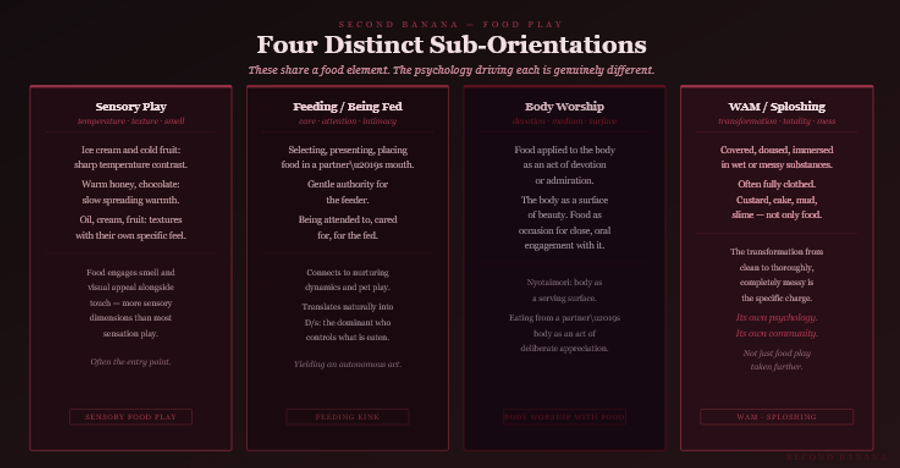
The range runs from precise sensory play with temperature and texture, through the specific intimacy of feeding and being fed, through body worship that uses food as the medium, through to wet and messy play — a distinct orientation with its own specific psychology and its own community that deserves its own treatment rather than being folded into general food play as a messier variant of the same thing. This piece covers the range properly, including the practical dimensions that food play involves in ways that most other kinks do not, and how the tag system gives practitioners specific vocabulary for the specific version of this practice they are actually drawn to.
The body as a surface for temperature, texture, and taste. The specific intimacy of someone feeding you, or being fed by you. The specific charge of being entirely covered in something wet and messy. These are three genuinely different erotic experiences that happen to share a food element.
The Sensory Dimension
Temperature Play With Food
Food offers some of the most accessible and most varied temperature contrasts available in erotic sensory play. Ice cream, frozen fruit, and ice on warm skin produce the same sharp temperature contrast that ice play does generally — but with additional texture and, for some practitioners, the specific charge of the food’s associations of pleasure and indulgence. Warm chocolate, honey, caramel, or warm oil produce a slow, spreading warmth that is distinct from the sharp localised heat of wax play while sharing the same general pleasure of heat against skin.
Temperature food play is often the entry point for people who are drawn to sensation play more generally but want something more accessible than formal wax or ice play. The foods are everyday objects with none of the equipment dimension of other forms of sensation play, and the sensations they produce are intense and specific without requiring particular skill or knowledge to engage with safely. For many practitioners this remains the primary draw throughout their food play practice; for others it opens a door to exploring sensory play more broadly.
Texture and the Specific Sensuousness of Food
Beyond temperature, food offers a specific range of textures against skin that have their own erotic charge independent of temperature effects. The slip of oil or honey, the light pressure of cream, the specific tactile quality of fruit against skin — these have sensory properties that some practitioners find specifically erotically compelling in ways that connect to the broader tactile kink territory without being identical to it.
The specific sensoriousness of food — the way it appeals to multiple senses simultaneously, including smell and sometimes taste — distinguishes it from most other forms of sensation play, which are primarily tactile. Food brings smell, visual appeal, and the specific associations that particular foods carry into a sensory experience that is more multidimensional than most other forms of erotic sensation.
Oral Dimensions
The oral dimension of food play — using the mouth to remove food from a partner’s body, or using food in ways that involve oral contact — adds an intimacy and a specific sensory quality that purely tactile food play does not have. The combination of the food’s flavour and texture with the warm pressure of a mouth, applied to the body in ways that are deliberately erotic, is a specific sensory experience that many food play practitioners describe as the most specifically pleasurable dimension of the practice.
Feeding and Being Fed
A distinct dimension of food play is the specific intimacy of feeding and being fed — an erotic practice that is less about sensation and more about care, attention, and a particular quality of intimate relationship between the feeder and the fed.
The Care Dimension
Feeding a partner — selecting what they eat, presenting it, placing it in their mouth — is an act of care and attentiveness that carries a specific intimacy. The feeder is in a position of gentle authority, making choices for the person they’re feeding, directing their experience in a relatively mild but nonetheless specific way. Many practitioners who are drawn to feeding describe it as one of the most intimate and personally meaningful expressions of care available in an erotic context.
For the person being fed, the experience of having food selected, presented, and placed in one’s mouth by a partner carries a specific quality of being attended to and cared for that connects to the nurturing dimension of the Daddy dynamic and to the general psychology of yielding care to another. Being fed is a specific, pleasurable surrender of a normally autonomous act to someone whose care one trusts, and the specific pleasure of this is genuine and distinct from other forms of submission or care.
Connecting to D/s Dynamics
Feeding and being fed translates naturally into explicit D/s dynamics: the dominant who controls what the submissive eats, when they eat, and how they receive food is exercising a very specific and intimate form of authority. Pet play dynamics sometimes incorporate feeding as an expression of the animal role — being fed from a bowl, or by hand, as part of the specific dynamic of the role. These connections are real and practitioners who are drawn to food play within a D/s context are typically drawn to the intimacy and the authority dimension as much as to the food itself.
Body Worship With Food
Food used as a medium for body worship — applying food to a partner’s body as part of expressing devotion, desire, or admiration — is a distinct form of food play that combines the sensory dimension with the relational and devotional psychology of body worship more broadly.
The specific practice of eating food from a partner’s body — sometimes called body sushi or nyotaimori in Japanese culture, where the body is used as a serving surface — has its own distinct aesthetic and psychological charge: the partner’s body as a surface of beauty and intimacy, food as an occasion for close, attentive engagement with that surface. This is a practice that sits at the intersection of sensuality, body appreciation, and the specific intimacy of very close, mouth-to-body contact conducted in an unhurried and deliberately appreciative way.
Wet and Messy Play: Its Own Territory
Wet and messy play — known as WAM in its community, or sometimes sploshing — is a distinct orientation that overlaps with food play but has its own specific psychology that deserves separate treatment rather than being treated as simply food play taken further.
What WAM Actually Is
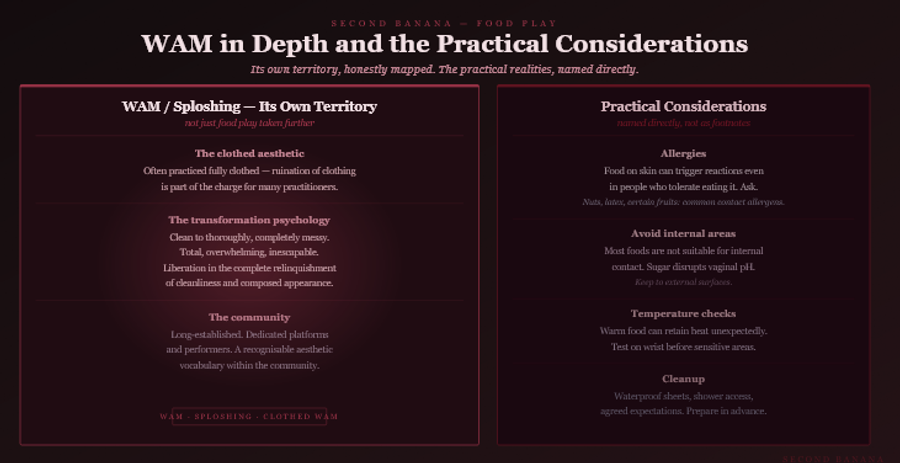
WAM involves the specific erotic charge of being covered, doused, or immersed in wet or messy substances — frequently but not exclusively food-based. The substances involved range from cake and pie to custard, baked beans, mud, slime, and various other wet or semi-solid materials. Crucially, WAM is often practiced fully clothed rather than on bare skin, which is one of the features that most clearly distinguishes it from general food play: the specific charge for many WAM practitioners includes the ruination of clothing, the transformation of a normally clean and composed appearance into a thoroughly messy one.
The Psychology of Transformation and Mess
The specific erotic charge of WAM centres on transformation — the specific pleasure of a clean, composed person becoming thoroughly, completely, often absurdly covered in mess. This transformation dynamic connects to the broader transformation kink psychology covered in other pieces in this series, but with a specific quality of physical totality: the mess is complete and overwhelming rather than partial, covering the entire person rather than being applied to a specific body area.
For many WAM practitioners, the transformation quality is primary — the charge is in watching or experiencing the transformation from clean to utterly messy, not specifically in the food or substance itself. Many WAM practitioners describe a specific quality of liberation in the complete relinquishment of cleanliness and composed appearance that WAM produces: a specific freedom in being entirely, thoroughly, inescapably covered in something, with no possibility of maintaining the ordinary standards of presentation that govern most social situations.
WAM and Its Community
WAM has a long-established online community and a specific culture around the practice, with dedicated platforms, performers, and an aesthetic vocabulary that is recognisable within the community. The WAM community’s specific culture — including the clothed-and-messy aesthetic that many practitioners find more compelling than unclothed food play — is part of what makes WAM its own specific territory rather than simply a subset of general food or sensation play. Practitioners who are drawn to WAM specifically are often drawn to the whole aesthetic and the community as much as to the specific physical experience.
Practical Considerations — Worth Naming Directly
Food play is one of the kinks in this series with real practical dimensions that are worth naming matter-of-factly rather than treating as footnotes.
- Allergies and intolerances: food applied to skin can trigger allergic reactions even in people who would not react to consuming the same food. Nut-based foods, latex, and certain fruits are common contact allergens. Asking about food allergies before food play is not overcautious — it is basic care.
- Avoiding internal areas: most foods are not suitable for internal contact, even foods that are safe to eat. Sugar-based substances can disrupt vaginal pH and create conditions for infection. Food play is generally kept to external body surfaces.
- Cleanup: food play is messier than most erotic activities and benefits from preparation — waterproof sheets, easy access to a shower, and advance agreement about who does what cleanup. The mess is part of the practice for some people; for others it is a cost worth managing with preparation.
- Temperature checks: foods that are warm should be tested on the wrist before application to more sensitive areas. The erotic context can reduce accurate temperature perception and food can retain heat unexpectedly.
What This Has to Do With Second Banana
Food play’s range — from delicate temperature play through feeding intimacy through body worship through WAM — means that two practitioners who both identify as into food play may have almost nothing in common in terms of what they actually want. The same specificity imperative that applies across this series applies here: the tag names the broad territory, but what makes a match genuinely good is specificity about which sub-orientation is primary.
The Second Banana tag system gives food play practitioners specific vocabulary:
- Food play — the broad orientation
- Sensory food play — for temperature and texture primary orientation
- Feeding kink — for those drawn to the feeding/being fed dynamic
- Body worship with food — for those using food as a devotional medium
- WAM / sploshing — for wet and messy play specifically
- Clothed WAM — for the specific clothed-and-messy aesthetic
- Food and D/s — for those incorporating food play into power exchange
- No internal contact — useful practical signal for partners