Foot Worship: The Psychology of the Most Common Fetish | Second Banana
Foot Worship:
The Psychology of the Most Common Fetish, and What Both Sides Actually Experience
The Most Documented Fetish in the Literature
If researchers studying human sexuality had to identify the single most consistently documented specific fetish across the history of the literature, the answer would be the same every time: feet. Foot fetishism — podophilia — appears across cultures, across historical periods, across genders and sexual orientations, and in every large-scale survey of sexual interests that has ever been conducted. It is not a modern phenomenon or a Western one. It is one of the most universal expressions of the human capacity to locate erotic charge in something that mainstream sexual culture treats as non-sexual.
Despite — or perhaps because of — this prevalence, foot fetishism is also among the most reliably mocked sexual interests in popular culture. The foot fetish is a punchline in a way that other fetishes are not, which is worth examining because the mockery serves a specific social function: it allows people to simultaneously acknowledge the widespread existence of the interest and maintain their distance from it. The joke is the mechanism by which prevalence is recognised without being taken seriously.
This piece takes it seriously. The psychology of why feet specifically carry such consistent erotic charge. The neuroscience that offers one of the more convincing accounts of a specific fetish’s origin. The practice of foot worship as a D/s dynamic and what both sides experience. The specific forms foot worship takes. And how Second Banana’s tag system connects people who share this orientation without the performance of shame that general platforms require.
The most common fetish in the research literature is also one of the most reliably mocked. The mockery and the prevalence are not in tension. They are the same social mechanism working in opposite directions.
Why Feet: The Neuroscience
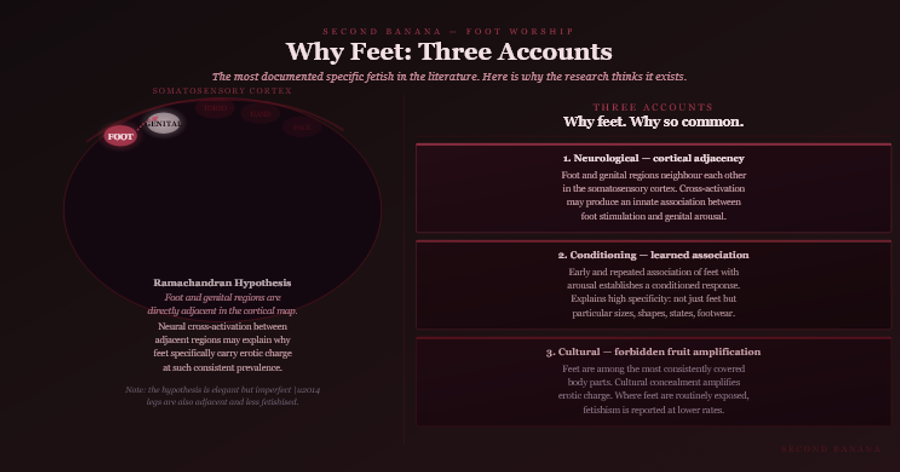
The Ramachandran Hypothesis
The most widely cited scientific account of foot fetishism comes from neuroscientist V.S. Ramachandran, whose work on phantom limbs and cortical remapping led him to a specific and striking observation about the brain’s somatosensory cortex — the region that maps sensory experience from the body’s surface.
In the somatosensory cortex, different body regions are represented in adjacent areas, and the mapping is not proportional to body size but to the density and sensitivity of the nerve supply. The genitals and the feet are represented in directly adjacent cortical regions — the foot region immediately neighbouring the genital region in the cortical map. Ramachandran’s hypothesis is that this adjacency creates the conditions for cross-activation: neural activity in the foot region spilling over into the adjacent genital region, or vice versa, producing an association between foot stimulation and genital arousal that is, in some individuals, sufficient to establish a fetishistic connection.
This is not the only account of foot fetishism ’s prevalence, and it has been critiqued by researchers who note that the cortical adjacency hypothesis would predict equivalent prevalence for the leg and shin, which do not show the same fetishistic distribution. But it remains the most elegant single-mechanism explanation for why feet specifically — rather than other body parts that are culturally taboo or not typically eroticised — show such consistent fetishistic prevalence across populations and cultures.
Conditioning and Early Association
A complementary account — not competing with Ramachandran’s neurological hypothesis but operating alongside it — is classical conditioning. Sexual arousal is a powerful unconditional stimulus, and anything that is repeatedly and consistently associated with its occurrence can become a conditioned stimulus for arousal over time. For people who develop foot fetishes, an early association between foot contact or visual exposure and arousal — whether through direct experience, through the proximity of feet in childhood environments where arousal was simultaneously present, or through other individual pathways — can establish the association that becomes a consistent erotic orientation.
This conditioning account is consistent with why foot fetishes are often highly specific: not just feet in general but specific aspects of feet — particular sizes, shapes, states of care, presence or absence of nail polish, bare versus stockinged, the soles versus the toes versus the arch. These specificities are more consistent with a conditioned association to particular stimulus features than with a purely neurological account, and they suggest that individual foot fetishism is shaped by the specific details of early erotic experience as much as by general neurological architecture.
Cultural Amplification
The third contributing factor is cultural. Feet are among the most consistently covered body parts in most cultures — shoes are worn in almost all public contexts, foot exposure is relatively rare in formal or professional settings, and the sight of bare feet carries a specific intimacy charge in cultures where they are normally covered. This cultural framing creates the conditions for the ‘forbidden fruit’ mechanism that amplifies many fetishes: the erotic charge of the taboo, the specific pleasure of access to something normally concealed.
In cultures where feet are more routinely exposed — some South and Southeast Asian contexts, for instance — foot fetishism is reported at lower rates. This does not prove the cultural account — reporting rates are affected by many factors — but it is consistent with the hypothesis that cultural concealment amplifies the erotic charge of foot exposure in the same way that any taboo amplifies erotic charge.
What Foot Worship Actually Is
Foot worship describes the erotic practice of attending to a partner’s feet with focused care and sensual attention: kissing, licking, massaging, holding, smelling, or otherwise engaging with the feet as the primary object of erotic focus. The ‘worship’ framing is not accidental — it captures something specific about the quality of attention that distinguishes foot worship from merely finding feet attractive. The foot worshipper is not a passive admirer. They are an active, devoted attendant, and the devotion itself is part of the erotic content.
The practice exists across a wide spectrum of intensity and context. At one end: a partner who finds feet genuinely appealing incorporating foot massage and kissing into otherwise conventional sexual encounters. At the other: an explicitly D/s dynamic in which foot worship is a structured expression of the submissive’s deference to the dominant, with specific protocols around how and when access to the feet is granted, what acts of worship are expected, and what the dominant’s posture and attitude during the worship communicates about the power dynamic between them.
The Forms Foot Worship Takes
Foot worship encompasses several distinct forms of engagement that practitioners often have specific orientations toward. Visual appreciation — finding the sight of a partner’s feet specifically arousing, with particular attention to shape, state of care, footwear, or the specific context in which they are revealed. Physical worship — kissing, licking, massaging, holding the feet with focused attention. Olfactory engagement — the scent of feet, particularly after they have been enclosed in shoes, which carries its own specific erotic charge for some practitioners that is distinct from the visual and tactile dimensions. Footwear — the erotic charge of specific shoe types, particularly high heels, which elongate and frame the foot in specific ways and carry their own extensive cultural and erotic history.
These different forms often coexist in the same practitioner, but they can also be quite separate: someone who finds the sight of bare feet intensely arousing may have no particular interest in olfactory engagement, and vice versa. Understanding which forms are central to one’s own orientation is part of the self-knowledge that enables productive matching with partners who can engage with the specific dimension that matters.
The D/s Dimension: What Each Side Experiences
The Worshipper
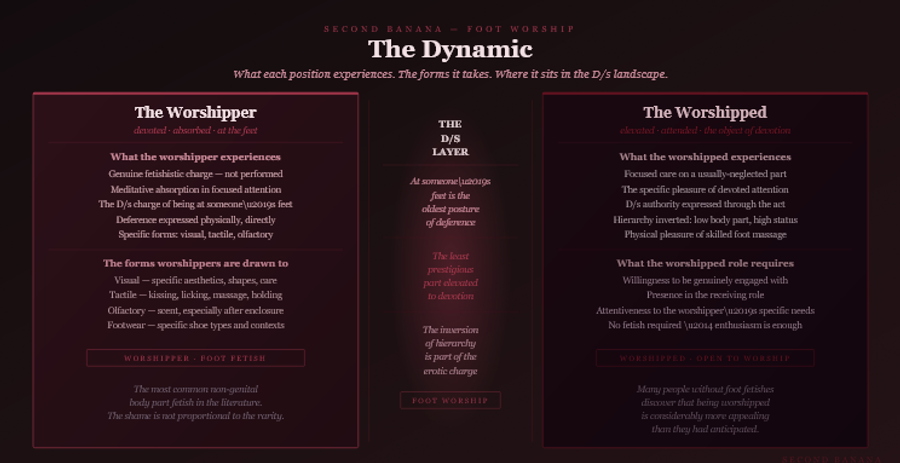
The foot worshipper’s experience is organised around several interlocking psychological mechanisms that together explain the specific quality of the orientation. The most fundamental is the fetishistic charge of the feet themselves — the specific, consistent arousal that the sight or contact with feet produces, which is not chosen or performed but is a genuine and consistent feature of the worshipper’s erotic response.
Layered on top of the fetishistic charge is a specific D/s dimension that many foot worship practitioners describe as central to the appeal. Being positioned at someone’s feet is a culturally universal posture of deference and submission — the posture of supplication, of reverence, of someone who acknowledges another’s authority. The foot worshipper who is genuinely on their knees attending to a partner’s feet is inhabiting that posture physically and psychologically, and the submissive charge of that position is itself erotically significant.
Many foot worshippers also describe a specific quality of focused absorption in the practice — the experience of being entirely occupied by a specific, limited, tactile engagement that produces a meditative quality similar to what Shibari practitioners describe in rope space. The narrowness of focus, the specificity of the attention, and the physical immediacy of the engagement together produce an altered state of absorbed presence that practitioners value for its own sake.
The Worshipped
The experience of being worshipped is psychologically distinct and equally worth examining. The person whose feet are being worshipped receives a specific form of devoted attention that is qualitatively different from most other forms of erotic engagement: focused, patient, skilled, and entirely directed at a part of the body that is rarely the subject of such concentrated care.
For people with no particular foot fetish of their own, receiving foot worship can nonetheless be profoundly pleasurable — the physical sensation of skilled massage and attentive touch on the feet is genuinely enjoyable regardless of fetishistic orientation, and the psychological experience of being attended to with such focused devotion carries its own specific charge. Many people who do not think of themselves as having any foot-related erotic interest discover, when they encounter a skilled and enthusiastic foot worshipper, that being the object of that specific attention is considerably more appealing than they had anticipated.
For people with a genuine orientation toward being worshipped — whose pleasure in foot worship comes not merely from the physical sensation but from the power dynamic it expresses — the experience has an additional layer. The dominant in a foot worship D/s dynamic is not simply receiving pleasant physical attention. They are occupying a specific position of erotic authority — one in which their feet, culturally among the least prestigious body parts, have been elevated to objects of devotion by the worshipper’s attention. This inversion of cultural hierarchy — the elevated status of something normally treated as low — is itself erotically charged and is part of what makes explicit foot worship D/s dynamics appealing to the dominant as well as the submissive.
The Prevalence and the Mockery
Foot fetishism is consistently reported as the most common non-genital body part fetish in the research literature. Scorolli and colleagues’ 2007 analysis of online fetish communities found that foot and toe fetishes accounted for approximately half of all fetishes focused on body parts — more than all other body part fetishes combined. Lehmiller’s 2018 nationally representative US survey found that a significant minority of respondents reported foot-related sexual interests. Multiple other surveys across different populations and methodologies have produced similar findings.
And yet foot fetishism attracts a specific and persistent mockery that other interests of comparable or greater prevalence do not. The joke is not merely a cultural accident. It serves a function: the mockery of foot fetishism is a way of acknowledging the prevalence of an interest that would otherwise be embarrassing to acknowledge, by placing it in a frame where acknowledgment and distance are achieved simultaneously. To laugh at foot fetishism is to signal that one knows it exists while maintaining that one’s own relationship to it is one of amused detachment rather than participation.
This mechanism produces a specific and unfair shame burden for people with genuine foot fetishes. They are simultaneously aware that their interest is extremely common — that statistically many of the people laughing at the joke share some version of the orientation — and that the social cost of naming their interest honestly is disproportionate to its actual unusualness. The result is that a great many people with genuine foot fetishes navigate without partners who share or engage with their orientation, simply because the shame cost of asking is too high.
The shame is not proportional to the rarity. It is inversely proportional to it. The more common the interest, the more work the mockery has to do.
What This Has to Do With Second Banana
The practical challenge for foot fetishists is one of disclosure timing and social cost. The interest is specific enough that a partner who does not share or engage with it will notice its absence in a relationship, but the cultural mockery makes naming it early feel disproportionately risky. The result is that many people with foot fetishes either disclose awkwardly mid-relationship, after significant emotional investment has been made on both sides, or do not disclose at all and experience a persistent gap between their erotic life and their actual encounters.
Second Banana’s post-first model addresses this directly. A person with a foot fetish can write about it specifically and honestly before anyone has responded — naming the interest, describing what forms of foot worship are most important to them, what they’re looking for in a partner who receives or engages with this orientation, and what the dynamic looks like at its best. The people who respond have already seen the interest named and have chosen to engage rather than to pass.
The tag system gives foot worship practitioners specific vocabulary:
- Foot worship — the orientation itself
- Foot fetish / podophilia — for the fetishistic dimension
- Worshipper / worshipped — role in the dynamic
- Visual / tactile / olfactory — which dimensions of foot engagement are primary
- Footwear important — for those whose orientation includes specific shoe types
- Pedicure aesthetic matters — for those with specific care and presentation preferences
- D/s dimension important — for those whose foot worship is primarily a power exchange practice
- No D/s / sensual only — for those who want foot worship without the explicit dynamic
- Partner open to worship — for those who do not have their own foot fetish but are genuinely enthusiastic
These Second Banana tags allow matching at the level of orientation, role, and specific form — which prevents the most common foot worship matching failures: a foot worshipper connecting with a partner who is tolerant but not genuinely engaged, or a person who loves having their feet attended to connecting with someone who has no particular interest in providing that attention.