Shibari: The Art, the Intimacy, and the Philosophy of Japanese Rope Bondage | Second Banana
Shibari:
The Art, the Intimacy, and the Philosophy of Japanese Rope Bondage
More Than Rope
People who encounter Shibari for the first time — through a photograph, through a workshop, through watching someone tie — often describe a specific quality of response that surprises them. The photographs are striking not because of what they show but because of what they convey: a quality of care, of presence, of two people entirely absorbed in each other. The person being tied is not merely restrained. They look like they are being attended to in a way that has no obvious parallel in ordinary life. The rigger’s hands are not just working. They are listening.
This is the thing about Shibari that is very difficult to explain to someone who has only encountered rope bondage in its generic Western form, or who associates it primarily with the aesthetic of restraint and captivity. Shibari is all of those things — it is technically demanding rope bondage, it is visually striking, it is erotic for many of the people who practice it. But it is also something else: a specific relational practice in which the rope is the medium through which two people communicate, in which the quality of the tie reflects and shapes the quality of the connection between the rigger and the bunny, and in which the goal is not merely restraint but a specific altered state of mutual presence that practitioners call by various names but that most describe as among the most profound experiences available to them.
This piece covers the history, the philosophy, the specific relational dynamic of the rigger and bunny, the rope space that Shibari deliberately cultivates, and what distinguishes Shibari from generic rope bondage — not to gatekeep or to establish hierarchies of practice, but because the distinction is genuinely useful for people who are drawn to Shibari specifically and want to understand what they’re drawn to.
In Shibari, the rope is not what constrains. It is what connects. The knots are not what matters. The hands that make them are.
A Brief History: Where Shibari Comes From
The Hojujutsu Origins
Shibari — the word means ‘to tie’ or ‘binding’ in Japanese — has its origins in hojujutsu, the Japanese martial art of rope restraint used by samurai and later by law enforcement to restrain and transport prisoners. The historical hojujutsu tradition was practical rather than aesthetic, but it established a sophisticated vocabulary of rope techniques, knot structures, and body mapping that would later be adapted and elaborated by the artists and practitioners who developed what we now call Shibari or Kinbaku.
The erotic dimension of Shibari as we know it emerged primarily in the early twentieth century, with significant acceleration in the postwar period. Ito Seiu, an artist and writer working in the 1910s through 1950s, is widely credited with developing the aesthetic of erotic rope bondage through his photography and illustration — work that drew on classical Japanese imagery of captive women while elaborating a new visual language of restraint, vulnerability, and beauty. His influence on subsequent Shibari practice is difficult to overstate.
The Postwar Development
The postwar period saw the emergence of kinbaku magazines — publications focused on erotic rope photography that created both a community of practitioners and an aesthetic standard for the form. Figures like Kitan Club and Uramado published work that established the visual conventions of Japanese rope bondage and gave practitioners a shared reference point for what the art could look like at its most developed.
The practitioners who became most influential in shaping modern Shibari — Nureki Chimuo, Hajime Kinoko, Yukimura Haruki among others — brought different approaches to the tradition. Some emphasised the physical intensity and dramatic aesthetic of complex suspension ties; others developed a more intimate, floor-based practice focused on the emotional and energetic connection between rigger and bunny. These different emphases remain present in contemporary Shibari communities and are worth knowing about because they reflect genuinely different philosophies of what the practice is for.
The Western Migration
Shibari migrated to Western kink and rope bondage communities primarily through practitioners who had studied in Japan and through books and workshops by figures like Midori, whose 2001 book The Seductive Art of Japanese Bondage brought Shibari vocabulary and technique to English-speaking audiences with both rigour and warmth. The contemporary Western Shibari scene is diverse and active, with workshops, jams, festivals, and a significant online community — and also ongoing and sometimes contentious conversation about the relationship between Western practice and the Japanese tradition it draws from.
The Philosophy: What Makes Shibari Distinct
Nawa no Kokoro — The Heart of the Rope
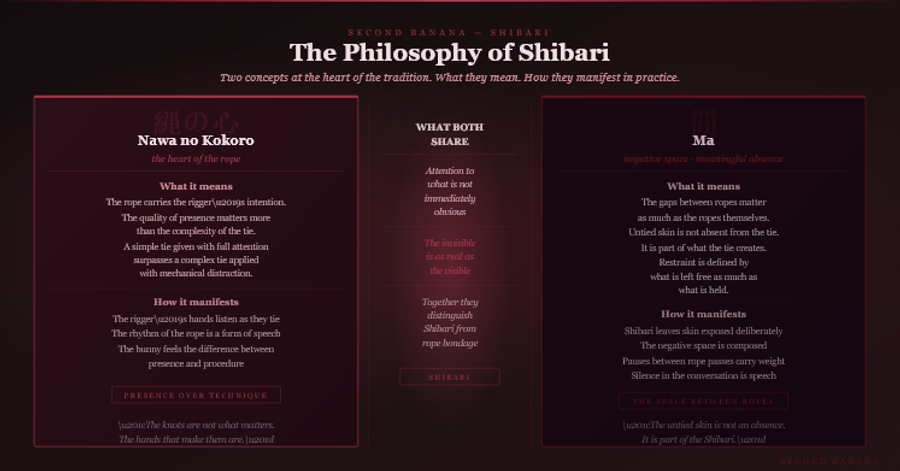
Central to Shibari philosophy is a concept that has no direct English translation but is often rendered as nawa no kokoro — the heart, or spirit, of the rope. The idea is that the rope in Shibari is not merely a physical material used to restrict movement. It is a medium through which something is communicated between rigger and bunny: care, attention, intensity, vulnerability, connection. The quality of that communication is not determined by the complexity of the tie or the aesthetic beauty of the finished result but by the quality of presence and intention that the rigger brings to the process of tying.
A technically perfect tie applied with distracted or mechanical attention is, in Shibari philosophy, an inferior tie to a simpler tie applied with complete presence and genuine attention to the person being tied. This emphasis on the quality of presence over the complexity of technique is what distinguishes Shibari most clearly from generic rope bondage — and it is what practitioners who are deeply invested in the tradition most want to convey to those approaching it for the first time.
Ma — Negative Space and Absence
The Japanese aesthetic concept of ma — negative space, the meaningful absence between things — has a specific application in Shibari. The gaps between ropes, the untied spaces on the body, the pauses between patterns, are understood as carrying their own meaning and their own aesthetic weight. A Shibari tie is not merely the ropes that are applied but the negative space that they define: the skin left exposed, the volume of air enclosed by the tie, the contrast between restraint and freedom.
This attention to negative space gives Shibari its characteristic aesthetic — very different from the dense, comprehensive restraint of some Western bondage traditions. Shibari ties often leave large portions of the body untied, with the rope work concentrated at specific points that create tension, support, or visual contrast. The untied skin is not an absence of Shibari. It is part of the Shibari.
The Rope as Conversation
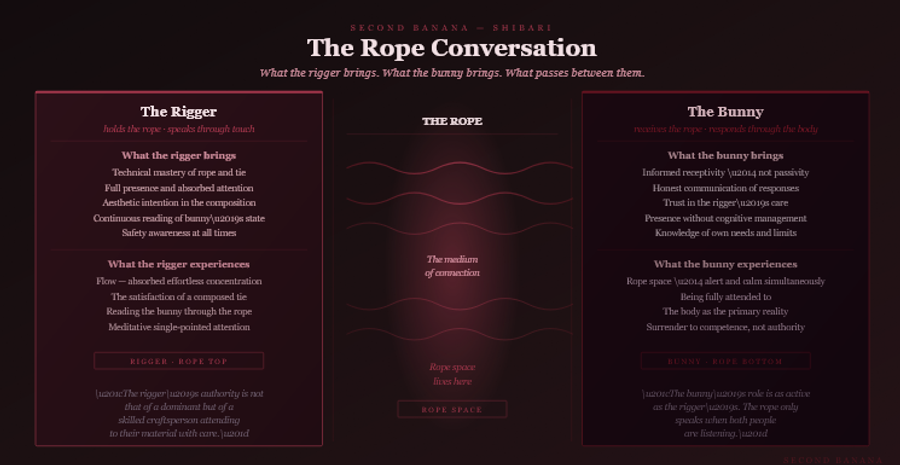
Perhaps the most useful single framing of Shibari for people encountering it for the first time is that the rope is a medium of conversation between rigger and bunny. The rigger speaks through the quality of their touch, the tension of the rope, the rhythm of the tie, the attention they bring to the bunny’s responses. The bunny speaks through physical feedback — the way their body responds to each wrap, the quality of their breath, the micro-movements that communicate how they are experiencing the tie.
This conversation is non-verbal but highly specific. Experienced riggers describe learning to read a bunny’s state with considerable accuracy through the physical information available through the rope: the tension in their muscles, the quality of their stillness, the warmth and colour of their skin. The rope is not just on the bunny’s body. Through the rope, the rigger is in continuous contact with the bunny’s nervous system.
The Rigger / Bunny Dynamic
The relationship between rigger and bunny in Shibari is specific enough to have its own vocabulary — vocabulary that reflects the distinct character of the dynamic compared to generic bondage or conventional D/s. The terms themselves are worth noting: ‘rigger’ rather than ‘dominant’ or ‘top,’ ‘bunny’ rather than ‘submissive’ or ‘bottom.’ The difference is not merely linguistic. In Shibari, the power dynamic is less central than in much BDSM practice — or rather, the power operates differently. The rigger’s authority is not the authority of a dominant over a submissive but the authority of a skilled craftsperson attending to their material with care and expertise.
This does not mean that Shibari is not erotic or that it does not involve a power dynamic — for many practitioners it is intensely erotic and involves a very clear sense of who holds the rope. But the erotic charge is located not primarily in the power exchange but in the quality of attention and the intimacy of the connection. The bunny surrenders not to the rigger’s authority but to their care and competence. The distinction is subtle but experienced practitioners consider it significant.
What the Rigger Brings
The Shibari rigger brings technical knowledge — of rope types, knot structures, tension patterns, body mechanics, and the safety considerations that must be actively managed throughout any tie. This technical knowledge is substantial and takes years of practice to develop to a level that supports complex or intensive work. Workshops, rope jams, community mentorship, and dedicated self-study are all part of how serious riggers develop their craft.
Beyond technique, the Shibari rigger brings a quality of attention that is the practice’s most demanding requirement. The rigger must be continuously present to the bunny’s state — monitoring physical indicators of stress or distress, reading emotional responses, and adjusting the tie accordingly in real time. This sustained attentiveness is not merely a safety requirement. It is what makes the tie a conversation rather than a procedure.
Serious riggers also typically bring an aesthetic sensibility — a considered approach to composition, negative space, and the visual relationship between rope and body that reflects the tradition’s origins as a photographic and theatrical art form. This aesthetic dimension is not universal among Shibari practitioners, but it is characteristic of those who engage most deeply with the tradition.
What the Bunny Brings
The bunny in Shibari brings what might be called informed receptivity — the capacity to receive the tie fully, to communicate their experience clearly, and to trust the rigger’s care without either passive collapse or anxious management. This is a specific capacity that is as demanding in its own way as the rigger’s technical skill.
The bunny who is unable to communicate their physical and emotional experience through the tie — who either masks their responses or becomes so activated by the experience that they lose the ability to signal genuine distress — creates conditions under which the rope conversation cannot function. The rigger can only read what the bunny communicates. The bunny’s capacity to communicate honestly, through both explicit signals and the physical information available through the rope, is as essential to the quality of the tie as the rigger’s attentiveness.
Bunnies who are new to Shibari often report that their role is more demanding than they expected — that the requirement to be genuinely present and receptive throughout the tie, to let the experience happen to them rather than managing it cognitively, is a practice in itself that takes time and repeated exposure to develop.
Rope Space: The State Shibari Cultivates
Rope space — the specific altered state of consciousness that Shibari can produce — is mentioned in the bondage piece as something that intensive rope bondage can generate. In Shibari, it is not a byproduct. It is often the explicit goal toward which both rigger and bunny are working, and the quality of the rope space achieved is frequently the primary measure of how well a tie has gone.
Rope space is characterised by a specific combination of states that practitioners describe consistently: heightened physical awareness and sensory acuity, a quality of mental quieting in which ordinary cognitive preoccupations fall away, a sense of being entirely in the body and entirely in the present moment, and a specific quality of emotional openness and trust. It is an altered state with a distinct neurological character — produced by the combination of deep pressure touch, sustained physical restraint, and the quality of attentive care from the rigger — and it is experienced by both bunny and, in a different form, by many riggers.
The rigger’s version of rope space is sometimes called ‘flow’ — the absorbed, effortless concentration that skilled practitioners of any complex craft can access when technique is sufficiently internalised to allow full presence. A rigger in flow is not thinking about knots. They are entirely present to their bunny and to the tie unfolding between them. This state, when it is achieved simultaneously by both rigger and bunny, is what experienced practitioners describe as the most profound experience the practice offers.
Rope space is not what happens during Shibari. It is what Shibari is trying to create. The tie is the means. The state is the destination.
Approaching Shibari: Community, Learning, and Practice
Learning the Craft
Shibari is not self-teachable from books or videos alone, and the serious practitioner community is consistent on this point. The physical risks of rope bondage — nerve compression, circulation restriction, joint stress — are present in all rope practice and become more significant as ties become more complex or intense. Learning to manage these risks requires in-person instruction with feedback from experienced practitioners who can observe and correct in real time.
The community infrastructure for Shibari learning is more developed than most people outside it realise. Most major cities have active rope bondage communities with regular rope jams — informal practice sessions where riggers of all experience levels tie, receive feedback, and learn from each other. Many have workshop series taught by experienced riggers, some of whom teach internationally. Online communities provide ongoing access to instruction, technique discussion, and community connection.
The learning path typically moves from basic single-column and double-column ties through body harnesses and limb ties to more complex full-body and suspension work. Suspension — lifting the bunny partly or fully off the ground — is considered the highest technical challenge in Shibari and requires extensive groundwork before it is safe to attempt. The community is generally welcoming to beginners who approach with genuine curiosity, humility, and respect for the safety culture.
The Cultural Dimension
Shibari’s origins in Japanese culture have generated ongoing conversation in Western practice communities about questions of cultural appreciation versus appropriation, about the relationship between Western practitioners and the Japanese tradition they draw from, and about how to engage with a tradition’s history and philosophy with genuine respect rather than surface aesthetic adoption.
These conversations are worth being aware of, not because they have resolved conclusions that every practitioner must hold, but because engaging with them — with the history of the form, with the philosophical concepts that distinguish it, with the community of practitioners who have developed it — is part of what it means to practice Shibari rather than merely to use Japanese aesthetic markers in rope bondage. The distinction matters to many practitioners who have invested deeply in the tradition.
What This Has to Do With Second Banana
Finding a Shibari partner — either as a rigger seeking a bunny or as a bunny seeking a rigger — requires a more specific match than most other kink practices. The rigger needs a bunny who genuinely wants to receive Shibari, who can be present and communicative throughout a tie, and who brings the informed receptivity that makes the rope conversation possible. The bunny needs a rigger with the technical knowledge to keep them safe and the quality of attentiveness to make the tie genuinely a tie rather than a technical exercise on their body.
The post-first model on Second Banana is well-suited to this matching challenge. A rigger can describe their approach — the tradition they draw from, their level of experience, whether they work primarily from a sensory/meditative or an aesthetic/performative orientation, what they’re looking for in a bunny relationship. A bunny can describe their experience, what they’re drawn to in Shibari specifically rather than rope bondage generally, what they need from a rigger in terms of communication style and pacing.
The tag system gives Shibari practitioners specific vocabulary:
- Shibari / Kinbaku — the specific tradition
- Rigger / rope top — the tying role
- Bunny / rope bottom — the receiving role
- Rope space as goal — signalling that the meditative dimension is primary
- Aesthetic / performative — for those whose practice emphasises the visual art dimension
- Floor work / suspension — indicating the level of intensity and technique
- Learning rigger / experienced rigger — honest skill level signalling
- Community practitioner — signalling engagement with the wider Shibari community
- Erotic / non-erotic / both — clarifying the relationship between Shibari and sexual practice
- Ongoing practice partner — for those seeking a sustained rigger/bunny relationship rather than a single scene
The distinction between Shibari and generic rope bondage in the Second Banana tag system is meaningful. Someone who posts with the Shibari tag is signalling a specific orientation toward the tradition, its philosophy, and its community — an orientation that is legible to other Shibari practitioners and that filters responses toward people who understand what they’re looking for.
Shibari also frequently operates outside the purely erotic context in which most Second Banana content is framed. For some practitioners the primary appeal is artistic or meditative rather than sexual, and the tag system accommodates this: the ‘non-erotic’ or ‘artform primarily’ tags allow practitioners to represent their orientation honestly without having to frame their practice in terms that don’t fit in the Second Banana Community.