Pup Play: Identity, Headspace, and the Psychology of the Pup/Handler Dynamic | Second Banana
Pup Play:
Identity, Headspace, and the Psychology of the Pup/Handler Dynamic
More Than Roleplay
The most common misunderstanding of pup play is that it is primarily about dressing up as a dog. The hood, the mitts, the collar — these are real parts of many practitioners’ pup play, and they matter. But they are expressions of something more fundamental than costume: a specific psychological headspace that pup play practitioners describe as one of the most genuine and restorative states they access, and for many, a core dimension of their identity rather than a role they put on and take off.
Pup play describes the practice of adopting a canine-inspired persona, headspace, or mode of being within an erotic, BDSM, or community context. The ‘pup’ in pup play is not a dog. They are a person accessing a specific psychological state characterised by playfulness, uncomplicated emotional expression, physical immediacy, freedom from social performance, and the specific pleasure of being cared for by someone who takes the handler role. This state has more in common with the primal play concept explored earlier in this series — the deliberate relaxation of the social management layer — than it does with the performance of animal behaviour.
Pup play exists across a spectrum from explicitly erotic to entirely non-sexual, and this range is an important feature of the practice rather than a source of confusion. For some practitioners, pup play is a sexual kink. For others, it is a community practice, an identity expression, a stress management tool, or all of these simultaneously. Taking pup play seriously means holding the full range rather than reducing it to any single version.
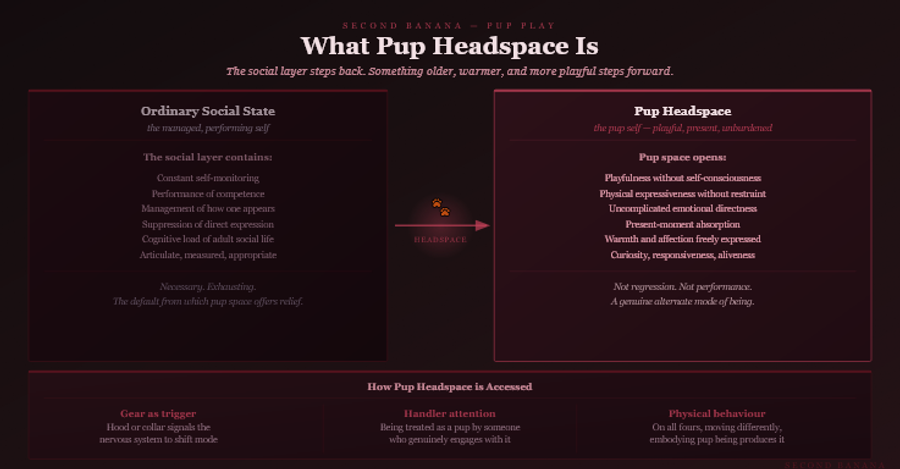
Pup headspace is not performance. It is a genuine psychological state — playful, present, unburdened. The gear signals it. The state is the point.
Pup Headspace: What It Actually Is
Pup headspace is the specific psychological state that pup play practitioners enter and that is the primary goal of the practice for most participants. It is characterised by a consistent cluster of qualities that practitioners across the pup community describe with remarkable consistency: a reduction in social performance and cognitive self-monitoring, an increase in playfulness and physical expressiveness, a heightened capacity for uncomplicated emotional expression, and a specific quality of present-moment absorption that many practitioners describe as among the most mentally restful states they access.
The social performance reduction dimension is worth dwelling on because it is the mechanism that most directly connects pup headspace to the primal play concept. In pup headspace, the normal requirement to present a managed, competent, socially appropriate self is suspended. The pup is not expected to be articulate, measured, or professionally composed. They are expected to be playful, responsive, expressive, and physically immediate. This suspension of the social management requirement is itself deeply pleasurable for many people — especially people whose daily lives involve sustained high-level performance of social competence.
The playfulness dimension is distinct from the infantilised regression that characterises some other age-play dynamics. Pup headspace is not about accessing a younger or more dependent version of the self — it is about accessing a more animal, more physical, more immediately expressive version. The pup is not a child. They are a creature: curious, affectionate, physically engaged, responsive to their handler’s attention, and freed from the cognitive demands that adult human social life continuously imposes.
How Pup Headspace is Accessed
Different practitioners access pup headspace through different routes, and understanding one’s own access route is useful both for the practitioner and for the handler who is supporting the experience. For some, the gear is the primary trigger: putting on the hood or the collar signals to the nervous system that a different mode of being is available, and the headspace follows relatively automatically. For others, the handler’s attention and care is the primary trigger: being treated as a pup by someone who takes that seriously and engages with it genuinely is what allows the headspace to emerge.
For many practitioners, the access route involves physical behaviour: getting on all fours, moving differently, making sounds that are more animal than human, being physically handled and stroked rather than verbally engaged. These physical behaviours are not merely performance. They are the action-system through which the psychological state is produced — the embodied enactment of pup being is what allows the cognitive experience of pup being.
The Pup/Handler Dynamic
The pup/handler relationship is the primary relational structure of pup play, and it is distinct enough from conventional D/s dynamics to deserve its own account rather than being assimilated into the dominant/submissive framework.
The Handler Role
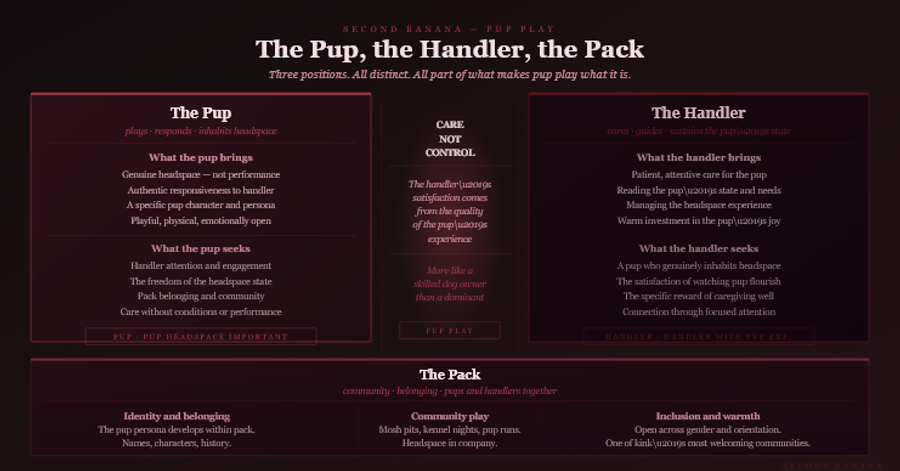
The handler is not a dominant in the conventional sense. Their primary function is not authority or control but care and guidance — the attentive management of the pup’s experience in headspace, the provision of the attention and physical engagement that sustains the pup’s state, and the skilled reading of the pup’s needs and responses. A good handler is more like a skilled dog owner than a conventional BDSM dominant: patient, attentive, genuinely warm toward their pup, and invested in the pup’s enjoyment of the experience rather than in the expression of their own authority.
This caregiving orientation distinguishes the handler role from most other dominant positions in the kink landscape. The handler’s satisfaction comes primarily from the quality of the pup’s experience rather than from the exercise of control. A handler who is watching their pup play freely, respond enthusiastically, and genuinely inhabit pup headspace is getting exactly what the dynamic offers — not a submissive who defers to their authority, but a pup who flourishes under their care.
The handler also manages the boundary between pup headspace and ordinary human engagement — monitoring the pup’s state, managing the transition into and out of pup space, and taking responsibility for the practical dimensions of safety and communication that the pup in deep headspace may not be well-positioned to manage for themselves. This responsibility is substantial and requires the handler to remain more cognitively engaged than many other dominant roles.
What the Pup Brings and Seeks
The pup brings a specific quality of authentic responsiveness — the genuine inhabited quality of pup headspace rather than a performed approximation of canine behaviour. A pup who is truly in headspace is not doing impressions of a dog. They are being genuinely curious, physically immediate, affectionately expressive, and present in a way that their ordinary social self is not. This authentic quality is what makes the pup/handler dynamic satisfying for both parties — and it is also what distinguishes experienced practitioners from newcomers for whom headspace is still more performance than genuine state.
What pups seek from the handler relationship varies considerably. Some pups primarily seek the playful engagement and physical attention — the handler as the person who plays with them, gives them stimulation and affection, and treats them with the specific warmth that the pup persona invites. Others seek the structure and care — the handler as the person who manages their experience, keeps them safe in headspace, and provides the clear framework within which the pup can relax into their state without having to manage their own safety or social presentation. Many seek both simultaneously.
Pup Play and Identity
For a significant proportion of pup play practitioners, particularly within the gay and queer leather/kink communities where the practice is most established, pup play is not merely a scene activity but a dimension of identity. The pup persona is not a costume worn for specific occasions but a genuine self-expression that is present, to varying degrees, in many contexts of life.
This identity dimension has several components. The pup name — a canine-inspired name distinct from one’s legal name — is used within the community and sometimes in all contexts where the person is comfortable with it. The pup persona — a particular character with its own qualities, aesthetic, and way of engaging — is developed over time and becomes more clearly articulated the more the practitioner engages with the community and the practice. The community membership — belonging to a pack or a broader pup community — provides social connection and a sense of belonging that is itself valuable independent of any specific scene.
The identity dimension does not require the erotic dimension. Many practitioners whose pup identity is primarily a community and self-expression practice have no particular interest in pup play as a sexual activity. Others find that the erotic and identity dimensions are inseparable. Both are legitimate, and the pup community has generally developed a culture of acceptance for the full range.
Pup Play and Petplay: The Distinction
Pup play is a specific form of petplay — the broader category of practice in which a person adopts an animal persona — but it has a sufficiently distinct character, community, and psychological profile to be considered on its own terms. Other common petplay animals include kittens, ponies, and foxes, each with their own associated communities, aesthetics, and relational dynamics.
What distinguishes pup play from other petplay forms most consistently is the emphasis on community, pack identity, and the specific pup headspace with its playful, affectionate, uncomplicated emotional expressiveness. Pony play tends to emphasise training, performance, and the specific pride of the well-trained animal. Kitten play often emphasises independence and aesthetic. Pup play emphasises pack, play, and the specific warm relationship between pup and handler. These are tendencies rather than rules — individual practitioners vary — but they reflect genuine differences in what each form of petplay is for.
The Psychology: Why Pup Play Works
The psychological mechanisms behind pup play’s appeal are well-suited to the present moment in particular. Many people whose lives involve sustained high cognitive load — professional demands, social performance, the constant management of how one is perceived across multiple digital and physical contexts — find pup headspace valuable precisely because it offers a state that is entirely orthogonal to all of that. In pup space, there is no performance to manage, no self to present, no adequacy to demonstrate. There is only play, physical presence, and the warm attention of a handler who is entirely focused on the pup’s experience.
This is the same mechanism that makes other forms of kink valuable for high-achieving, high-performing people: the specific relief of a context in which the cognitive management layer is not needed. But pup play produces this relief through a specifically playful, affectionate, community-oriented route that is distinct from the intensity of primal play or the submission of conventional D/s. Pup space is warm rather than intense, joyful rather than transcendent, communal rather than dyadic.
The pack dimension adds a specifically social mechanism. Human beings are deeply social animals whose fundamental wellbeing is tied to belonging and being known within a group. The pup community, with its packs, its shared aesthetics, its events, and its culture of inclusion for people who often feel excluded from mainstream social structures, provides this belonging in a form that many practitioners describe as more genuine and less conditional than any other community they have experienced.
In pup space, the question is not who you are. It is whether you want to play. That is a very different question, and for many people, a much easier one to answer honestly.
The Gear and the Community
Gear
Pup play gear — hoods, mitts, collars, tails, kneepads — serves several distinct functions that are worth understanding separately. The hood is simultaneously a sensory modifier (limiting vision and sound in ways that support pup headspace), a visual marker of the pup persona, and a trigger for the psychological state. The collar is both a symbol of the pup’s relationship with their handler (when worn in the context of an established pup/handler dynamic) and a community marker of pup identity. Mitts limit hand function in ways that reinforce the physical experience of being in a non-human mode. Kneepads make floor-level engagement sustainable for extended periods.
The gear is expensive and not strictly necessary for pup headspace — many practitioners access excellent pup space with nothing more than a collar. But gear does real psychological work for the people who use it, and the community has developed a rich aesthetic around it that is itself a form of self-expression and community belonging.
Community
The pup play community is one of the most active and well-organised within the broader kink landscape. Pup runs, mosh pits, kennel nights, and broader leather/kink events with pup-specific programming provide regular opportunities for pups to be in headspace together and for handlers to connect with pups. Online communities are extensive and genuinely supportive, particularly for newcomers who may not yet have local community access.
The community is also notable for being more explicitly inclusive across gender and sexual orientation than many other kink communities. While pup play has historically been most visible in gay male leather communities, the practice has expanded significantly across gender and orientation over the past decade, and many pup communities actively welcome and include people across the full gender and orientation spectrum.
What This Has to Do With Second Banana
Finding the right pup/handler match — or finding other pups to play with — requires a level of specificity that general platforms cannot provide. A pup looking for a handler needs someone who genuinely understands the caregiving dimension of the role, who is invested in the pup’s headspace experience rather than in conventional dominance, and who has the patience and attentiveness to manage a pup’s experience in headspace effectively. A handler looking for a pup needs someone who can genuinely access pup headspace rather than performing it, who is responsive and engaged, and whose specific pup character is a good match for the handler’s style.
The post-first model gives pup practitioners interested in primal play the vocabulary to represent what they’re looking for before anyone responds. A pup can describe their headspace, their pack orientation, whether they’re primarily seeking erotic pup play or community connection, what their gear situation is, and what they need from a handler in terms of engagement style. A handler can describe their approach, their experience, and what kind of pup relationship they’re looking to build.
The Second Banana tag system gives pup play practitioners specific vocabulary:
- Pup play — the orientation itself
- Pup / puppy — the pup role
- Handler — the handler role
- Pack / pack dynamics — for those oriented toward group pup community
- Pup headspace important — signalling that genuine headspace is the goal not performance
- Gear important / no gear — whether equipment is part of the practice
- Erotic / non-erotic / both — clarifying the sexual dimension
- Established pup identity / exploring — experience level signal
- Handler with pup experience / new to handling — handler experience signal
- Community oriented / scene oriented — what kind of connection is sought