Jealousy: What It Actually Is, What It’s Not, and What to Do With It | Second Banana
Jealousy:
What It Actually Is, What It’s Not, and What to Do With It.
The neuroscience of the emotion everyone has and nobody understands correctly
The Story We Tell About Jealousy
The story goes like this: jealousy is the price of caring. If you love someone enough, you will inevitably feel the particular anguish of imagining them with someone else, wanting someone else, being wanted by someone else. The intensity of the jealousy is proportional to the depth of the love. A person who feels no jealousy either doesn’t love deeply or isn’t paying attention. Jealousy, in this telling, is not a problem to be solved. It is evidence of something real.
This story is wrong in almost every particular, and believing it causes a specific and unnecessary kind of suffering.
Jealousy is not proof of love. It is not proportional to the depth of feeling. It is not a reliable signal about the value of a relationship or the significance of a connection. It is a threat response — a neurological event produced by the brain’s threat-detection system when it perceives a risk to something it has categorised as important. Understanding this distinction does not make jealousy go away. But it changes, fundamentally, what jealousy means, what it’s telling you, and what you can actually do with it.
This piece is about what jealousy actually is at the level of neuroscience and psychology. About the specific things it is and is not signalling. About how it operates differently depending on attachment style, relationship structure, and the specific beliefs a person holds about love and exclusivity. About retroactive jealousy, which is its own specific beast. And about what the research suggests actually works when you want to relate to jealousy differently — not to eliminate it, but to stop being entirely governed by it.
It is a piece that belongs in this series because jealousy sits underneath
everything we’ve written about ENM, about relationship anarchy, about attachment, about desire. It is the emotion most people are most afraid of in the context of non-conventional relationships, and the one most in need of an honest account.
What Jealousy Actually Is: The Neuroscience
Jealousy is technically a secondary emotion — what researchers call a blended emotion, because it is composed of more primary emotional states rather than being primary itself. In its classic formulation by emotion researcher Paul Ekman and subsequently elaborated in attachment and evolutionary research, jealousy involves some combination of fear, anger, and sadness, proportioned differently depending on the individual, the context, and the specific threat perceived.
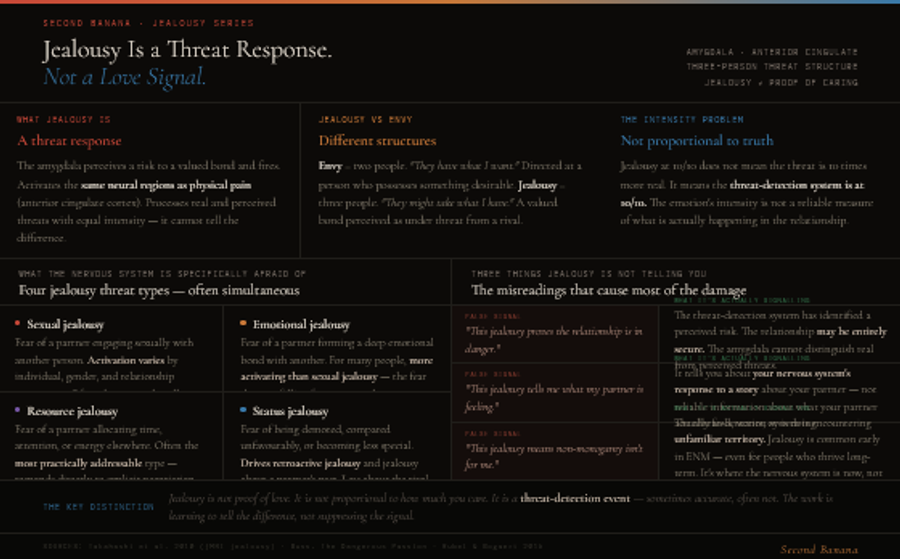
The neurological substrate of jealousy is the brain’s threat-detection network, centred on the amygdala but involving the anterior cingulate cortex, the prefrontal cortex, and the reward circuitry. Brain imaging studies — including a notable 2010 study by Takahashi and colleagues using fMRI — found that jealousy activates overlapping regions to physical pain, with the anterior cingulate cortex (which processes social pain) showing particularly strong activation. Jealousy, in neurological terms, hurts because it is processed by the same systems that process hurt.
What triggers the jealousy network is a perceived threat to a valued relationship or social bond — specifically, the perception that a third party is competing for or receiving something the jealous person values from the person they are bonded to. This could be attention, affection, sexual access, time, emotional energy, or social status. The threat does not have to be real. The perception of threat is sufficient to trigger the full neurological cascade.
Jealousy vs Envy: The Distinction That Matters
Jealousy and envy are consistently conflated in ordinary language and are neurologically and psychologically distinct. The distinction matters because they require different responses.
Envy is a two-person dynamic: I want what you have. It is directed at a person who possesses something desirable — a job, a quality, a relationship, an experience — that the envious person lacks. The structure is: they have something I want.
Jealousy is a three-person dynamic: I am afraid of losing you to them. It involves a valued relationship (person A and person B) and a perceived rival (person C) who is threatening that relationship. The structure is: they might take something I have.
Most of what people describe as jealousy in romantic contexts is correctly jealousy: the three-person dynamic of perceived threat to a valued bond. Some of what people describe as jealousy — particularly around a partner’s past, or a partner’s attractive friend, or a partner’s ex — is more accurately envy: the wish to have the quality or history that the rival represents. Retroactive jealousy, which we’ll get to, often has a significant envy component that makes it behave differently from standard jealousy.
What the Threat Network Is Actually Responding To
When jealousy fires, it is responding to a perceived threat to something the nervous system has categorised as important. But the content of that threat — what specifically the nervous system believes is at risk — varies enormously between people and between instances of jealousy, and understanding the specific content is the first step toward working with the emotion rather than just being flooded by it.
Research by evolutionary psychologist David Buss and subsequent work by attachment researchers has identified several distinct categories of jealousy threat that tend to activate differently:
- Sexual jealousy — the threat of a partner engaging sexually with another person. In evolutionary psychological theory, this is differentially activating depending on gender and, specifically, on certainty of parentage. The research on gender differences in sexual vs emotional jealousy is contested and has been significantly revised since Buss’s early work, but the basic distinction between sexual and emotional threat activation remains useful.
- Emotional jealousy — the threat of a partner forming a deep emotional connection with another person. For many people, this is considerably more activating than sexual jealousy: the fear that a partner is falling for someone else, sharing intimacy that feels more significant than physical intimacy.
- Resource jealousy — the threat of a partner allocating time, attention, energy, or financial resources to another person. Common in relationship structures where time is genuinely scarce, and often the most practically manageable of the jealousy types because it can be addressed through explicit negotiation.
- Status jealousy — the threat to one’s relative position in the relationship: being demoted, being compared unfavourably, becoming less special. This type often underlies retroactive jealousy and jealousy about a partner’s past.
Most jealousy episodes involve more than one of these simultaneously, which is part of what makes the emotion so difficult to parse from the inside. The flooding quality of jealousy — the way it occupies the whole mind and body — makes it hard to distinguish what is actually triggering it, which makes it hard to respond to specifically.
What Jealousy Is Not Telling You
Given that jealousy is a threat response and not a love signal, it is worth being direct about what it is not, in fact, telling you — because the misreadings are the source of most of the damage jealousy does to relationships.
It Is Not Telling You the Relationship Is in Danger
The jealousy signal tells you that the threat-detection system has identified a perceived risk. It does not tell you whether that risk is real. The amygdala cannot distinguish between an actual threat and a perceived threat — it processes both with the same intensity. This is why jealousy fires with equal vigour at an actual affair and at a partner mentioning an attractive colleague in passing. The threat-detection system is not calibrated for accuracy. It is calibrated for speed. The emotion arrives before any reliable assessment of the actual situation is possible.
The relationship is not necessarily in danger because you feel jealous. The relationship may be entirely secure. Your partner may be entirely committed. The rival may be entirely uninterested or entirely non-existent as a threat. Jealousy, in these cases, is the threat-detection system misfiring — identifying a risk that is not present — and acting on the jealousy as though it were reliable information is acting on a false alarm.
It Is Not Telling You About Your Partner’s Feelings
Jealousy tells you about your threat-detection system’s response to a perceived situation. It tells you very little about what your partner actually feels, wants, or is doing. The partner who is experienced by an anxiously attached person as constantly flirting with other people may, in reality, be entirely committed and simply socially warm. The partner whose text messages feel loaded with significance may be having entirely mundane conversations. The jealousy is processing a story about the partner, not reliable information about the partner.
This is one of the most important and most difficult things to hold when jealousy is happening: the intensity of the feeling is not proportional to the accuracy of the story the feeling is telling. Jealousy at ten out of ten does not mean the partner is ten times more likely to be doing something that warrants jealousy. It means the threat-detection system is at ten out of ten.
It Is Not Telling You That Monogamy Is Right for You
One of the most common responses to jealousy in the context of exploring non-monogamy is to treat the jealousy as evidence that non-monogamy is not viable: I feel jealous, therefore I am not built for this, therefore I should return to monogamy. This reasoning treats jealousy as information about relationship structure preferences when it is actually information about current nervous system state.
Jealousy is common in the early stages of exploring non-monogamy for people of all attachment styles, including people who go on to thrive in ENM relationships long-term. It is common because the threat-detection system is encountering unfamiliar territory and is responding to novelty as it responds to threat. Many people who have developed secure, satisfying ENM relationships report having experienced significant jealousy early in the process — jealousy that diminished as the nervous system accumulated evidence that the feared losses were not occurring.
This is not an argument that jealousy should be ignored or suppressed in the context of exploring non-monogamy. It is an argument that jealousy in this context is information about where the nervous system is right now, not a definitive verdict on what is possible over time.
Jealousy and Attachment Style: Why It Hits So Differently
Jealousy does not operate uniformly across people. The same external situation — a partner mentioning they found someone attractive, a partner spending an evening with an ex, a partner expressing enthusiasm about a new friendship — will produce dramatically different jealousy responses depending on a person’s attachment style. Understanding this variation is one of the most practically useful things the attachment research offers.
Anxious Attachment and Jealousy
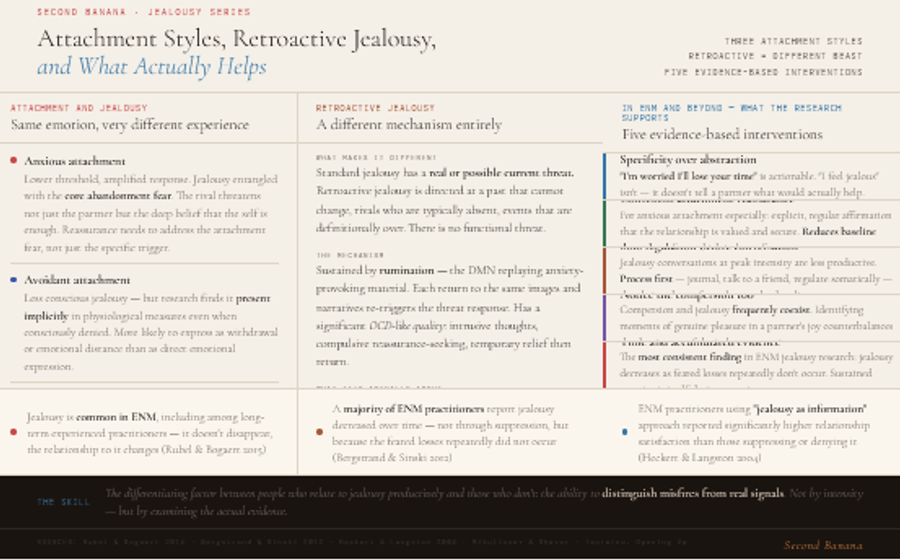
Anxiously attached people experience jealousy with particular frequency and intensity. The chronically activated sympathetic nervous system, the hypervigilance to signs of relational threat, the monitoring of a partner’s affect and attention — all of these features of anxious attachment mean that the jealousy threshold is lower and the jealousy response, when triggered, is amplified by the underlying anxiety.
For anxiously attached people, jealousy is often entangled with the attachment system’s core fear: abandonment. The perceived rival is not just someone who might be attractive to a partner — they are someone who might trigger the dreaded loss that the anxious nervous system is always braced for. The jealousy is not just about the rival. It is about the confirmation of the deep belief that the self is not enough, not safe, perpetually at risk of being replaced.
This entanglement means that anxiously attached people often need reassurance that addresses the attachment fear rather than just the specific jealousy trigger. Telling an anxiously attached partner that nothing happened with the colleague is less effective than also communicating: you are not at risk of losing me, I am here, you are enough.
Avoidant Attachment and Jealousy
Avoidantly attached people often appear to experience less jealousy than anxiously attached people, and this appearance is partially accurate and partially misleading. The deactivation of the attachment system that characterises avoidant attachment also deactivates some of the jealousy response — the threat-detection system is less sensitised to attachment threats because the attachment system itself is less active at the conscious level.
However, research by Mikulincer and Shaver found that avoidantly attached people do experience jealousy at the implicit level — detectable in physiological measures and reaction time tasks — even when they report not feeling jealous. The deactivation suppresses the conscious experience and the behavioural expression without eliminating the underlying response. Avoidantly attached people may also be more likely to express jealousy as withdrawal, emotional distance, or increased self-sufficiency rather than as the direct emotional expression more characteristic of anxious attachment.
Secure Attachment and Jealousy
Securely attached people experience jealousy too — the threat-detection system is not attachment-style dependent. What differs is the relationship to the jealousy. Securely attached people tend to be better able to identify what specifically they are jealous of, to communicate about it directly without the communication escalating into reassurance-seeking or withdrawal, to tolerate the discomfort of the emotion without it becoming all-consuming, and to update their assessment of the situation in response to actual evidence rather than remaining captured by the initial threat signal.
The secure relationship to jealousy is not the absence of jealousy. It is the capacity to experience jealousy as information to be examined rather than as a verdict to be acted on immediately.
Retroactive Jealousy: The Specific Beast
Retroactive jealousy — jealousy directed at a partner’s past rather than their present — is its own distinct phenomenon that behaves differently from standard jealousy and requires its own treatment.
Standard jealousy involves a current perceived threat: a real or imagined rival who is present, accessible, and competing for something the jealous person values. Retroactive jealousy involves a past that cannot be changed, rivals who are typically not present, and events that are definitionally over. There is no threat in any functional sense. And yet retroactive jealousy can be as intense, as consuming, and as relationship-damaging as jealousy of immediate threats — sometimes more so.
The mechanism that sustains retroactive jealousy is different from standard jealousy. Standard jealousy is maintained by genuine uncertainty: the threat might materialise, the outcome is not yet determined. Retroactive jealousy, because its object cannot change, is maintained by rumination — the default mode network’s tendency to replay and elaborate on anxiety-provoking material. The person experiencing retroactive jealousy returns to the same images and narratives about a partner’s past again and again, each return triggering the threat response afresh, each fresh trigger reinforcing the rumination loop.
Retroactive jealousy often has a significant OCD-like quality — intrusive thoughts, compulsive reassurance-seeking, temporary relief followed by return of the intrusive material. Research has found meaningful overlap between retroactive jealousy and OCD symptomatology, and some of the most effective treatments for severe retroactive jealousy (ERP — exposure and response prevention) are drawn from OCD treatment frameworks.
The status jealousy and envy components of retroactive jealousy are also significant. What many people experiencing retroactive jealousy are actually feeling, beneath the surface narrative about the past, is: does their history with someone else diminish what we have? Am I less special because they have been with others? Is the past evidence of something about their character or capacity for commitment that I should be afraid of? These are not questions about a past event. They are questions about the person’s own worth and safety in the current relationship — which is why addressing the factual content of the past rarely dissolves retroactive jealousy.
Jealousy in ENM: What the Research Actually Says
The assumption that ENM relationships require either the absence of jealousy or the suppression of jealousy is one of the most persistent myths about non-monogamy. It is wrong in both directions: ENM practitioners do experience jealousy, and the research on how they relate to it offers some of the most practically useful findings in the jealousy literature.
Jealousy Is Common in ENM, and That’s Fine
A 2017 study by Rubel and Bogaert reviewing the non-monogamy literature found that jealousy is a commonly reported experience among ENM practitioners, including long-term and experienced practitioners. Jealousy does not disappear with time in ENM — what changes is the relationship to it. Experienced ENM practitioners are more likely to treat jealousy as information to be processed rather than as a verdict to be acted on, more likely to communicate about it directly, and more likely to have developed personalised strategies for working with it.
A 2012 study by Bergstrand and Sinski found that a majority of ENM practitioners reported that jealousy had decreased over time in their non-monogamous relationships — not because they had suppressed it, but because the feared losses had repeatedly not occurred, and the nervous system had accumulated evidence that the relationship structure was not as threatening as initially perceived. This is consistent with exposure-based anxiety reduction: the threat-detection system recalibrates when the feared outcomes do not materialise.
The ‘Jealousy as Information’ Framework
The most widely used and empirically supported framework for working with jealousy in ENM contexts is treating jealousy not as a verdict but as a data source: the emotion signals that something in the current situation is activating the threat-detection system, and the useful question is what specifically is being threatened and why, not how do I make this stop.
Tristan Taormino, in her widely read Opening Up, and Dossie Easton and Janet Hardy, in The Ethical Slut, both articulate versions of this framework. The practical application involves: identifying what specifically feels threatened (connection, time, status, uniqueness, sexual exclusivity); examining whether the threat is real or perceived; communicating about the specific fear rather than the generalised jealousy; and asking for what would actually address the underlying need rather than asking for the rival to be eliminated.
Research by Heckert and Langston (2004) found that ENM practitioners who used this ‘jealousy as information’ approach reported significantly higher relationship satisfaction than those who attempted to suppress or deny jealousy. The emotion does not need to be eliminated. It needs to be understood.
What Actually Helps: The Evidence
Beyond the reframe, the research on what actually reduces jealousy in ENM contexts is consistent on a few specific interventions:
- Communication specificity — talking about what specifically is feared, not about jealousy in the abstract. “I’m worried I’ll lose your attention” is actionable. “I feel jealous” is not, because it doesn’t tell the partner what specifically would help.
- Consistent reassurance of the primary bond — for people with anxious attachment in particular, explicit and regular affirmation that the relationship is valued and secure reduces the baseline threat level from which jealousy fires. This is not reassurance-seeking in the dysfunctional sense. It is the partner providing the attachment security that the anxious nervous system needs in order to extend trust into unfamiliar territory.
- Solo processing before partner conversations — jealousy conversations that happen at the peak of the emotional response are less productive than conversations that happen after some initial self-regulation. Journaling, talking to a trusted friend, or using somatic regulation strategies before the partner conversation allows the prefrontal cortex to come back online and makes specific, productive communication more possible.
- Distinguishing between compersive and jealous responses — compersion (genuine pleasure in a partner’s pleasure with another person) and jealousy frequently coexist for ENM practitioners. Identifying and acknowledging the moments of compersion — when they occur — counterbalances the dominance of the jealousy narrative and builds evidence that ENM can produce positive as well as threatening feelings.
- Time and accumulation of evidence — the most consistent finding in the ENM jealousy research is that jealousy tends to decrease as experience accumulates and the feared losses repeatedly do not occur. The nervous system is an evidence-based system, even if it is slow to update. Sustained ENM practice is itself the intervention.
The Jealousy That Points to Something Real
Everything above about jealousy as misfire and false alarm is true. It is also true that jealousy sometimes points to something real: an actual breach of agreed boundaries, a genuine change in a partner’s investment in the relationship, a structural problem in the relationship that needs to be addressed rather than regulated away.
The skill that jealousy requires — and that the research consistently identifies as the differentiating factor between people who relate to jealousy productively and people who don’t — is the ability to distinguish between these two kinds of jealousy. The jealousy that is the threat-detection system misfiring at a perceived threat that is not real, and the jealousy that is carrying genuine information about a genuine problem.
This distinction is not made by the intensity of the jealousy — misfires can be as intense as real signals. It is made by examining the evidence: What specifically is happening in the relationship? What has changed, if anything? Is the partner behaving consistently with their stated commitments? Is the jealousy proportional to the actual situation, or wildly in excess of it? Has the jealousy been present regardless of the partner’s behaviour, suggesting it is driven by internal factors rather than external ones?
When jealousy is pointing to something real — a broken agreement, a partner who has genuinely shifted, a structural mismatch in the relationship — the response is not regulation but conversation. The jealousy in this case is doing what threat-detection is supposed to do: identifying a genuine problem that needs to be addressed. Treating it as a misfire in these cases is not emotional intelligence. It is avoidance.
Jealousy is not proof of love. It is not a measure of how much you care. It is the threat-detection system responding to perceived risk — sometimes accurately, sometimes not. The work is learning to tell the difference.
Second Banana and the Jealousy Question
Second Banana’s community skews toward people who have thought carefully about their relational structures, who communicate explicitly, and who take seriously the work of understanding their own emotional responses rather than simply acting on them. This is, by any measure, the community most likely to have a productive relationship with jealousy.
The tag system allows people to communicate, before any charged relational encounter, about where they are with jealousy and what they need. Tags like “working on jealousy,” “communication-first,” “experienced ENM,” “new to non-monogamy,” “secure attachment preferred” — these communicate something specific and important about a person’s current relationship with jealousy and what kind of partner and relationship structure they’re looking for.
The post-first model allows people to describe, in their own words, how they relate to jealousy — whether they’re experienced and have developed good tools, whether they’re new and working on it, whether they need a partner with particular patience or a particular kind of reassurance. This is information that most dating contexts never surface, and that matters enormously for whether a connection is going to work.
The people who show up at Second Banana are disproportionately the people who are already asking the questions this piece is trying to answer: what is jealousy actually telling me, what is it not telling me, and how do I work with it rather than simply be controlled by it? They are, in other words, the people most likely to be able to receive jealousy honestly and respond to it well — in themselves and in the people they connect with.
The Emotion That Deserves Honest Treatment
Jealousy has been romanticised and pathologised and misunderstood in roughly equal measure. The romanticisation — jealousy as proof of love — licenses the use of jealousy as a mechanism of control, frames possessiveness as care, and makes the absence of jealousy into a suspicious sign of indifference. The pathologisation — jealousy as a character flaw or weakness to be overcome — produces shame and suppression, neither of which helps the person experiencing it or the relationship they are in.
The honest treatment is this: jealousy is a threat response, produced by a nervous system doing exactly what it was designed to do, sometimes accurately and sometimes not. It is almost universal. It is not proportional to the love behind it. It is not a reliable guide to what is actually happening in a relationship. It is workable — not by elimination, but by developing a relationship with it that involves understanding what specifically it is responding to, communicating about that specifically, and updating the nervous system’s threat assessment as evidence accumulates.
That is harder than either romanticising it or being ashamed of it. It is also the only approach that actually helps.