Rejection Sensitive Dysphoria and Dating: The ADHD Experience Nobody Talks About | Second Banana
The Read Receipt
That Wasn’t Answered.
Rejection Sensitive Dysphoria, ADHD, and why dating feels like playing a game where the rules keep changing and you keep losing and nobody else seems to notice there’s a game
The Thing That Happens
You had a good date. You know you had a good date. There was laughter, there was the kind of conversation that runs over the allotted time without either of you noticing, there was a moment at the end where the goodbye lasted longer than goodbyes usually do. You got home and felt something close to hopeful, which is its own kind of vulnerability.
And then they didn’t text.
Not immediately, which would have been fine. Not that evening, which was understandable. The next morning arrived, and the silence was still there, and something shifted in you that is very difficult to describe to someone who hasn’t experienced it. It wasn’t disappointment exactly. It was more total than that. It had the quality of confirmation — as though the silence wasn’t new information but rather the inevitable arrival of something you already knew, somewhere, was coming. As though the good date had been, in some way you couldn’t quite name, a mistake to have believed in.
By the time they did text — twelve hours later, perfectly normal, warm, suggesting plans — you had already processed a small grief. You had already, in some partial and exhausting way, let them go. You responded enthusiastically because you were genuinely pleased, and you also quietly marvelled at the distance between the catastrophe your nervous system had been constructing and the entirely ordinary reality that had obtained all along.
If you have ADHD — or suspect you might — this experience, or some version of it, will be familiar. The technical name for it is Rejection Sensitive Dysphoria. The lived experience of it is something considerably harder to name: a form of emotional pain that arrives at intensities wildly disproportionate to the stimulus that produced it, that passes quickly and completely, and that, while it is happening, feels entirely like the truth.
What RSD Actually Is
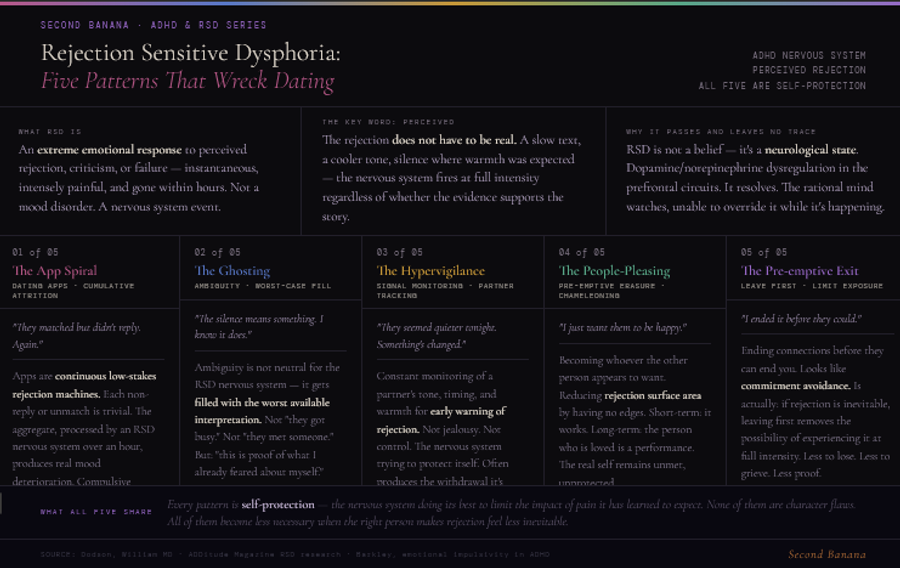
Rejection Sensitive Dysphoria was named and described most extensively by Dr William Dodson, an ADHD psychiatrist whose clinical work identified a pattern that ADHD patients consistently reported but that wasn’t well represented in the formal diagnostic criteria: an extreme, often instantaneous emotional response to perceived rejection, criticism, failure, or teasing that was qualitatively different from ordinary disappointment or hurt feelings.
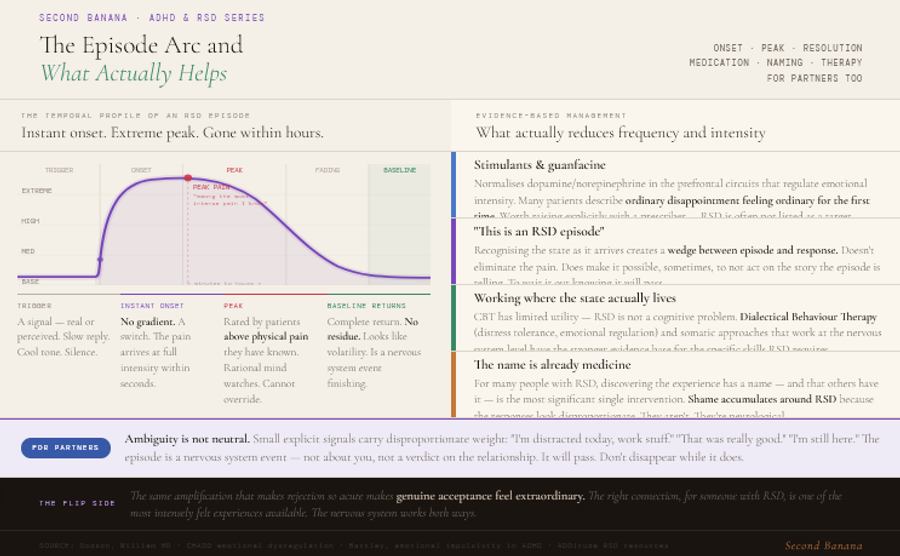
The word dysphoria is important here. It comes from the Greek for “difficult to bear,” and it is used clinically to describe states of profound emotional distress — the same word used in gender dysphoria, in postcoital dysphoria, in the dysphoria of severe depression. Dodson’s choice of the word was deliberate: what he was observing in his patients was not ordinary emotional sensitivity. It was a level of emotional pain that many described as among the most intense they regularly experienced — rating it, on pain scales, above physical pain they had also known.
RSD is not in the DSM. It is not a formal diagnostic criterion for ADHD. This is partly a limitation of diagnostic classification systems, which have been slow to incorporate the emotional dysregulation dimension of ADHD, and partly a consequence of RSD’s phenomenology: it passes quickly, leaves no lasting trace, and therefore tends to be invisible to people who aren’t specifically looking for it. The person who experienced a ten on the emotional pain scale an hour ago is now entirely functional and doesn’t look like someone in distress, which makes it easy for clinicians and researchers to miss.
What the research consistently supports is the underlying mechanism: ADHD involves dysregulation of dopamine and norepinephrine in the prefrontal circuits responsible for emotional regulation, impulse control, and the management of arousal states. The same neurological system that produces inattention, impulsivity, and executive dysfunction also governs the modulation of emotional intensity. The ADHD nervous system does not regulate emotion the way neurotypical nervous systems do — it amplifies, it does not filter, and the amplification is particularly acute for social and relational pain.
The Perceived vs Actual Rejection Problem
One of the most important and least understood features of RSD is that the rejection does not have to be real. The dysphoric response is triggered by perceived rejection — by anything the nervous system reads as a signal that it has fallen short, been found wanting, or been pushed away. A slow text reply. A tone of voice that seemed slightly cooler than usual. The absence of a compliment that was given last time. Someone seeming distracted during a conversation. A partner who seems less interested in sex than they were yesterday.
The nervous system’s threat-detection system fires on these signals with the same intensity it would bring to an actual, unambiguous rejection. There is no proportionality calibration. There is no subroutine that checks whether the evidence actually supports the conclusion. The signal arrives, the pain arrives, and the rational mind — which knows perfectly well that a slow text reply is almost certainly not evidence of catastrophic loss — watches from a slight distance, unable to override what the nervous system is doing.
This is why RSD is so difficult to explain to people who don’t experience it, and why it produces so much secondary shame in the people who do. You know the response is disproportionate. You know the evidence doesn’t support the conclusion. Knowing this does nothing to interrupt the pain, which arrives anyway, at full intensity, regardless of what you know.
The Speed and the Passing
RSD is also characterised by its temporal profile, which distinguishes it from mood disorders and from the slower, more persistent emotional states that often co-occur with ADHD. The onset is instantaneous — a switch rather than a gradient. The peak is extreme. And then it passes, often within minutes to hours, leaving behind a complete return to baseline and, frequently, a mild sense of bafflement at the intensity of what just happened.
This rapid cycling is part of what makes RSD so difficult to identify and so exhausting to live with. The intensity while it’s happening is genuine — it is not performance, not exaggeration, not a choice. But the passing is also genuine, which means that from the outside, the person looks like they are being dramatically inconsistent: devastated and then fine, grieving and then laughing, certain of catastrophe and then enthusiastically making plans. What looks like volatility is actually the ADHD nervous system doing exactly what it does, at exactly the speed it characteristically operates.
RSD and Dating: The Specific Configurations
Dating is, structurally, one of the most RSD-hostile environments an adult can regularly inhabit. It involves repeated, high-stakes encounters with strangers who have the power to accept or reject, whose communications are ambiguous by nature, whose timelines and intentions are opaque, and whose behaviour is subject to exactly the kind of partial, contradictory information that the RSD nervous system is most susceptible to misreading.
The following are the configurations that appear most consistently in the accounts of people with ADHD navigating contemporary dating.
The App Spiral
Dating apps are architecturally almost perfectly designed to produce RSD episodes. The swipe mechanism is a continuous low-stakes rejection machine — each left swipe is technically trivial and experientially meaningless, but the aggregate of them, processed by an RSD nervous system over an hour of use, can produce a genuine deterioration in mood and self-regard that has nothing to do with any individual decision. The match that doesn’t reply. The conversation that goes well and then stops. The person who unmatches without explanation. Each of these is ordinary attrition in the dating app ecosystem. For an RSD nervous system, each of them can land as a discrete wound.
People with RSD who use dating apps often describe a pattern of compulsive checking followed by regulatory shutdown: checking the app for replies at frequencies that they know are counterproductive, experiencing a small jolt of relief when there is activity and a disproportionate deflation when there isn’t, and eventually having to delete the app or go on enforced breaks because the cumulative emotional cost has become unsustainable. The app is not broken. The app is working exactly as designed. The ADHD nervous system is also working exactly as designed. They are simply badly matched.
The Ghosting
Ghosting — the cessation of communication without explanation — is painful for most people. For people with RSD, it occupies a specific and particularly cruel territory. The absence of an explanation means the RSD nervous system will generate one, and the one it generates will almost invariably be the worst available interpretation: not they got busy, not they met someone else, not they don’t know how to have this conversation — but I did something wrong. There is something wrong with me. This is evidence of what I have always suspected about myself.
The specific cruelty of ghosting for RSD is that the ambiguity it leaves is not neutral. Ambiguity, for the RSD nervous system, is not a blank space. It is a space that gets filled with the content of the person’s deepest fears about their own adequacy, attractiveness, and lovability. The ghost doesn’t know they are doing this. They think they are avoiding an awkward conversation. They are, from the RSD perspective, leaving a wound open.
The Hypervigilance
People with RSD in romantic contexts often develop a form of hypervigilance about relational signals that is exhausting to maintain and frequently counterproductive to intimacy. The constant monitoring of a partner’s tone, affect, response time, and level of expressed affection for signs of cooling, withdrawal, or dissatisfaction. The analysis of texts for subtext. The comparison of this week’s interactions with last week’s for evidence of change. The particular agony of being unable to tell whether a genuine change in a partner’s behaviour is significant or circumstantial.
This hypervigilance is not jealousy in the conventional sense, and it is not controlling behaviour in the conventional sense, though it can look like both from the outside. It is the RSD nervous system attempting to protect itself by getting early warning of the rejection it expects will eventually come. The irony — and it is a painful one — is that the hypervigilance often produces exactly the dynamic it is trying to prevent: the partner who experiences constant monitoring and reassurance-seeking, and who responds with withdrawal that confirms the fear that provoked the monitoring in the first place.
The People-Pleasing
The other major adaptive strategy that RSD produces in relationships is the opposite of hypervigilance: the pre-emptive elimination of any possible cause for rejection by becoming whoever the other person appears to want. People-pleasing, chameleoning, the effortful construction of a self that seems designed to be acceptable — agreeing with opinions that aren’t shared, performing enthusiasm for interests that aren’t held, suppressing desires and preferences and needs that might produce friction.
This strategy has an obvious short-term benefit and an obvious long-term cost. The short-term benefit is the reduction of RSD risk: if you become what someone wants, there is less surface area for rejection. The long-term cost is that the person who is loved is not you — it is the performance of you, carefully calibrated to produce acceptance. Which means the acceptance, when it comes, does not touch the part of you that most needs to be accepted. And the fear of rejection, perversely, increases: if they knew what I was actually like, they would leave.
People-pleasing in RSD contexts is often confusingly entangled with genuine empathy and care — people with ADHD frequently are highly attuned to others, genuinely interested in what others want, and motivated by real care as well as by RSD self-protection. The two things coexist, and distinguishing them requires a level of internal honesty that shame makes difficult.
The Pre-Emptive Exit
Perhaps the most self-defeating RSD pattern in dating is the pre-emptive exit: ending a connection before it can end you. The logic is simple and the cost is enormous. If rejection is coming anyway — and the RSD nervous system is fairly confident it is always coming eventually — then ending things first removes the possibility of experiencing the full intensity of being left. The person who leaves can tell themselves a story about choice. The person who is left has the story told for them.
Pre-emptive exits often look, from the outside, like commitment avoidance or emotional unavailability. They can look that way from the inside too, until you understand the mechanism driving them. It is not that the person doesn’t want connection. It is that the pain of losing connection is so reliably catastrophic, in their nervous system’s experience, that the rational response appears to be limiting how much connection is established in the first place. Less to lose. Less to grieve. Less surface area for the wound that is, they are certain, eventually coming.
RSD and Sex: The Dimension Nobody Mentions
The sexual dimension of RSD is almost entirely absent from the mainstream conversation about the condition, possibly because the mainstream conversation about RSD is almost entirely absent from anywhere other than ADHD specialist spaces. But RSD has specific and significant implications for sexual experience that deserve direct discussion.
Rejection in the Sexual Context
Sexual rejection is, for most people, one of the more tender forms of rejection available. The vulnerability required to initiate sex, or to disclose desire, or to be naked with someone and want them to want you back, is not ordinary social vulnerability. It is the kind that gets close to something core.
For people with RSD, this vulnerability is amplified considerably. A partner’s “not tonight” — entirely ordinary, entirely legitimate, entirely about their own state rather than about the quality of the person asking — can register as something much larger. A partner’s sexual disengagement during an encounter, or less-than-enthusiastic response, or the simple absence of initiation over a period of days, can be processed by the RSD nervous system as evidence of a broader withdrawal that the rational mind knows is probably not there.
This means that people with RSD in sexual relationships often carry a background anxiety about sexual rejection that shapes how they approach initiation, how they respond to their partner’s variable desire, and how present they are able to be during sex itself. The monitoring that RSD produces in social contexts extends into the bedroom: tracking a partner’s level of engagement, their vocalisation, their facial expression, for signs that this is going well enough, that they are wanted, that the connection is secure.
Disclosure and the RSD Calculus
We’ve written in the sexual shame piece about how shame makes disclosure of desire dangerous and how the cost of a poor reception can send a desire underground for years. RSD adds a specific neurological dimension to this: the person with RSD who discloses a sexual desire or preference is not just taking a social risk, they are taking a risk that their nervous system will process a negative or lukewarm reception as a major emotional event, regardless of how minor the actual response was.
This produces a specific and painful calculus around sexual disclosure. The desire to be known — which is genuine and strong — competes with the knowledge, drawn from experience, that a negative response will hurt at an intensity that seems wildly disproportionate and that will take time to process, even if the rational mind can immediately identify it as disproportionate. Many people with RSD resolve this calculus by not disclosing, or by disclosing in heavily hedged, easily-deniable ways that preserve the option of retreat if the reception is poor.
The Intensity of the Good
It is worth saying, because the negative dimensions of RSD dominate the conversation about it, that the same neurological amplification that makes rejection so acute also makes acceptance and connection feel extraordinary. The person with RSD who is genuinely received — whose desire is met with enthusiasm, whose disclosure lands in warmth, who experiences a partner’s desire for them as real and unambiguous — experiences this not at the ordinary level but at the amplified level that the ADHD nervous system brings to everything it processes intensely.
People with RSD in good sexual and romantic contexts often describe a quality of presence and intensity that is among the most valuable things in their lives. The flip side of the amplified pain is amplified joy, amplified connection, amplified gratitude for the people who make them feel safe. The nervous system that made dating so exhausting is the same nervous system that makes the right relationship feel like something almost unbearably good.
What Partners Need to Know
If you are in a relationship with someone who has RSD — whether or not it has been named as such — there are things that will help and things that will, with the best intentions, make it significantly harder.
Ambiguity Is Not Neutral
The single most useful thing a partner of someone with RSD can understand is that ambiguity in communication is not a neutral state for the person they are with. Where most people will fill a communicative gap with mild uncertainty, the RSD nervous system will fill it with its worst available interpretation. This does not mean that partners are responsible for eliminating all ambiguity — that would be exhausting and impossible. It means that small, simple acts of explicit communication — “I’m not in the mood tonight, nothing to do with you”, “I’ve been distracted today, it’s work stuff”, “that was really good” — carry disproportionate weight. They do not have to be elaborate. They have to be present.
Reassurance Is Useful and Has Limits
Reassurance helps in RSD episodes. The partner who says “I’m still here, this is okay” is providing something genuinely useful. But reassurance has a ceiling in RSD contexts that is worth knowing about: the relief it provides is temporary, because RSD is a nervous system state, not a cognitive belief. The belief can be updated by reassurance. The nervous system state requires time and its own internal processes to resolve. Partners who exhaust themselves providing reassurance and then feel frustrated when it hasn’t permanently fixed anything are not failing — they are bumping up against the limits of what reassurance can do for a state that is not fundamentally about belief.
The Episode Is Not About You
When an RSD episode is happening, its content — the story the RSD nervous system is telling about what the partner’s behaviour means — is almost certainly not an accurate account of what the partner’s behaviour means. The partner who is being experienced as withdrawing, cooling, rejecting, or losing interest is very often simply going about their ordinary life. Knowing that the episode is a nervous system event rather than a verdict helps both people: the person with RSD is not being irrational, and the partner is not actually doing the thing the episode has cast them as doing.
What Actually Helps: The Evidence for RSD Management
RSD management — not cure, because the underlying neurological difference is not going away, but genuine reduction in frequency and intensity — involves a combination of approaches that work on different parts of the problem.
Medication
ADHD medications, particularly stimulants (amphetamine salts and methylphenidate) and the non-stimulant guanfacine, have documented effects on RSD in clinical practice. The mechanism is the normalisation of dopamine and norepinephrine availability in the prefrontal circuits responsible for emotional regulation. Dodson’s clinical observations, replicated by others, found that many patients experienced significant reduction in RSD intensity with appropriate medication management — sometimes describing it as the first time in their lives that ordinary disappointment had felt like ordinary disappointment rather than like annihilation.
Medication is not universally effective for RSD, and finding the right medication and dose involves the same iterative process that ADHD medication management always involves. But for people who haven’t considered RSD as a target when thinking about their ADHD treatment, it is worth raising explicitly with a prescribing clinician.
Naming and Forecasting
One of the most consistently reported RSD management strategies is simple and available without medication: naming the state as it is arriving. The person who can recognise, in real time, “this is an RSD episode, this is my nervous system doing its thing, the story it is telling me is not reliable information” has not eliminated the pain. But they have created a small wedge of metacognitive distance between the episode and their response to it. They can, sometimes, not act on the story the episode is telling. They can, sometimes, wait it out with slightly less certainty that the catastrophic interpretation is true.
Forecasting — telling a partner in advance that this pattern exists and what it looks like — is similarly useful. The partner who already knows that “I know this is RSD” is a sentence their person might say has context for what follows. They don’t need to take it personally, manage it, or fix it. They need to do relatively little — often just not disappear — and the episode will pass.
Therapy Approaches
Cognitive behavioural therapy has limited direct utility for RSD — the problem is not primarily cognitive, and restructuring thoughts about rejection does not reliably interrupt the nervous system event. Dialectical Behaviour Therapy, which was developed for borderline personality disorder but has been applied to ADHD emotional dysregulation, has a stronger evidence base for the specific skills RSD requires: distress tolerance, emotional regulation, the ability to observe emotional states without being fully captured by them. Somatic approaches — as discussed in the tantra and shame pieces — work at the body level, which is where the RSD state actually lives.
Community and Recognition
For many people with RSD, the most significant single intervention is the discovery that the experience has a name and that other people have it. The shame that accumulates around RSD — around being the person who cried because a text wasn’t answered, who felt catastrophic pain because a partner was quiet over dinner, who has ended relationships pre-emptively to avoid the pain of being left — is significantly reduced by the knowledge that this is a documented feature of a neurological difference, not a personal failing or a character flaw.
Dating with RSD: What Second Banana Makes Possible
The post-first model is, for people with RSD, one of the most significant structural features of how Second Banana works. The invitation to write about who you are and what you’re looking for — before you’ve met anyone, before any individual has had the opportunity to accept or reject you, before the RSD nervous system has a target — is a low-stakes way of being honest that most dating architectures don’t offer.
The Second Banana tag system allows people with RSD to name what they need without having to perform a vulnerability in the moment of need. Tags like “please communicate directly,” “remind me you’re still here,” “neurodivergent kink,” “RSD aware,” “no ghosting, ever” — these are pre-emptive honesty that the right person will recognise and the wrong person will self-select out of. This is efficient. It also reduces the surface area of ambiguity before the connection even begins.
The anonymous posting model matters here in a specific way. One of the things people with RSD most need before disclosure is the ability to assess safety — to have some sense of whether this is a person who will receive vulnerability well before committing to the exposure of it. The ability to post honestly and read responses before a face and identity are attached gives a small but meaningful amount of information about the kind of person on the other side.
And the community. The community of people who have thought carefully about their own nervous systems, who communicate with specificity, who understand that a slow reply is not a verdict on their desirability — this is, for someone with RSD, not a small thing. It is the difference between a dating environment that is actively hostile to how their nervous system works and one that is, at minimum, comprehensible. The right Second Banana is not the person who never triggers RSD — no one is that person. It is the person who, when RSD fires anyway, knows what it is and doesn’t run from it.
You Were Not Being Dramatic
The pain was real. The read receipt that wasn’t answered, the date that went well and was followed by silence, the partner who seemed slightly cooler on Tuesday than they had been on Saturday — the pain those things produced was not performance, not exaggeration, not a choice, not evidence of weakness or instability or the unsuitability for adult relationships that shame has sometimes suggested.
It was a nervous system doing what it does, at the intensity it characteristically operates, in a domain — the relational, the romantic, the sexual — where the stakes feel highest and the signals are most ambiguous and the gap between what you want and what you fear is at its widest.
RSD makes dating harder than it is for most people. It makes certain configurations of dating — the app, the early stages, the ambiguous middle distance of something not yet defined — genuinely difficult in ways that are hard to explain and that the culture has no good framework for. It also makes the right connection, when it arrives, feel like something most people will never quite access. The same nervous system. The same amplification. Pointed, for once, at something that is actually there.
Find the person who replies. Who says the thing out loud. Who, when you tell them about the read receipt and the small grief you processed while they were just getting on with their day, doesn’t think you’re too much. Who thinks you’re exactly enough.