High Drive or Something Else: Understanding Hypersexuality
High Drive or Something Else: Understanding Hypersexuality
Published by Second Banana · Sex & Self-Knowledge Series
There is a version of this topic that gets written as a cautionary tale — the person whose sexual appetite is pathologised, whose desire is treated as evidence of damage. There is another version that gets written as pure validation — high libido is healthy, sex-positivity means never questioning how much you want or how often you pursue it. Neither version is very useful.
The more honest account sits between them. For some people, the question of whether their drive is high or whether something else is happening is genuinely worth examining — not because desire is suspect, but because compulsive patterns can look like preferences from the inside, and because the difference matters.
This article is not a diagnostic tool. It doesn't tell you whether your libido is a problem. What it does is lay out the actual distinction between a high sex drive and hypersexuality as clinicians and researchers understand it, describe the mechanisms that sustain compulsive patterns, and give some questions worth sitting with if the topic feels relevant to you.
What We Mean When We Say High Libido
A high sex drive means that sexual desire is frequent and often intense. The person with a high libido wants sex often, may think about it frequently, and places significant value on its presence in their life. This is a normal variation in human sexuality. Some people have very high drives; some have very low ones; most are somewhere in between, and where you land is influenced by biology, age, hormones, stress levels, relationship context, and a number of other factors.
High libido becomes a friction point mainly in relational contexts — when partners are mismatched in their drive levels, or when social environments treat high desire as inherently problematic. The desire itself is not the issue; the issue is incompatibility or stigma.
What high libido does not involve, as a defining feature, is distress. Someone with a high sex drive who has consistent outlets for that drive, who is pursuing sex with people who want to have it with them, and who is not experiencing their desire as disruptive to other areas of their life — that person has a high libido. Full stop.
What Hypersexuality Actually Is
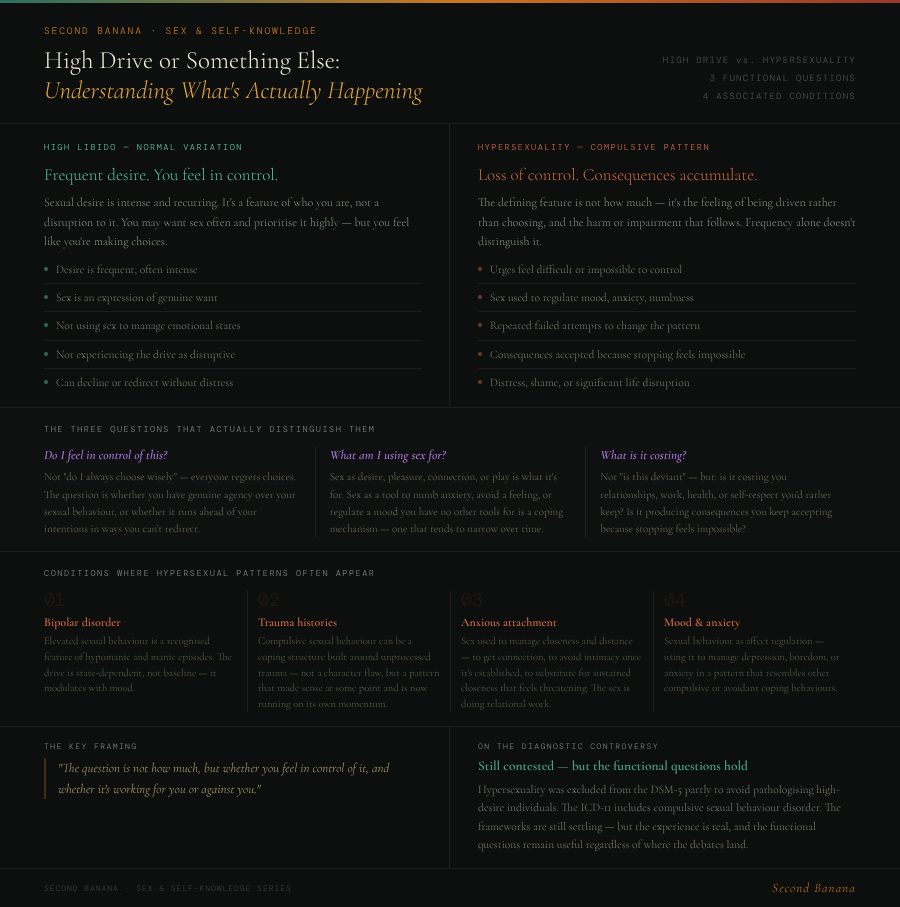
Hypersexuality — also discussed under terms like compulsive sexual behaviour or out-of-control sexual behaviour — is characterised not primarily by frequency or intensity of desire, but by a loss of control over sexual thoughts, urges, and actions, and the distress or functional impairment that results.
The key features, as researchers and clinicians typically describe them:
- Recurrent, intense sexual fantasies, urges, or behaviours that feel difficult or impossible to control
- Engaging in sexual behaviour in response to anxiety, depression, boredom, or stress — using sex as an affect-regulation strategy rather than an expression of genuine desire
- Repeated unsuccessful attempts to reduce or manage the behaviour
- Continuing the behaviour despite negative consequences — to relationships, to work, to physical health, to self-image
- Spending a disproportionate amount of time on sexual activity or recovery from it, to the exclusion of other valued activities
The critical distinction here is functional: the question is not how much, but whether you feel in control of it, and whether it's working for you or against you. Someone who has a lot of sex because they enjoy it and have opportunities to have it is not hypersexual. Someone who is pursuing sex compulsively, using it to manage internal states they don't have other tools for, and finding that it's disrupting their life — that's a different thing.
The Diagnostic Controversy
It is worth knowing that hypersexuality sits in genuinely contested diagnostic territory. It was considered for inclusion in the DSM-5 and ultimately excluded, in part because of concerns about pathologising sexual minorities and high-desire individuals, and in part because of ongoing disagreement about whether it constitutes its own disorder or is better understood as a symptom of other conditions.
The ICD-11 (the World Health Organization's diagnostic manual) does include compulsive sexual behaviour disorder, defining it as a persistent pattern of failure to control intense, repetitive sexual impulses or urges resulting in repetitive sexual behaviour, with marked distress or functional impairment lasting at least six months.
What this means practically is that the clinical landscape is still settling. If you're trying to understand your own experience, the absence of a universally agreed-upon diagnosis doesn't mean the experience isn't real — it means the frameworks for understanding it are still developing. The functional questions (am I in control, is this working for me, is it causing harm) remain useful regardless of where the diagnostic debates land.
Compulsive Sexual Behaviour and Other Conditions
One reason hypersexuality is diagnostically complex is that it often appears in the context of other conditions, rather than as a standalone phenomenon. This matters for understanding it.
Mood and anxiety disorders
Elevated sexual behaviour is a recognised feature of hypomanic and manic episodes in bipolar disorder. Someone who is in a hypomanic episode may experience a significantly elevated sex drive, reduced inhibition, and an increase in sexual risk-taking — not because their baseline drive is high, but because their neurological state has temporarily altered. Similarly, some people use sexual behaviour as a coping mechanism for anxiety or depression, in a pattern that resembles other compulsive or avoidant behaviours.
Trauma histories
Trauma, particularly sexual trauma, is associated with hypersexual patterns in some individuals. This is not universal — trauma affects sexual behaviour in a range of ways, including towards reduced desire or avoidance — but for some people, compulsive sexual behaviour is part of how unprocessed trauma organises itself. This isn't a character flaw or a simple choice; it's a coping structure that made sense at some point and that is now operating on its own momentum.
Attachment patterns
People with anxious or disorganised attachment sometimes use sex to manage closeness and distance in ways that can tip into compulsive territory — pursuing sex to get connection, using it to avoid intimacy once connection is established, or engaging in a pattern of repeated brief encounters as a substitute for the sustained closeness they want but find threatening. The sex is doing a lot of work that isn't really about sex.
Addiction overlap
There is ongoing debate about whether hypersexual behaviour constitutes an addiction in a meaningful neurobiological sense. Some research points to similarities in the brain's reward circuitry between substance use disorders and compulsive sexual behaviour; other researchers argue the analogy is imprecise. What seems clear is that for some people, the functional pattern — escalation, loss of control, continuation despite consequences, failed attempts to stop — mirrors what we see in substance or behavioural addictions, whatever the underlying mechanism.
The Questions Worth Asking
If you're trying to understand your own experience, a few questions are more useful than simply counting frequency or comparing yourself to some imagined norm:
Do I feel in control of this?
Not "do I always make the choices I wish I had made in retrospect" — everyone has that experience. The more pointed question is whether you feel like you have genuine agency over your sexual behaviour, or whether it feels like something that happens to you, that runs ahead of your intentions, that you try to redirect and can't.
What am I using sex for?
Sex as an expression of desire, pleasure, connection, or play is what it's for. Sex as a way to manage anxiety, numb boredom, avoid a feeling, or regulate a mood that you don't have other tools for is using sex as a coping mechanism. That's not inherently catastrophic, but it's worth noticing, because coping mechanisms tend to become less functional over time and to narrow the range of responses available to you.
What is it costing?
Not in a moralising sense — not "is this deviant" or "would someone else disapprove." In the specific sense: is it costing you relationships, work, health, time, or self-respect that you would rather not be spending? Is it producing consequences you keep accepting because stopping feels impossible?
Have I tried to change it and failed?
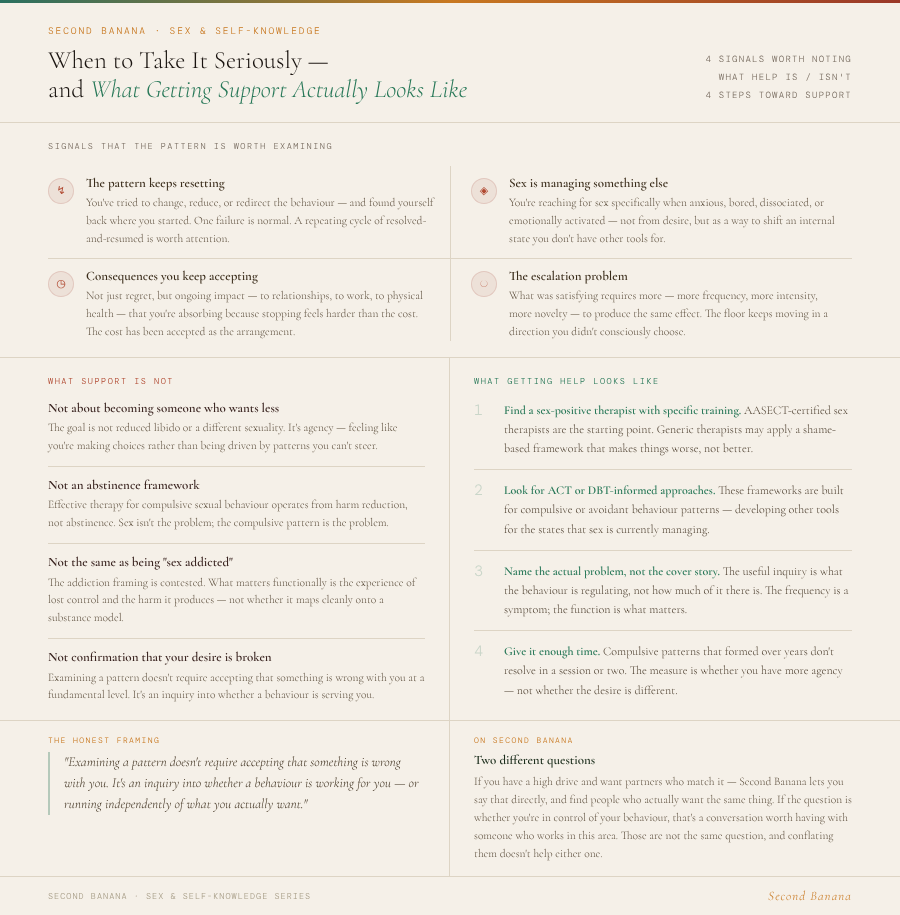
The experience of trying to reduce or redirect a behaviour and finding that you can't is a signal worth taking seriously. Not one failed attempt — everyone has those. A pattern of resolved-and-resumed, of feeling briefly in control and then finding yourself back where you started, is worth bringing to someone who works in this area.
What Getting Support Looks Like
If any of the above resonates, it's worth knowing that support is available and that it doesn't require you to adopt a framework in which your sexuality is bad or damaged.
Therapists who work with compulsive sexual behaviour typically operate from a harm-reduction rather than abstinence framework. The goal isn't to eliminate desire — it's to help you understand what's driving the pattern, develop other tools for managing whatever the sex is managing, and get to a place where you feel like you're making choices rather than being carried along by a current you can't steer.
Sex-positive therapists with specific training in sexual compulsivity are preferable to generalist therapists who may inadvertently apply a shame-based framework. AASECT-certified sex therapists and therapists trained in ACT or DBT approaches to compulsive behaviour are good starting points.
What support does not require is accepting that you are broken, that your desire is pathological in some irreducible way, or that the goal is to become someone who has less interest in sex. The goal is to become someone who is making deliberate choices about their sexual life rather than being driven by ones they can't control.
The Second Banana Angle
Second Banana is built on the premise that knowing what you want and being willing to say so is both more honest and more effective than the ambient ambiguity most dating platforms operate on. That principle applies here too.
People with high sex drives often find conventional dating frustrating for the same reasons anyone with an unusually specific set of preferences finds it frustrating: the norms of the platform don't make space for directness about what you're actually looking for. The result is a lot of signalling and inference and missed connections.
What Second Banana makes possible is saying what you actually want — including that you want a lot of sex, or that sex is a central priority in what you're looking for — and finding people who are genuinely interested in that. That's different from people who are willing to tolerate it, or who don't know what they're agreeing to until they're in it.
If you're in the other situation — if the question isn't "how do I find people who match my drive" but "am I in control of this" — that's a different conversation, and one worth having with someone who works in this area rather than with a dating platform. Those two things are not the same question, and conflating them doesn't serve anyone. 🍌