How to Talk About Sex With a Partner (And Why It’s So Hard) | Second Banana
The Conversation
You Keep Not Having.
On sexual communication, why it’s the strongest predictor of satisfaction in the research, and what actually makes it easier
The Finding That Keeps Coming Up
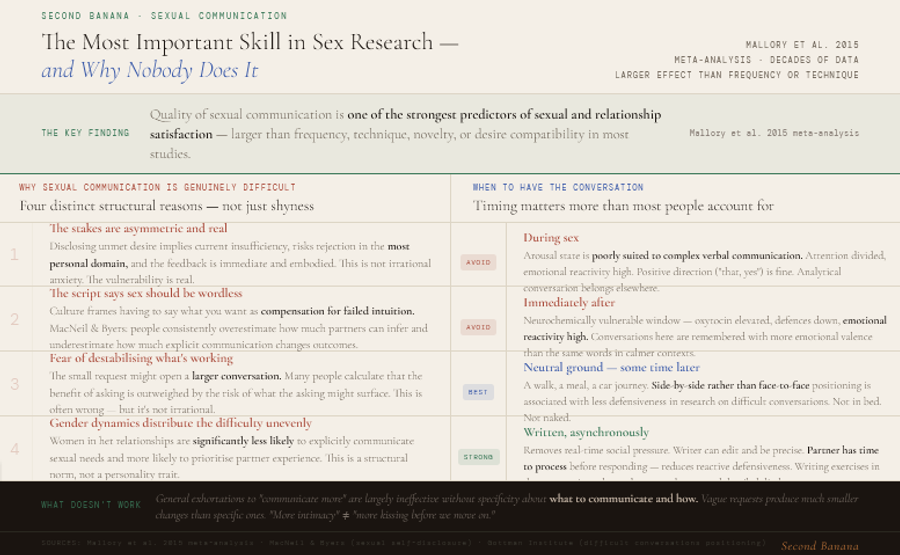
We’ve cited it three times across this series without ever making it the subject of its own piece: the Mallory and colleagues meta-analysis from 2015, which reviewed decades of research on the relationship between sexual communication and sexual satisfaction, and found that the quality of sexual communication between partners is one of the single strongest predictors of both sexual and relationship satisfaction — larger, in most studies, than the frequency of sex, larger than compatibility of desire levels, larger than technique or novelty or almost any other variable researchers have thought to measure.
This finding is simultaneously the most important and the most actionable thing the sex research has to offer, and it gets buried under a cascade of more dramatic interventions every time someone writes about improving a sex life. New positions. Toys. Scheduling. Role play. None of these have anything close to the consistent effect size of simply being able to talk honestly with a partner about what you want, what’s not working, and what you’d like more of.
This piece is about why that conversation is so hard, what specifically makes it difficult rather than just treating difficulty as a given, and what the research — plus the accumulated practical wisdom of sex therapy — says actually helps. It’s also about why Second Banana’s architecture is, in a genuine sense, a training ground for exactly this skill.
Why It’s Hard: The Actual Reasons
Sexual communication is difficult for reasons that deserve more honest examination than the usual advice-column reassurances (“just be open!” “create a safe space!”) provide. The difficulty is not primarily about shyness or inhibition in the conventional sense. It is about a specific set of social dynamics and psychological stakes that make talking about sex structurally harder than talking about almost anything else.
The Stakes Feel Asymmetric
When you tell a partner what you want sexually that you’re not getting, you are doing several things simultaneously. You are disclosing a desire. You are implicitly communicating that something about the current situation is insufficient. You are making yourself vulnerable to the possibility that the partner won’t want to do what you want, or won’t be able to, or will react in a way that makes the disclosure feel like a mistake. And you are doing all of this in the domain where the feedback is most immediate and most embodied, and where rejection feels most personal.
The stakes, in short, are genuinely high. This is not irrational anxiety about a low-stakes conversation. It is a reasonably calibrated assessment of a genuinely complex social situation. Understanding this is the first step toward navigating it better: the difficulty is real and the vulnerability is real, and pretending otherwise doesn’t help.
The Script Says It Should Be Wordless
The cultural script for good sex is one in which partners read each other perfectly, where desire communicates itself through touch and breath and movement without requiring speech, where having to say what you want implies that the other person has failed to intuit it. This script is not just inaccurate. It is actively counterproductive. It frames sexual communication as compensatory — something you do when wordless understanding has broken down — rather than as an inherent part of good sexual experience.
Research by MacNeil and Byers found that people consistently overestimate how much their partners can infer about their sexual preferences from context and non-verbal cues, and underestimate how much explicit communication actually changes outcomes. The gap between what partners assume each other know and what they actually know is, on average, larger than most couples believe. The script has made people confident in inferences that are frequently wrong.
The Fear of Changing What’s Working
A specific and underacknowledged source of reluctance around sexual communication is the fear that naming what’s not working will also destabilise what is. If the conversation about wanting more oral sex leads to a wider conversation about the sexual dynamics of the relationship, and that wider conversation is uncomfortable or reveals mismatches, then the small request has opened something larger. Many people make an implicit calculation that the benefit of asking for what they want is outweighed by the risk of what the asking might surface.
This calculation is often wrong — the research is clear that couples who communicate more have better outcomes, and that avoided conversations tend to fester rather than stay contained. But it is not an irrational fear, and dismissing it doesn’t help people past it.
The Gender Dynamics
The difficulty of sexual communication is not distributed evenly across genders. Research consistently finds that women in heterosexual relationships are significantly less likely than their partners to explicitly communicate what they need sexually, and more likely to monitor and prioritise their partner’s experience rather than advocate for their own. This is not a personality difference. It is the product of cultural norms that construct female sexual desire as a response to male initiation rather than as an independent thing that deserves to be named and met.
The same research that documents the orgasm gap — covered in the orgasm piece — also documents the communication gap that produces it. Women who explicitly communicate what stimulation they need report substantially higher orgasm rates. The barrier is not knowledge of what they need. It is permission to say it.
What the Research Says Actually Helps
Sex therapists and researchers have studied sexual communication interventions long enough to have some well-supported conclusions about what moves the needle and what doesn’t. The headline finding is that general exhortations to “communicate more” are largely ineffective without specificity about what to communicate and how.
Timing: Not During, Not Immediately After
The timing of sexual conversations matters enormously, and the two most common choices — during sex and immediately after — are both poor.
During sex, the nervous system is in a state of arousal that is poorly suited to complex verbal communication. Attention is divided, emotional reactivity is heightened, and feedback in the moment — especially critical or corrective feedback — is more likely to produce defensiveness than openness. This doesn’t mean no talking during sex. Positive direction (“that, yes”) is different from analytical conversation. The latter belongs elsewhere.
Immediately after sex, both partners are in the neurochemically vulnerable post-sex window covered in the aftercare piece: oxytocin elevated, defences down, emotional reactivity high. This is a poor time for conversations that might produce conflict or disappointment. What happens in this window is remembered with more emotional valence than conversations that happen in calmer states.
The research-supported window is “neutral ground”: some time after the encounter, not in bed, not while naked, ideally in a context with low emotional stakes — a walk, a meal, a car journey. The physical side-by-side rather than face-to-face positioning that these contexts often involve is associated with less defensiveness and more honest communication in the research on difficult conversations generally.
Positive Framing, Specific Requests
The framing research is consistent: conversations that focus on what you want more of produce better outcomes than conversations that focus on what’s wrong or insufficient. This is not about avoiding honest feedback. It is about recognising that the brain is considerably more receptive to “I’d love more of this” than to “I wish you did less of that,” and that the former framing is also more actionable — it tells the partner what to do rather than only what to stop doing.
Specificity matters more than most people think. Research on sexual communication effectiveness finds that vague requests (“I want more intimacy”) produce much smaller changes in behaviour than specific ones (“I’d love more kissing before we move to other things”). The specific request gives the partner something they can actually try, and the success of trying it gives both partners positive reinforcement for the conversation having happened.
The Disclosure Reciprocity Norm
One of the most robust findings in the self-disclosure research is that disclosure tends to be reciprocal. When one person shares something vulnerable, the listener is significantly more likely to share something vulnerable in return. This holds in sexual communication contexts: a partner who discloses their own desire or uncertainty — rather than simply asking the other person about theirs — creates the conditions for the conversation to become genuinely mutual.
This means that the more effective opening to a sexual communication conversation is often not “what do you want?” but “can I tell you something I’ve been thinking about what I want?” The disclosure goes first. The reciprocity follows.
Separating the Conversation from the Verdict
A significant source of reluctance around sexual communication is the conflation of having the conversation with its outcome being fixed. If I say I want something, and my partner doesn’t want that, then we now have a problem that didn’t exist before I said it.
Research on sexual communication in therapy contexts finds that couples who are able to separate “I’m saying this” from “this must now be resolved” have much more productive conversations. The conversation can be the end in itself — the partner now knowing what you want, you now knowing where they stand — without that knowledge requiring immediate action or resolution. This is a skill that develops with practice but it’s also something that can be explicitly named: “I want to tell you something I’ve been thinking about — I’m not asking you to respond immediately or to fix anything. I just want you to know.”
Written Communication as a Bridge
For many people, written communication — a text, a letter, even a shared document — significantly reduces the difficulty of sexual disclosure. The asynchronous nature of writing removes the real-time social pressure of the face-to-face conversation. The writer can edit, can say things more precisely than in live speech, and doesn’t have to manage their facial expression and body language while watching their partner receive potentially uncomfortable information.
The partner, receiving a written disclosure, also has time to process before responding — which reduces the likelihood of reactive defensiveness and increases the likelihood of a considered response. Research on couples in therapy consistently finds that writing exercises — where partners write about their desires and then exchange the writing — produce disclosures that are both more honest and more detailed than verbal conversations on the same topics.
Second Banana’s post system is, in a structural sense, this kind of written disclosure — but directed outward rather than toward a specific existing partner. The practice of writing about desire specifically and honestly, before anyone specific is reading it, is practice in exactly the skill the research identifies as most valuable.
The Conversations People Most Avoid
Not all sexual communication is equally difficult. A few specific conversations come up consistently in sex therapy practice as the ones people most consistently avoid, and they deserve direct treatment.
What You Need to Orgasm
We covered this in the orgasm piece: the information that the majority of vulva-owners need direct clitoral stimulation to orgasm is both widely under-communicated and enormously consequential for sexual experience. The barrier is not knowledge of what’s needed. The barrier is permission to say it to the specific person in front of you.
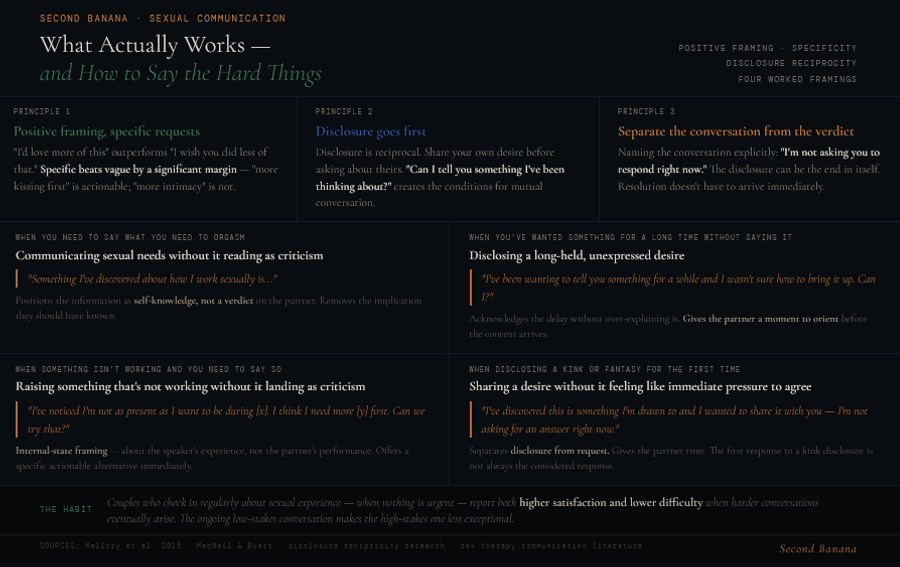
The most useful framing here, supported by communication research: “Something I’ve discovered about how I work sexually is…” This framing positions the information as self-knowledge rather than as criticism, and removes the implication that the partner should have known or guessed.
Something You Want That You Haven’t Asked For
Unrequested desires that have been privately held for months or years are among the most difficult things to disclose, because the act of disclosure implies a prolonged period of unexpressed wanting that can itself feel like a vulnerability or an accusation. (Why didn’t you say something sooner? What does it mean that you’ve wanted this and not said it?)
The most useful framing here involves naming the fact of the unexpressed period without apologising for it: “I’ve been wanting to tell you something for a while and I wasn’t sure how to bring it up. Can I?” This acknowledges the delay without over-explaining it and gives the partner a moment to orient themselves before the content arrives.
Something That’s Not Working
This is the hardest category, because it most directly implies a judgment about the partner’s performance. The framing that research supports most consistently is the one that repositions the issue as information about the speaker rather than a verdict on the listener:
“I’ve noticed I’m not as present as I want to be during [specific thing]. I’ve been trying to understand what that’s about for me, and I think part of it is that I need more [specific thing] first. Can we try that?”
This framing: names the experience in terms of the speaker’s internal state rather than the partner’s actions; positions it as a discovery rather than an established complaint; and immediately offers a specific actionable alternative, making the conversation generative rather than merely critical.
A Fantasy or Kink You’ve Never Mentioned
The disclosure of a kink or fantasy to a partner who doesn’t know about it is among the highest-stakes sexual communication conversations, because the possible outcomes include not just “they don’t want to do it” but “they’re uncomfortable that I want it,” “they see me differently now,” and “this changes something about how they think about me.”
The research on kink disclosure in established relationships — sparse but consistent — finds that the timing and framing of the initial disclosure matters more than the content. Disclosures framed as sharing something about the self (“I’ve discovered this is something I’m drawn to and I wanted to share it with you”) produce better responses than disclosures framed as requests (“will you do this?”) because they separate the disclosure from the implicit pressure to immediately agree or refuse.
They also allow the partner time: the first response to a kink disclosure is not always the considered response. Giving a partner room to sit with new information before expecting an answer respects the fact that they may need time to locate their own response.
Building the Habit
The most consistent predictor of good sexual communication is not the quality of individual high-stakes conversations but the existence of an ongoing low-stakes habit of talking about sex — when there’s nothing urgent to address, when things are going well, when the conversation is about curiosity rather than problem-solving.
Couples who check in regularly about sexual experience — “Is there anything you’ve been thinking about lately?” “Was there anything about last week that was particularly good?” “Anything you’d want more of?” — report both higher sexual satisfaction and lower difficulty when harder conversations eventually arise. The infrastructure of an ongoing conversation makes individual difficult disclosures less exceptional and therefore less threatening.
This habit is also what Second Banana is practising when you use it. Writing a post that describes what you want honestly, choosing tags that represent your actual desire rather than a more defensible version of it, reading other people’s posts and noticing what resonates and what doesn’t — this is all desire-communication practice. The skill that makes the platform work is the same skill that the research identifies as the single strongest predictor of sexual satisfaction. It’s just being exercised in a different context, with the stakes lowered by the anonymous architecture, until it becomes available to bring into the rooms that matter most.
Second Banana and the Communication That Matters Most
There is a specific reason that Second Banana’s post-first model is not just a practical mechanism but an epistemological one. Writing about what you want before you have a specific partner to tell it to forces a kind of self-knowledge that most people never develop: you have to know what you want clearly enough to put it into words that a stranger could understand. The vague internal sense of “I want more intimacy” or “something is missing” has to become specific enough to be legible.
That specificity is not a Second Banana requirement for its own sake. It is the precondition for the sexual communication that the research tells us matters most. You cannot tell a partner specifically what you need if you haven’t found the words for it yet. The platform is a space to find the words.
Find those people. They’re already practising the most important sexual skill there is.