What a Situationship Actually Is (and Why You’re Still In One)
What a Situationship Actually Is (and Why You're Still In One)
Published by Second Banana · Relationships & Dynamics Series
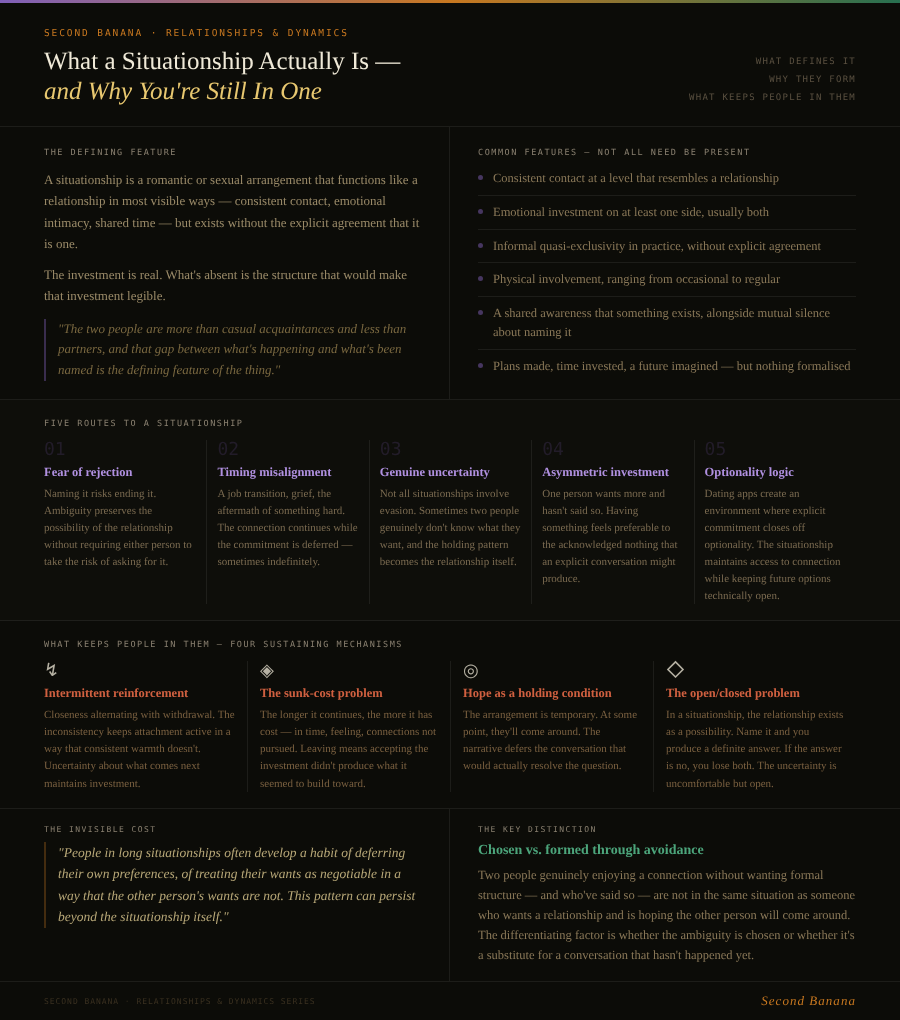
A situationship is a romantic or sexual arrangement that functions like a relationship in most visible ways — consistent contact, emotional intimacy, shared time, sometimes physical involvement — but exists without the explicit agreement that it is one. The two people are more than casual acquaintances and less than partners, and that gap between what's happening and what's been named is the defining feature of the thing.
The word has circulated long enough now that most people have a rough sense of what it means. What gets discussed less often is the mechanism: why situationships form, what need they meet, and what structural factors make them so difficult to exit even when both people involved are aware that the arrangement isn't quite what either of them would choose.
This is not an article about why situationships are bad. Many of them are entered into freely, by people who genuinely prefer the arrangement at that stage. But many are also sustained by ambiguity, by fear of making things explicit, and by a particular kind of hope — and those are worth examining separately from the ones that are simply chosen.
What Defines a Situationship
The defining characteristic is the absence of a named agreement. This isn't the same as being casual — a casual arrangement that's been explicitly agreed to is not a situationship; it's a casual relationship. The situationship exists in the space where things are happening but haven't been articulated, where both people are likely aware that there's something between them and equally aware that it hasn't been formally acknowledged.
The common features, most of which need not all be present:
- Consistent contact and ongoing communication, often at a level that resembles a relationship
- Emotional investment on at least one side, usually on both, though not always equally
- Some degree of exclusivity in practice, even without explicit agreement — often neither person is actively dating others, though this hasn't been discussed
- Physical involvement, ranging from occasional to regular, though physical involvement alone doesn't define a situationship
- A shared awareness that something exists alongside a mutual silence about naming it
- Plans made and kept, time invested, some version of a future imagined — but none of it formalised
The last point is worth dwelling on. Situationships are not necessarily characterised by low investment. They can involve a great deal of time, feeling, and care. The investment is real; what's absent is the structure that would make that investment legible.
Why They Form
Situationships form when both people want something they're not willing or able to claim directly. The routes to this are varied.
Fear of rejection
If you name what you want and the other person doesn't want the same thing, the arrangement ends. The situationship preserves the possibility of the relationship without requiring either person to take the risk of explicitly asking for it. The ambiguity functions as protection.
Timing misalignment
One or both people is in a life phase that doesn't feel conducive to a formal relationship — a job transition, grief, the aftermath of something hard. The situationship allows the connection to continue while the internal work is deferred. Sometimes this resolves into something explicit. Often the deferral becomes indefinite.
Genuine uncertainty
Not all situationships involve evasion. Sometimes two people genuinely don't know what they want from each other, or from anyone. The indefinite arrangement is a holding pattern while they figure it out. The problem arises when the holding pattern becomes the relationship itself.
Asymmetric investment
In many situationships, one person wants more than the other and hasn't said so. The person who wants more accepts the terms available because having something is preferable to the acknowledged nothing that an explicit conversation might produce. The person who wants less is often aware of this, which produces its own discomfort.
The optimisation logic of modern dating
Dating apps create an environment where explicit commitment comes with a cost: it closes off optionality. The situationship, in this context, can function as a strategy for maintaining access to connection while keeping future options technically open. Neither person has agreed to anything, so neither has foreclosed anything. This can be deliberate or largely unconsidered.
What Keeps People In Them
The more interesting question than why situationships form is why they persist. Many people are aware, at some level, that they would prefer a clearer arrangement, and yet the situationship continues.
Several mechanisms sustain them:
Intermittent reinforcement
Situationships characteristically involve irregular signals — periods of closeness alternating with withdrawal, warmth followed by distance. This pattern is not random. The inconsistency keeps the attachment active in a way that consistent warmth often does not. The uncertainty about what will happen next maintains investment and attention.
The sunk-cost problem
The longer a situationship continues, the more it has cost — in time, in feeling, in the relationships or connections that weren't pursued while this one was ongoing. The investment creates resistance to exit. Leaving would mean accepting that the investment didn't produce what it seemed to be building toward.
Hope as a sustaining condition
Most situationships are sustained by an implicit narrative: that the arrangement is temporary, that at some point the other person will recognise what's here and choose to formalise it, that the ambiguity will resolve in the right direction. The narrative isn't delusional — sometimes it's accurate. But it functions to defer the conversation that would actually resolve the question.
The fear of what explicit means
In a situationship, the relationship exists as a possibility. The moment you name it, you produce a definite answer. If the answer is yes, you gain a relationship but lose the dream of one, which carries its own odd grief. If the answer is no, you lose both. The uncertainty is uncomfortable but it's also open.
What It Costs
The costs of a situationship are often invisible while they're accumulating and legible mainly in retrospect.
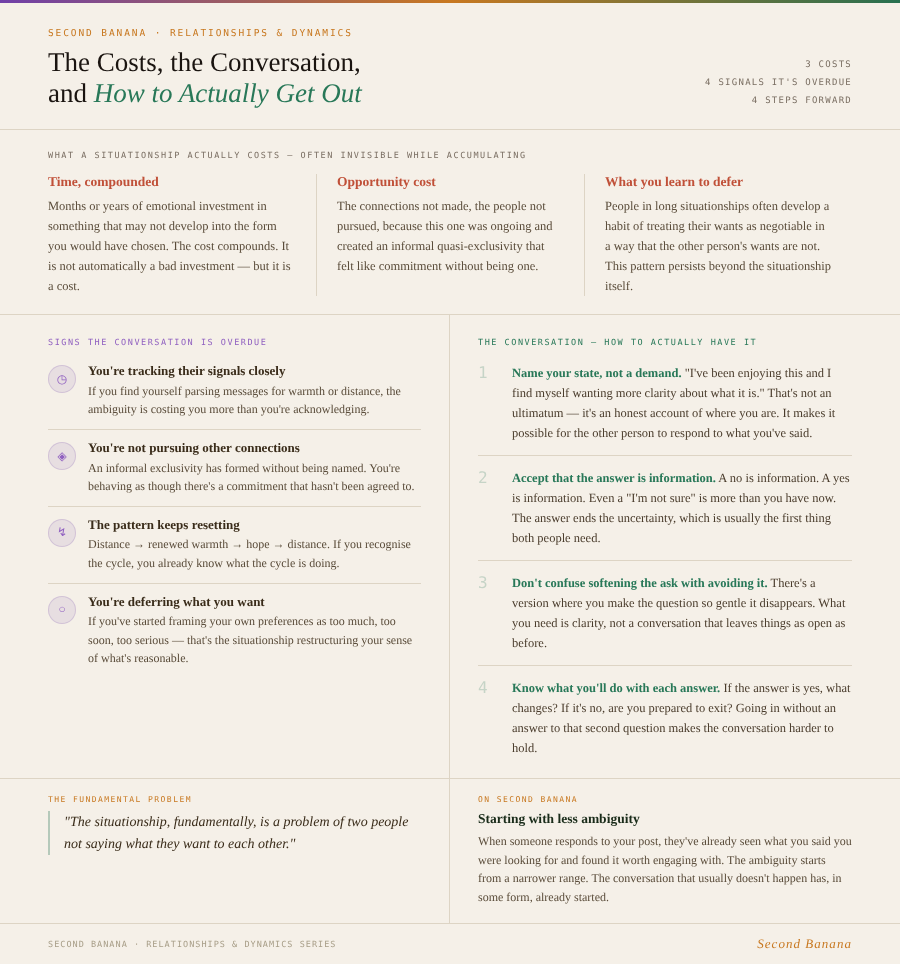
The most direct cost is time — months or years of emotional investment in something that may not develop into the form you would have chosen. This is not automatically a bad investment; a lot of genuine experience happens in situationships. But it is a cost, and it compounds.
There are also opportunity costs: the connections not made because this one was ongoing, the people not pursued because the situationship created a kind of informal quasi-exclusivity that felt like a commitment without being one.
The less visible cost is to your own sense of what you're allowed to want. People in long situationships often develop a habit of deferring their own preferences, of treating their wants as negotiable in a way that the other person's wants are not. This pattern can persist beyond the situationship itself.
The Conversation That Usually Doesn't Happen
Most situationships end without a conversation about what they were. They dissolve through distance, or they gradually become relationships without ever being named, or one person simply leaves. The explicit conversation about what's happening — which both people would usually benefit from, even if the outcome isn't what one person hoped — rarely occurs.
The reason is straightforward: the conversation is high-risk. It requires naming something that both people may have avoided naming deliberately, and it produces a definite answer where indefiniteness was serving a function.
What's worth noting is that the conversation doesn't have to be a confrontation or an ultimatum. It can simply be an expression of where you are. "I've been enjoying this and I find myself wanting more clarity about what it is." That's not a demand; it's an honest account of your own state. It makes it possible for the other person to respond honestly to what you've said rather than to what they imagine you might want.
The outcome of that conversation isn't guaranteed. But it ends the uncertainty, which is usually the first thing both people need.
Not All Situationships Are the Same
It's worth distinguishing between situationships that both people have chosen and ones that have formed through avoidance. The former is a valid arrangement. Two people who are genuinely enjoying a connection without wanting the structure of a formal relationship and have said so — implicitly or explicitly — are not in the same situation as someone who wants a relationship and is hoping the other person will come around.
The confusion arises because from the outside, and sometimes from the inside, they can look identical. The differentiating factor is whether the ambiguity is chosen or whether it's serving as a substitute for a conversation that hasn't happened yet.
The Second Banana Angle
The Second Banana format is a small structural intervention in the ambiguity problem. When someone writes a post about who they are and what they're looking for — not a photograph and a brief, but an actual account of themselves and their intentions — they're making their preferences explicit before anyone responds. The post is itself the conversation that usually doesn't happen.
This doesn't guarantee clarity in every connection that follows. People can still be uncertain; preferences can still be unclear. But the person who responds to your post has at minimum seen what you said you were looking for and found it worth engaging with. The ambiguity starts from a narrower range.
The situationship, fundamentally, is a problem of two people not saying what they want to each other. Second Banana is a format that makes saying it slightly less possible to avoid. 🍌