
Anonymity Kink: The Psychology of Not Knowing and Not Being Known | Second Banana
Anonymity Kink:
The Psychology of Not Knowing and Not Being Known — and Why Withheld Identity Is One of the Most Consistently Compelling Erotic Charges
The Stranger in the Room
There is a specific quality of erotic charge that attaches to the unknown — to the person whose face you cannot see, whose name you will never learn, who will be gone before morning and leave nothing behind but the memory of the encounter. This is among the most widely reported sexual fantasies across genders and orientations. The stranger fantasy, in its various forms, consistently appears in large-scale surveys of sexual interests as one of the most common. And yet it is rarely discussed with any precision, because the precision requires naming something that most people have been taught to treat as evidence of something troubling about themselves rather than as a specific and understandable erotic orientation.
Anonymity kink describes the specific erotic charge some people locate in withheld or concealed identity — their own, their partner’s, or both. It encompasses the stranger encounter, the masked or hooded partner, the anonymous online exchange that goes no further than words, the glory hole and the blindfold and the encounter that is deliberately structured to prevent identification. What these forms share is not danger or transgression for its own sake, but a specific quality of erotic freedom that anonymity enables: the freedom from the social management layer that known identity requires.
This piece covers the psychology of anonymity kink from both sides — being anonymous and encountering it — the specific forms it takes, its relationship to other dynamics in this series, and why Second Banana’s own architecture is unusually well-matched to this orientation.
When no one knows who you are, you can be exactly who you are. Anonymity doesn’t conceal the self. For many people, it’s the first time the self has room to show up fully.
The Psychology: Why Anonymity Is Erotic
The Social Management Layer, Lifted
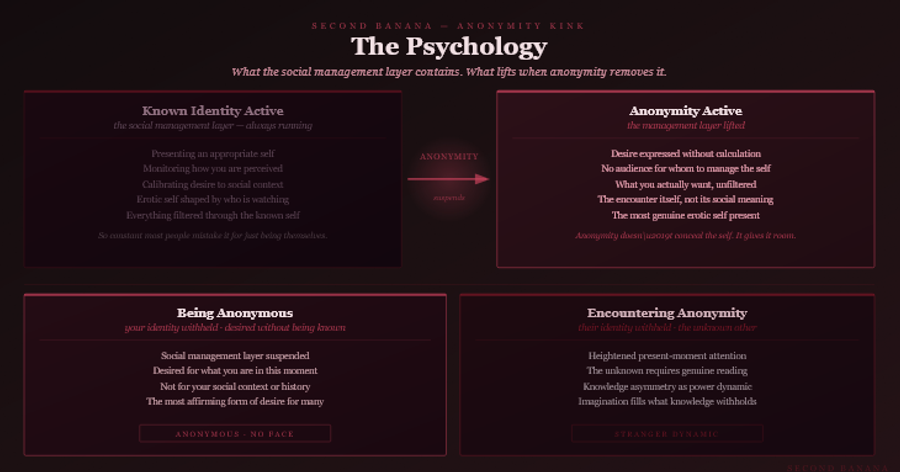
Human social interaction is governed by an extensive layer of identity management: the continuous, largely automatic process of presenting an appropriate version of oneself, monitoring how one is being perceived, calibrating behaviour to the social context and the specific person one is with. This management layer is so constant that most people have difficulty distinguishing it from simply being themselves. It operates at a background level throughout most social encounters, including most sexual ones.
Anonymity suspends this layer. When neither party knows who the other is — or when the anonymous party knows that their identity is concealed — the requirement to present, manage, and calibrate is removed. What remains is something more immediate and less mediated: desire, response, physical presence, and the encounter itself, unfiltered by the social machinery that normally surrounds it. For many people, this quality of unmediated encounter is itself deeply erotic — not because of the transgression it represents but because of the presence it enables.
This is the same mechanism that makes other forms of role-play, persona adoption, and identity suspension erotically charged. The difference with anonymity kink is that the suspension is achieved through concealment rather than through construction: not by adopting a different identity but by removing the known one.
The Freedom of Not Being Seen
Being known creates obligations. When someone knows who you are — your name, your face, your social context — your erotic self is subject to their judgment, their memory, their capacity to connect what happens between you to your identity in the rest of your life. For many people, this awareness operates as a significant inhibitor: what they want erotically is shaped and constrained by what they believe the other person’s knowledge of them allows.
Anonymity removes this. The person who is anonymous can want what they actually want, express what they actually feel, inhabit the erotic register that is genuinely theirs without calculating what it will mean for how they are seen. This freedom is not the freedom to do something they would otherwise consider wrong — it is the freedom to be something they are that the management layer normally keeps compressed. The anonymous encounter can be, for many people, the most genuinely self-expressive erotic experience they have, precisely because the self that appears there is not being managed for an audience.
The Charge of the Unknown Other
The erotic charge of not knowing who your partner is operates through a different but related mechanism. The unknown partner is, in a specific sense, pure potential — their identity is undefined, which means the encounter is not constrained by the social history, relational context, or personal associations that a known person brings. The stranger is only what they are in this moment, and this moment is only what it is.
There is also a specific quality of heightened attention that the unknown produces. When you cannot rely on prior knowledge of a person to predict their responses, to anticipate their needs, or to calibrate your own behaviour against a known reference point, you must be more fully present to what is actually happening. The unknown partner requires more genuine attention, more actual reading of moment-to-moment signals, more real-time responsiveness. This heightened presence is itself erotic in ways that the comfortable predictability of familiar partnerships sometimes is not.
The mystery dimension also carries its own specific charge for many practitioners — the imagination fills in what knowledge does not supply, and the imagination’s version of the unknown partner is often specifically calibrated to what the person finds most compelling. The stranger can be exactly what you want them to be, at least until reality resolves the ambiguity, and the sustained ambiguity of anonymity maintains this imaginative dimension longer.
The Forms Anonymity Kink Takes
The Stranger Encounter
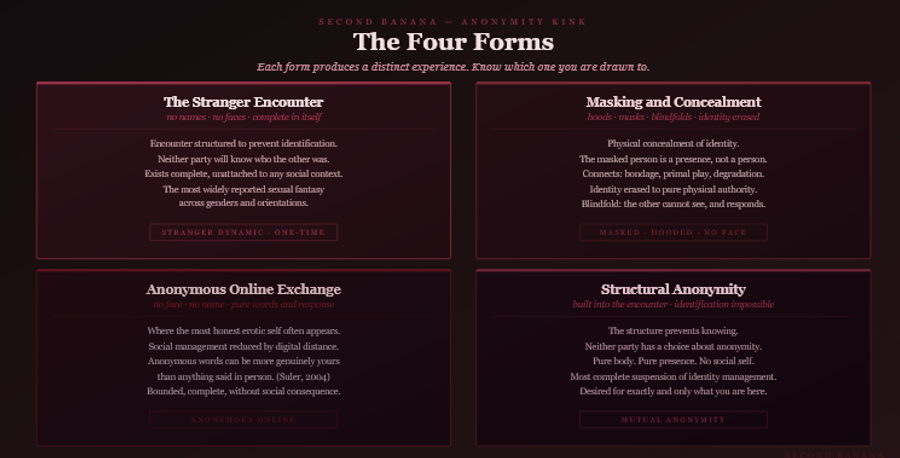
The stranger fantasy — the encounter with someone whose identity you do not know and will not learn — is the most widely reported form of anonymity kink and one of the most consistently common sexual fantasies across populations. In its explicitly kink form, it is structured to maintain the anonymity throughout: no names exchanged, no faces seen, no contact information, no follow-up. The encounter exists complete in itself, unattached to any social context before or after.
The appeal is the combination of psychological mechanisms described above: the social management layer suspended, the unknown other requiring genuine presence, the encounter existing without consequences in the ordinary social world. For many practitioners, the stranger encounter is among the most intensely erotic experiences available precisely because of this combination — it is more purely about desire and response than almost any other form of sexual engagement.
Masking and Identity Concealment
Physical anonymity through masking — hoods, masks, blindfolds, anything that conceals the face or prevents identification — is the form of anonymity kink that overlaps most directly with other dynamics in this series. The blindfold is among the most common entry-level bondage accessories, and its primary function is exactly what anonymity kink describes: it prevents the blindfolded person from seeing (and therefore knowing) their partner, and it transforms the quality of the encounter in the ways the psychology section describes.
Full masking — the anonymous partner whose face is entirely concealed — adds a dimension of identity erasure that connects to degradation kink (the person reduced to a body rather than an identity), to primal play (the animal presence that precedes social identification), and to the specific eroticism of power that is expressed through bodies rather than through persons. The masked partner is not a person in the social sense: they are a presence, a physical force, a specific quality of erotic attention, entirely detached from the social machinery of names and faces and history.
Anonymous Online Exchange
The anonymity of online erotic exchange — no face, no name, pure words and response — has its own specific erotic register that is distinct from in-person anonymity and worth treating separately. For many people, anonymous online exchange is where the most honest version of their erotic self appears: the social management layer that governs in-person interaction is reduced, the known-identity obligations are absent, and what remains is desire expressed directly in language.
Many people whose erotic self-expression is most constrained in person — by shyness, by professional context, by the social complexity of their ordinary lives — discover in anonymous online exchange a quality of erotic freedom and directness that they cannot access elsewhere. The words they write anonymously are often more genuinely theirs than anything they say in person, because they are not being shaped by the social management of a known identity.
This form of anonymity kink connects directly to the written erotica and sexting dynamics that have their own extensive communities, and to the specific charge of being responded to by someone who is themselves anonymous — a mutual anonymity that creates a specific quality of encounter, bounded and complete, that ordinary social life rarely provides.
Glory Holes and Structural Anonymity
Structural anonymity — encounters designed and built to prevent identification, of which the glory hole is the most culturally recognised example — represents the most fully committed form of anonymity kink. The entire encounter is structured around the impossibility of knowing: neither party can see the other, neither knows who the other is, neither has any obligation or connection beyond the encounter itself. The structure removes choice about anonymity; it is simply the condition of the encounter.
The specific erotic charge of structural anonymity is the combination of total freedom from identity management with total physical engagement. The person on either side of the partition is purely a body, a presence, a source of specific physical sensation, with no social context attached. For practitioners who are drawn to the complete suspension of the social self, this form offers something that partially-anonymous encounters cannot: the genuine impossibility of being known.
Both Sides: Being Anonymous and Encountering It
Being Anonymous
The person who is anonymous in an encounter — whose identity is concealed, whose name is not known, who will leave no trace — experiences the freedom described at length above: the social management layer suspended, the self that appears more genuinely theirs, the erotic expression less constrained by social obligation. But there is an additional dimension that is worth naming specifically: the specific pleasure of being desired without being known.
When someone responds to you erotically without knowing who you are — without the context of your social status, your professional identity, your relationship history, any of the things that normally shape how people respond to you — the desire that reaches you is more purely about what you are in this encounter rather than what you are in your life. Many practitioners describe this as among the most erotically affirming experiences available: being wanted for exactly what you are presenting, without any of the social machinery that normally mediates that response.
Encountering Anonymity
The person who encounters anonymity — whose partner is unknown, masked, or deliberately unidentified — experiences the heightened presence, imaginative freedom, and specific charge of the unknown other described above. But there is also a specific quality of the power dynamic that anonymity creates that is worth naming. The anonymous partner holds a specific kind of authority: they know who they are, and you do not. This asymmetry of knowledge is itself a form of power, and for practitioners who are drawn to power dynamics, the knowledge asymmetry of anonymity has its own specific charge.
The encounter with a masked or unknown partner also carries a specific quality of surrender — not the negotiated surrender of a formal D/s dynamic, but the more elemental surrender of giving oneself to someone whose identity one cannot verify. This requires and produces a specific quality of trust and present-moment commitment that is distinct from more structured forms of erotic surrender.
Anonymity, Consent, and Safety
Anonymity kink requires specific attention to consent and safety precisely because the normal social mechanisms that support both — knowing who you are dealing with, having recourse to shared social context, being accountable to one’s identity — are deliberately suspended. This does not make anonymity kink more dangerous than other forms of sexual engagement, but it does mean the consent and safety architecture needs to be explicit rather than implicit.
In fully anonymous in-person encounters, the consent negotiation typically happens before anonymity is established: what is and is not on offer, what signals mean what, how the encounter can be ended. The anonymity is the context within which the already-negotiated encounter happens, not an alternative to negotiation. Encounters that begin without any consent discussion and use the anonymity structure as cover for the absence of discussion are not anonymity kink — they are simply encounters without consent, with anonymity providing deniability.
For online anonymous exchange, the consent architecture typically emerges through the exchange itself: the gradual escalation through mutual response, the explicit naming of what is and is not welcome, the established norms of whatever platform or context the exchange is happening in. The anonymity does not remove the requirement for this architecture; it changes the form it takes.
What This Has to Do With Second Banana
The post that someone writes on Second Banana, before anyone has responded and before they have committed their identity to the expression, is often the most honest erotic self-expression they have produced. The anonymity of the posting context — the fact that the post exists before it is attached to a known person — enables exactly the freedom that anonymity kink practitioners seek. For many users, the experience of writing that post is itself a form of anonymity kink: the specific pleasure of expressing desire without social management, and waiting to see who responds to what you actually want.
The Second Banana tag system gives anonymity kink practitioners specific vocabulary:
- Anonymity kink — the orientation itself
- Stranger dynamic — for those specifically drawn to no-name, no-face encounters
- Masked / hooded — for physical identity concealment
- Anonymous online — for those whose primary expression is digital and nameless
- No names / no faces — specific structural preferences
- Identity play — for those who combine anonymity with persona and character work
- One-time encounter — for those seeking the complete stranger dynamic
- Ongoing anonymous connection — for those who want sustained anonymity within a recurring exchange
- Mutual anonymity — for encounters where neither party is identified
The anonymous posting model also means that practitioners of anonymity kink are already, in a sense, doing the thing on the platform. The post they write is an anonymous expression of desire; the responses they receive are from people who responded to that expression without yet knowing them fully. The platform’s structure is already anonymity kink’s natural habitat. The Second Banana post is not just a tool for finding an anonymous encounter — it is itself an anonymous encounter of a kind, between an expressed desire and the people who recognise themselves in it.