
Orgasm Control and Denial: Edging, Denial, and the Neuroscience of Wanting | Second Banana
Orgasm Control and Denial:
Edging, Denial, Chastity, and the Neuroscience of Why Wanting Longer Makes the Wanting Itself Pleasurable
The Kink That Went Mainstream Without Its Framework
Edging — the practice of bringing oneself or a partner to the edge of orgasm and then stopping, repeatedly, before allowing or withholding release — has had a curious recent history. In the last several years it migrated from kink communities into wellness content: articles about extending pleasure, improving orgasm intensity, and ‘sexual mindfulness.’ TikTok, men’s health publications, and relationship advice columns picked it up as a technique rather than a practice, stripped of its erotic context and reframed as optimisation.
This mainstreaming is not a bad thing — it means a larger audience now has the word and some of the experience. But it also means that a large proportion of people who find edging genuinely compelling are working with a framework that only covers the lightest end of a spectrum that extends into considerably more interesting territory. The orgasm control and denial dynamic, in its full form, is not a technique for better orgasms. It is a power exchange with its own specific psychology, its own neuroscience, its own vocabulary of forms, and its own community of practitioners who have been exploring its possibilities for much longer than wellness culture has been writing about it.
This piece covers the full spectrum: edging as sensation practice, denial as power exchange, chastity as physical enforcement, ruined orgasm as its own distinct category, and the specific neuroscience of anticipation that explains why this dynamic produces the intensity it does. It is written for people who already know they’re drawn to this territory and want the full map, and for people who encountered edging in its wellness framing and sense there is considerably more on offer.
Edging is the entry point. Orgasm control is the dynamic. Denial is the power. The neuroscience of wanting explains why all three produce such an intense erotic charge.
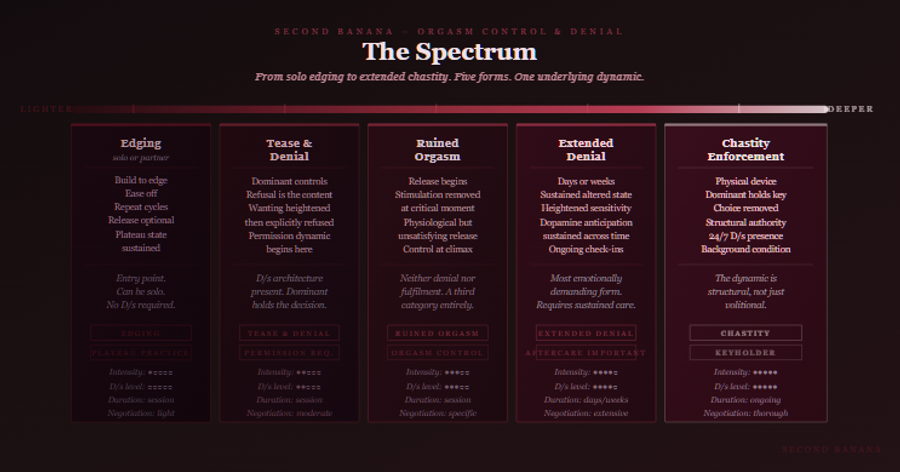
The Spectrum: From Edging to Extended Denial
Orgasm control and denial covers a wide range of practice that is worth mapping before going into the psychology of any individual form. The common thread across all of it is the deliberate management of the trajectory toward orgasm — whether by extending the approach, repeatedly redirecting it, deliberately sabotaging it at the last moment, or preventing it entirely for an extended period.
Edging
Edging is the most accessible entry point and the most widely practiced form. The practice involves bringing arousal to the brink of orgasm — the ‘edge’ — and then reducing stimulation to prevent climax, then returning to build again. The cycle can repeat multiple times in a single session. When orgasm is eventually permitted it is typically more intense than it would have been without the edging, because the neurochemical buildup has been sustained over a longer period.
Edging can be self-directed — a solo practice — or partner-directed. In the partner-directed form it begins to take on a D/s dimension: one person is managing the other’s approach to orgasm, deciding when to ease off, when to return, and ultimately whether and when to allow release. This is where edging shades into orgasm control proper.
Tease and Denial
Tease and denial extends the edging logic into a fuller erotic dynamic. The dominant builds arousal deliberately — through physical stimulation, through words, through anticipation — and withholds release, not merely pausing but explicitly refusing. The refusal is itself part of the erotic content. The submissive’s desire is acknowledged, engaged with, heightened, and then denied — and this denial is not a failure of the dynamic but its expression.
Tease and denial is where orgasm control becomes a power exchange in the fullest sense. The dominant holds something the submissive wants intensely. The submissive’s wanting is visible, real, and not immediately satisfied. The gap between desire and fulfilment is the dynamic’s primary erotic content, and the dominant’s authority is expressed through their management of that gap.
Extended Denial
Extended denial moves the timeframe beyond a single session. Rather than edging within an encounter and then permitting release, extended denial withholds orgasm across hours, days, or longer. The submissive is kept in a sustained state of heightened arousal and unmet desire. The dominant may permit stimulation without release, may prohibit it entirely, or may use a chastity device to enforce the prohibition physically.
Extended denial produces specific psychological and physiological effects that single-session denial does not — effects that are themselves erotically charged and that form part of the appeal of the dynamic for practitioners who pursue it. The heightened sensitivity to arousal cues, the preoccupation with desire, the specific quality of attention that sustained wanting produces — all of these are experiences that the dynamic deliberately cultivates.
Ruined Orgasm
Ruined orgasm is a distinct category that deserves its own treatment because it operates on a different logic from denial. In a ruined orgasm, physical climax is permitted to begin but stimulation is withdrawn or redirected at the critical moment, producing an orgasm that is physiologically real but experientially unsatisfying — a release without the peak pleasure that normally accompanies it.
The ruined orgasm is neither denial nor fulfilment. It occupies a specific middle position that is itself erotically charged for the people who seek it. For the submissive, it is a particular form of the dominant’s control: even the moment of supposed release is managed and directed. For the dominant, it is a precise and technically demanding expression of that control. The ruined orgasm says: your body’s response is mine to direct, even at the moment when you expected to be released from that direction.
Forced Orgasm
At the other end of the control spectrum from denial is forced orgasm — where the dominant compels orgasm against the submissive’s protestations, often repeatedly. Within a consensual context this is typically practiced as a form of CNC-adjacent play in which the ‘forcing’ is part of the agreed-upon scenario. The dynamic inverts the control logic of denial: rather than withholding, the dominant overwhelms. Both are expressions of the same fundamental power over the submissive’s most intimate physiological responses.
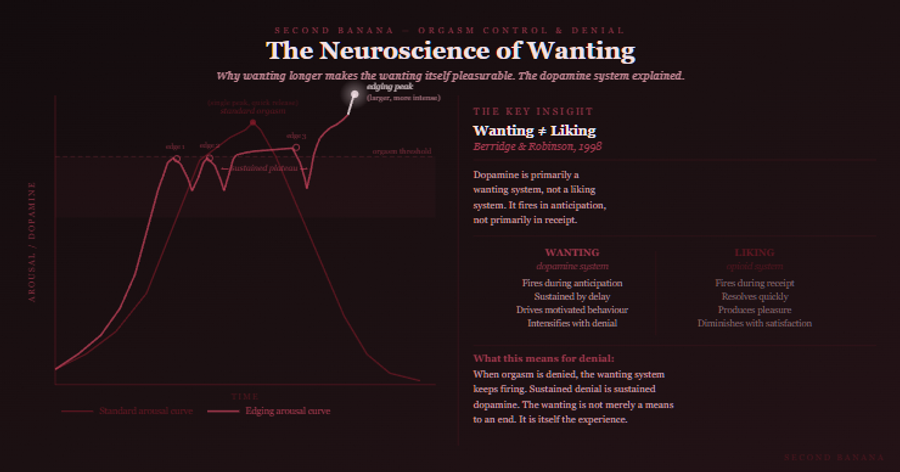
The Neuroscience of Wanting
The specific intensity of orgasm control and denial — why wanting something longer makes the wanting itself pleasurable, why denial can feel as compelling as satisfaction — has a reasonably clear neuroscientific account that is genuinely interesting and that helps explain why this dynamic produces the effects it does.
The Dopamine Anticipation System
The key insight from neuroscience research on desire and reward is that the dopamine system is primarily a wanting system rather than a liking system. This distinction, developed by Kent Berridge and colleagues at the University of Michigan, is fundamental to understanding why denial works the way it does. Dopamine is released not primarily when we receive a reward but when we anticipate one — and sustained anticipation sustains dopamine release in a way that immediate satisfaction does not.
When orgasm is delayed or denied, the anticipatory dopamine release continues rather than resolving. The wanting state is maintained. This produces a specific neurological experience — heightened attention, increased motivation, a quality of focused desire — that is itself pleasurable and that intensifies the erotic experience rather than merely prolonging it. The person being denied is not simply waiting for a pleasure they’re being kept from. They are in a neurologically distinct state of sustained wanting that has its own experiential character.
This is why edging produces more intense orgasms than uninterrupted stimulation: the dopamine anticipation system has been running at high intensity for a sustained period, and when release finally occurs, the neurochemical cascade is larger. It is also why extended denial can produce a quality of preoccupation and heightened sensitivity that practitioners frequently describe as among the most erotically intense experiences they have — not despite the lack of release but because of it.
The Plateau State
Sexual response research identifies a sustained high-arousal state called the plateau phase — the period of maintained high arousal between the excitement phase and orgasm. Edging, at its most refined, keeps the practitioner in the plateau phase for extended periods rather than moving through it quickly toward resolution. This extended plateau produces its own distinct experiential quality: a sustained altered state of high physiological arousal that has similarities to other altered states produced by intense BDSM practice.
Practitioners who edge extensively report that the plateau state, when sustained long enough, produces a quality of experience that is qualitatively different from ordinary arousal — a heightened sensory awareness, a specific kind of focused presence, and sometimes a dissociative quality that is experienced as pleasurable rather than distressing. This altered state is part of what makes edging more than a technique for stronger orgasms: it is itself an experience worth seeking.
The Psychology of Anticipation
Beyond the neuroscience, there is a specific psychological dimension to the appeal of wanting that operates at a cultural and experiential level. Human beings, it turns out, are frequently happier in anticipation of something than in receipt of it — a well-documented phenomenon in the positive psychology literature. The planning, the imagining, the sustained attention to what is coming all produce a quality of engaged pleasure that the actual receipt of the thing sometimes fails to match.
Orgasm denial deliberately harnesses this anticipation psychology. The submissive who is denied for an extended period is not simply deprived; they are in a sustained state of anticipatory attention to their own desire. The dominant who manages this denial is not simply withholding; they are curating an experience of wanting that is itself pleasurable and that makes the eventual release — if and when it comes — more significant rather than less.
Denial as Power Exchange
Orgasm control and denial is among the most intimate forms of power exchange in the D/s landscape, and this intimacy is a significant part of its appeal for the people who practice it. The dominant who controls another person’s orgasm holds something more fundamental than most other expressions of D/s authority — they hold the timing and permission of a physiological response that is among the most involuntary and most personal that the body produces.
For the submissive, surrendering this control is a specific and profound form of submission. It is not submission to instructions or to physical constraint but to the most intimate possible management of one’s own body. The submissive who genuinely cannot orgasm without permission — whether because of psychological conditioning, chastity device, or the terms of an extended denial dynamic — has given a form of authority that is qualitatively different from most other submissive positions.
The dominant’s experience of holding this authority is correspondingly specific. Knowing that the submissive’s most urgent physical desire is entirely within their management is a form of erotic authority that requires considerable responsibility — the dominant must calibrate the denial carefully, maintaining the submissive in a state that is erotically charged without becoming genuinely distressing, managing the emotional as well as the physiological dimensions of the dynamic.
Permission and the Erotic Weight of Asking
One of the most consistently reported features of orgasm control dynamics is the specific erotic charge of asking permission. The submissive who has agreed to seek permission before orgasm, and who genuinely cannot proceed without it, inhabits a specific psychological position in the moment of asking: they are at peak arousal, they are entirely dependent on the dominant’s decision, and the outcome is uncertain. The dominant’s response — yes, no, wait, or a conditional — carries an erotic weight that is disproportionate to its verbal content.
This permission dynamic can be built into a single session or extended across a longer-term agreement. Couples who operate orgasm control as an ongoing dynamic — where the submissive maintains an agreement to seek permission even outside explicit scenes — report that the permission structure changes the texture of their daily interaction in ways that are themselves erotically charged. The awareness of the agreement, and the specific position it places each person in relative to the other, maintains a quality of D/s engagement even in ordinary life.
Orgasm as Reward
In extended denial dynamics, the eventual permission to orgasm functions as a reward rather than simply a conclusion. This shifts the meaning of orgasm from a natural endpoint to a gift or a prize — something that has been withheld and that is now being granted by the dominant’s choice. Many practitioners report that this shift in meaning changes the quality of the orgasm itself: it is not merely more intense due to the neurochemical buildup but differently experienced, carrying an emotional and relational weight that unmanaged orgasms do not.
Chastity: Physical Enforcement of Denial
Chastity devices — physical devices that prevent genital stimulation or erection — add a dimension to orgasm denial that psychological agreement alone does not provide: the removal of the option to comply or not comply. A submissive who has agreed not to orgasm can choose to break that agreement. A submissive in a chastity device cannot.
This removal of choice is itself erotically charged for many practitioners. The chastity device is a tangible, constant reminder of the dynamic — a physical expression of the dominant’s authority that is present whether or not the dominant is. The submissive who wears a chastity device through an ordinary day — at work, in social situations, in all the contexts where the D/s dynamic is not otherwise visible — maintains a continuous awareness of the power exchange that is different in character from a psychological agreement.
For the dominant, the chastity device provides a specific quality of authority: the knowledge that the physical enforcement is in place removes the need for the submissive’s constant active compliance. The authority is structural rather than volitional. This frees both parties from the moment-to-moment management of the agreement and allows the denial to operate as a background condition of the relationship rather than a foreground negotiation.
Chastity and the Cuckolding Connection
Chastity kink has a well-established connection to cuckolding dynamics — explored in detail in the cuckolding piece in this series — where the cuckold’s chastity device enforces their sexual denial while their partner has encounters with the bull. In this configuration, chastity is not merely a denial tool but a specific expression of the power differential: the cuckold is denied while the partner is fulfilled by someone else. The device makes the asymmetry physical and constant.
But chastity kink exists entirely independently of cuckolding for many practitioners. The device and the denial it enforces are the dynamic, without reference to any third party. The dominant holds the key; the submissive wears the device; the power exchange is complete in that structure alone. Understanding chastity as a standalone dynamic rather than only as a component of cuckolding gives it the full treatment it deserves.
The Practical Landscape: Negotiation and Care
What Gets Negotiated
Orgasm control and denial requires specific negotiation across several dimensions. The duration of denial — whether this is a single session or an extended agreement, and whether there is a defined endpoint or the timeline is at the dominant’s discretion. The conditions under which orgasm may be requested and granted. The consequences of unauthorised orgasm, if any. Whether chastity devices are involved and, if so, who holds the key and under what circumstances it can be accessed. The emotional check-in frequency for extended denial dynamics, because the psychological effects of sustained denial can be significant and require active management.
Extended denial in particular requires more ongoing communication than most D/s dynamics because the emotional effects accumulate over time in ways that are not always predictable. A submissive who is comfortable with three days of denial may find that five days produces an emotional response that requires attention. The dominant’s responsibility includes monitoring these effects and maintaining the dynamic at an intensity that is erotically charged without becoming genuinely distressing.
Aftercare for Denial Dynamics
Aftercare in orgasm control dynamics has a specific character. Following a session that ends in release — particularly after extended edging or extended denial — the physiological and neurochemical resolution can produce a significant emotional response, sometimes called ‘sub drop’ in its more intense forms. The drop from sustained high arousal to post-orgasmic resolution can be sharp, and the emotional vulnerability that follows intense orgasm control play deserves the same quality of aftercare attention as any other intense BDSM session.
For extended denial dynamics that do not end in a session but continue as an ongoing agreement, the concept of aftercare extends to regular check-ins and emotional maintenance conversations. The submissive in a month-long denial dynamic is in a sustained altered state for that period, and the dominant’s responsibility to their wellbeing is correspondingly sustained.
What This Has to Do With Second Banana
Orgasm control and denial is a dynamic that requires a specific kind of partner more than almost any other in this series. The dominant who manages this dynamic well needs to understand the neuroscience of what they’re doing, to calibrate the denial with genuine attention to the submissive’s state, to hold the authority structure with consistency and care, and to manage the emotional dimensions of sustained denial without reducing them to a technique. Finding this person on a platform that asks for photographs and demographic data is largely chance.
The Second Banana post-first model gives practitioners of this dynamic the vocabulary to represent what they’re looking for before anyone responds. A submissive seeking a dominant for an orgasm control dynamic can write about what form of denial appeals — edging within sessions, extended denial, chastity enforcement, ruined orgasm, permission structure — and what they need from a dominant in terms of attentiveness, consistency, and aftercare. A dominant can write about their experience with this dynamic, their approach to calibration, what they enjoy about holding this particular form of authority.
The Second Banana tag system gives both sides specific vocabulary:
- Orgasm control / orgasm denial — the orientation
- Edging — single-session plateau practice
- Tease and denial — the full power exchange form
- Extended denial — multi-day or longer agreements
- Chastity — device enforcement
- Ruined orgasm — the specific middle category
- Permission required — the ongoing agreement structure
- Keyholder — for chastity dynamics where physical enforcement is involved
- Aftercare important — signalling awareness of the emotional dimension
- Dominant who controls / submissive who is denied — role and position
These tags allow people to signal their specific position on the spectrum before the conversation begins — which matters because the person seeking a single-session edging experience and the person seeking a month-long chastity dynamic are looking for genuinely different partners, even though both fall under the same broad category of orgasm control.
The community that Second Banana attracts — people who communicate specifically and honestly about what they want — is particularly well-suited to this dynamic. Orgasm control requires more sustained and attentive communication than most other kinks: it is not something that can be improvised or assumed. The post-first model selects for exactly the quality of practitioner this dynamic requires.