Edging: The Psychology of the Threshold, Why Repeated Approach Builds What a Single Climb Cannot | Second Banana
Edging:
The Psychology of the Threshold, and Why Repeated Approach Builds What a Single Climb Cannot
The Threshold, Not the Calendar
Edging and chastity belong to the same family of denial-based eroticism covered elsewhere in this series, but they operate on entirely different timescales and through different mechanisms, and the distinction matters. Chastity is sustained denial across days, weeks, or longer, typically governed by a keyholder who controls a single eventual release. Edging is denial compressed into a single session — the repeated, deliberate approach to the brink of orgasm followed by a pulled-back retreat, again and again, before any release is permitted at all.
Where chastity’s psychology is built from accumulation over time — acuity, then devotion, then release — edging’s psychology is built from repetition within a single, compressed arc: arousal climbing toward a specific physiological threshold, deliberately interrupted just before that threshold is crossed, allowed to subside, and then built again. The specific charge of edging comes from this repeated proximity to a point of no return that is never quite reached until the person controlling the process — oneself or a partner — decides it finally will be.
This piece covers what is actually happening physiologically and psychologically during edging, why repeated threshold-approach produces an intensity that a single uninterrupted climb does not, the practice as both a solo technique and an explicit power-exchange dynamic, and what makes the eventual release, when it comes, so frequently described as more intense than orgasm reached the ordinary way.
The threshold is not a wall. It is a point you can see from increasingly close range, again and again, without ever quite arriving — until someone decides you finally will.
What Is Actually Happening: The Plateau and the Point of No Return
Human sexual arousal has a recognised physiological arc: excitement, a plateau phase in which arousal intensifies and stabilises at a high level, orgasm, and resolution. Within the plateau phase there is a specific, identifiable threshold — often called the point of no return or the point of ejaculatory inevitability in people with penises, with an analogous threshold in people with other anatomy — beyond which orgasm becomes physiologically inevitable regardless of any further action or inaction.
Edging is the deliberate practice of bringing arousal up to the immediate edge of this threshold and then stopping or reducing stimulation before it is crossed, allowing arousal to partially subside, and then building again. The skill of edging — whether practiced solo or directed by a partner — is precisely in this calibration: close enough to the threshold to produce the specific intensity that proximity generates, but not so close that the threshold is accidentally crossed before it is meant to be.
This is a genuinely different physiological event from chastity’s sustained low-arousal denial. Chastity keeps arousal largely unaddressed over an extended period. Edging repeatedly drives arousal to its physiological peak and pulls back — a completely different pattern of neurochemical and physiological activation, repeated multiple times within a single session.
Why Repeated Approach Builds What a Single Climb Does Not
The Compounding Effect
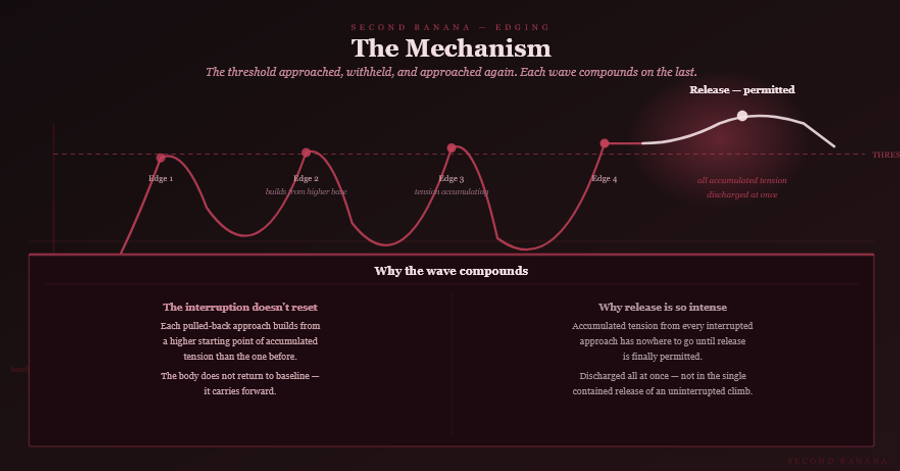
Each approach to the threshold during an edging session involves real physiological escalation — increased blood flow, muscular tension, the build of the same neurochemical cascade that accompanies any arousal climb. When this escalation is interrupted before completion, the body does not simply reset to baseline; each subsequent approach tends to build from a higher starting point of accumulated arousal and tension than the one before. Many practitioners describe each successive edge as feeling more intense than the last, and this is consistent with what is physiologically happening: the cumulative, compounding effect of repeated near-threshold arousal that has not been discharged.
This compounding is the mechanistic explanation for why orgasm following an extended edging session is so frequently and consistently described as significantly more intense than orgasm reached through a single uninterrupted arousal climb. The accumulated tension and arousal from each interrupted approach has nowhere to go until release is finally permitted, and when it is, it is released all at once rather than in the single, more contained discharge of an uninterrupted climb.
The Specific Psychology of Proximity
Beyond the physiological compounding, there is a specific psychological dimension to repeated proximity to a threshold that is not crossed. Each approach to the edge produces a heightened state of focused, present-moment awareness — the body and attention are entirely oriented toward an imminent, significant physiological event. When that event is deliberately withheld at the last possible moment, the heightened state does not simply dissipate; it persists, now combined with the specific psychological charge of having been so close and not arrived.
This repeated experience of acute, focused proximity to climax, withheld at the threshold, produces a sustained quality of intense presence that is psychologically distinct from ordinary arousal building toward a single orgasm. Many practitioners describe extended edging sessions as producing an altered, intensely focused state that has real overlap with the subspace mechanism described elsewhere in this series — the same general neurochemical territory, reached through a specific repeated-threshold mechanism rather than through sustained intense sensation.

Edging as Solo Practice
Edging exists, importantly, as a solo masturbation technique entirely independent of any power dynamic or partner involvement. Many practitioners discover and practice edging purely as a way of intensifying their own solo sexual experience — extending arousal, building toward a more intense eventual orgasm, or simply exploring the specific quality of sustained, threshold-proximate arousal for its own sake.
In this solo context, the practice is entirely self-directed: the practitioner is both the person experiencing the build and the person making the decision to pull back at each approach, requiring a specific kind of self-awareness and self-discipline that some practitioners find valuable and engaging in its own right, separate from any erotic charge connected to power exchange or partner control. This solo dimension of edging deserves to be named clearly, because much of the popular content on this topic assumes a controlling partner is always part of the picture, when for many practitioners it is not.
Edging as Partnered Power Exchange
For other practitioners, edging’s primary charge is explicitly connected to partner control — a dynamic that shares real psychological territory with the chastity keyholder dynamic but compressed into a single session with many more, much more frequent decision points.
The Controlling Partner’s Authority
In partnered edging, the controlling partner makes the repeated, real-time decisions that define the session: when to begin building arousal, how close to the threshold to bring their partner, exactly when to stop or reduce stimulation, how many edges to produce before any release is permitted, and ultimately whether and when release happens at all. This is a much more granular and continuously exercised form of authority than chastity’s single eventual decision — the controlling partner in edging is making dozens of small, precise judgment calls within a single session, each one requiring genuine attunement to their partner’s state.
This places real demands on the controlling partner that connect directly to the attunement and labor described in the Dom piece in this series: reading a partner’s proximity to threshold accurately, in real time, often from subtle physical and vocal cues, and calibrating stimulation with precision. A controlling partner who misjudges and allows an accidental, unintended orgasm, or who is too cautious and never produces the proximity that makes edging effective, is not exercising the skill the dynamic requires.
The Locked Partner’s Experience
For the partner being edged, the specific charge is the combination of repeated, acute physical intensity and the psychological experience of having their threshold managed entirely by someone else’s judgment and timing. Unlike solo edging, where the practitioner retains the final say at every moment, partnered edging requires a genuine yielding of that control — the locked partner experiences the build, the proximity, and the withdrawal entirely according to another person’s decisions, with their own input limited to whatever feedback mechanism (verbal, safeword, or otherwise) the dynamic has established.
This yielding of moment-to-moment threshold control is, for many practitioners, the specific source of edging’s erotic charge in a partnered context — a particularly granular and continuously renewed form of submission, repeated dozens of times within a single session rather than yielded once at the start and held for an extended duration the way chastity’s submission is structured.
What This Has to Do With Second Banana
Edging spans a wide range of specific practitioner orientations — solo practice, partnered power exchange, occasional use as a technique within otherwise conventional encounters, and sustained, session-defining practice for those for whom the threshold dynamic is central to their erotic orientation. Being specific about which of these describes what someone is looking for considerably improves matching quality.
The post-first model allows practitioners to be precise: whether they are looking for a controlling partner who will direct an edging session with real skill and attunement, whether they want to be the controlling partner themselves, or whether edging is simply a technique they enjoy incorporating into broader encounters rather than a defining orientation.
The Second Banana tag system gives edging practitioners specific vocabulary:
- Edging — the practice itself
- Edging control — for those who want to direct a partner’s threshold
- Edged / controlled — for those who want to yield threshold control
- Multiple edges preferred — for those drawn to extended, repeated-threshold sessions
- Orgasm control — for the broader denial orientation that edging connects to
- Chastity and edging — for those who combine both denial mechanisms
- Skilled and attentive — explicit signal about the controlling partner’s required calibration