
Electro Play: The Psychology and Physiology of Electrostimulation, and Why This Sensation Is Unlike Any Other | Second Banana
Electro Play:
The Psychology and Physiology of Electrostimulation, and Why This Sensation Is Genuinely Unlike Any Other
A Genuinely Different Sensation
Electro play — the deliberate application of electrical current to the body for erotic sensation — occupies a distinct category within sensation play, and the distinction is not merely descriptive. Most forms of sensation play work through the skin’s ordinary touch-sensation pathways: pressure receptors, temperature receptors, pain receptors responding to impact, friction, heat, or cold. Electrical stimulation works differently. It bypasses much of this ordinary pathway and addresses nerve and muscle tissue directly — producing sensation through a mechanism that has no real equivalent elsewhere in the sensation play landscape.
This is why practitioners consistently describe electro sensation in terms that don’t map cleanly onto other forms of intensity. It isn’t simply ‘more intense’ impact or pressure. It has a specific tingling, pulsing, sometimes muscle-contracting quality that many describe as feeling like it is happening to the nervous system itself rather than to the skin — a phantom quality, sensation that seems to originate from inside rather than from an external touch. This is not an exaggeration or a purely subjective impression. It reflects the genuinely different physiological mechanism at work.
This piece treats that mechanism with the technical respect it deserves: what is actually happening when current is applied to the body, why the sensation feels the way practitioners describe, the real and specific safety considerations that responsible electro play requires, and the particular psychology of control that this sensation’s precision and variability produces.
Other sensation play touches the skin and lets the nervous system interpret it. Electro play addresses the nervous system directly. That difference is not subtle, and it is the whole reason this kink feels the way it does.
The Actual Mechanism
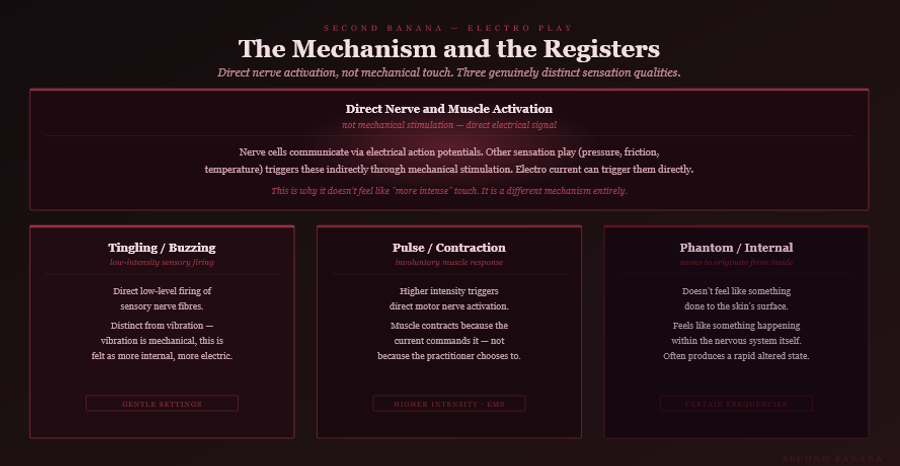
Nerve cells communicate through electrical signals — action potentials that travel along nerve fibres to produce sensation, trigger muscle contraction, or carry pain signals to the brain. Electrical stimulation devices used in electro play apply current directly to the skin’s surface, and at sufficient intensity this current can directly trigger these nerve signals rather than requiring the indirect mechanical stimulation (pressure, vibration, friction) that other sensation play relies on to provoke a nerve response.
At lower intensities, this produces the tingling, buzzing sensation most commonly associated with electro play — direct, low-level activation of sensory nerve fibres. At higher intensities, or with devices specifically designed for it, the current can directly trigger motor nerve activation, producing involuntary muscle contraction — the specific pulsing, gripping sensation that some electro devices are built to produce, particularly in muscle-dense areas.
The frequency and waveform of the current significantly affects the resulting sensation. Different devices and settings produce qualitatively different experiences: a steady, continuous current feels different from a pulsed or rhythmic one; different frequencies activate different nerve fibre types, producing sensations that range from gentle tingling to sharp, percussive sensation to the deep muscle-pulse quality associated with EMS-derived (electrical muscle stimulation) equipment.
The Specific Sensation Qualities
The Tingling and Buzzing Register
At gentle settings, electro sensation produces a specific tingling or buzzing quality that practitioners consistently describe as unlike vibration, despite the common comparison. Vibration is mechanical — the skin and underlying tissue physically moving back and forth. Electro tingling is the direct, low-level firing of sensory nerve fibres, and many practitioners describe it as feeling more ‘electric’ or ‘internal’ than vibration’s more clearly mechanical, external quality.
The Pulse and Contraction Register
At higher intensities or with devices designed for it, electro play can produce involuntary muscle contraction — a specific pulsing or gripping sensation, particularly noticeable in muscle-dense tissue. This sensation is genuinely unique to electro play; no other form of sensation play produces involuntary muscle response in this way. Practitioners who are specifically drawn to this register often describe a particular fascination with the body responding in ways that feel outside their own conscious control — the muscle contracting because the current commands it to, not because the practitioner is choosing to tense it.
The Phantom and Internal Quality
Many practitioners describe electro sensation, especially at certain frequencies and intensities, as having a quality that seems to originate from inside the body rather than from an external touch — sensation that doesn’t feel like something being done to the skin’s surface but like something happening within the nervous system itself. This phantom quality is part of what makes electro play feel categorically different from other intensity-based kinks, and it connects to why many practitioners describe electro sessions as producing an unusually rapid and complete altered state — the direct nervous system address seems to bypass some of the gradual build that other forms of intense sensation require.
Equipment and the Real Safety Considerations
Electro play’s equipment landscape spans a wide range of device types with genuinely different mechanisms, intensities, and risk profiles, and conflating them is a meaningful safety error.
TENS and EMS-Derived Devices
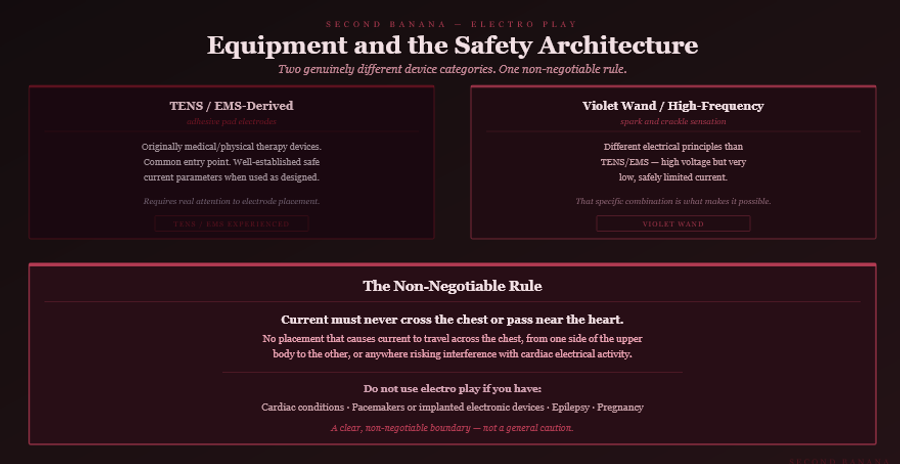
Devices derived from TENS (transcutaneous electrical nerve stimulation) and EMS (electrical muscle stimulation) units — originally medical and physical therapy devices — are among the most common entry points into electro play, typically using adhesive pad electrodes placed on the skin’s surface. These devices generally operate within well-established safe current parameters when used as designed, but require real attention to electrode placement.
Violet Wands and High-Frequency Devices
Violet wands and similar high-frequency, low-current devices produce a different sensation profile — often a sharper, more localized spark or crackle sensation — and operate on different electrical principles than TENS/EMS-derived equipment. These devices typically use high voltage but very low, safely limited current, which is the specific combination that makes the sensation possible without the higher-current risks of other electrical equipment.
Placement: The Most Important Safety Rule
The single most important safety rule in electro play, repeated consistently across every reputable resource on the topic, is that current must never be allowed to cross the chest or pass anywhere near the heart — electrode or contact placement that would cause current to travel across the chest, from one side of the upper body to the other, or anywhere that risks interference with cardiac electrical activity is categorically unsafe. This is not a minor caution; it is the central safety principle that all responsible electro play practice is built around, and it determines what placements are acceptable before any other consideration.
People with cardiac conditions, pacemakers or other implanted electronic medical devices, epilepsy, or who are pregnant should not engage in electro play, as electrical current carries specific risks for these conditions that other sensation play does not. This is a clear, non-negotiable safety boundary rather than a general caution.
Starting Conservatively
Because electrical sensation can escalate in ways that are less intuitively predictable than mechanical sensation play, responsible practice starts at the lowest intensity setting and increases gradually, with continuous communication about the sensation’s quality and intensity throughout. Equipment should be well-maintained, used as designed by reputable manufacturers, and never improvised from non-purpose-built electrical devices.
The Psychology of Control
Electro play’s power exchange dimension has a specific psychological texture distinct from CBT’s vulnerability-of-anatomy framing, even though both are sensation-and-trust based dynamics covered in this series. Where CBT’s charge centres on the specific vulnerability of the anatomy involved, electro play’s charge centres significantly on the controllability and variability of the sensation itself — the dial, the rhythm, the pattern as something the controlling partner plays like an instrument.
For the controlling partner, electro equipment’s precise, continuously adjustable intensity and pattern settings provide a specific and unusually granular form of control — the ability to shape a partner’s sensation experience with real-time precision that other sensation play tools don’t offer in quite the same way. Many practitioners who control electro play describe a specific satisfaction in this precision: composing a sensation experience for a partner the way a musician might compose with an instrument, with intensity and rhythm and pattern all available as deliberate creative choices.
For the receiving partner, the specific charge often connects to the phantom, internal quality of the sensation described above — the experience of a partner having this degree of direct, precise access to one’s own nervous system, producing sensation that feels like it is originating from inside rather than being done to the skin’s surface. This particular quality of access and control — more direct and more precisely variable than most other forms of sensation play — is, for many receiving partners, the specific source of electro play’s erotic charge.
What This Has to Do With Second Banana
Electro play requires a partner with specific equipment literacy and genuine safety knowledge — this is not a kink where general enthusiasm substitutes for actual competence, given the real physiological considerations involved. Finding a partner who has the specific combination of genuine interest, appropriate equipment, and safety literacy is a real matching challenge that general dating platforms handle poorly.
The post-first model allows electro practitioners to be specific about their equipment, experience level, and safety practices before any encounter — essential information that protects both parties and that is awkward to introduce mid-conversation on platforms not built for this level of specificity.
The Second Banana tag system gives electro practitioners specific vocabulary:
- Electro play — the practice itself
- TENS / EMS experienced — specific equipment familiarity
- Violet wand — for those drawn to high-frequency devices specifically
- Electro control — for those who want to direct sensation
- Electro receiving — for those who want to be on the receiving end
- Safety-literate — explicit signal about safety knowledge
- Own equipment — for those who bring their own devices
- New to electro — honest experience signalling for those exploring