
How to Write Your Second Banana Post (And Why Specificity Changes Everything) | Second Banana
How to Write
Your Second Banana Post.
On specificity, self-disclosure, and why the post that finds your person is the honest one
The Post That Actually Works
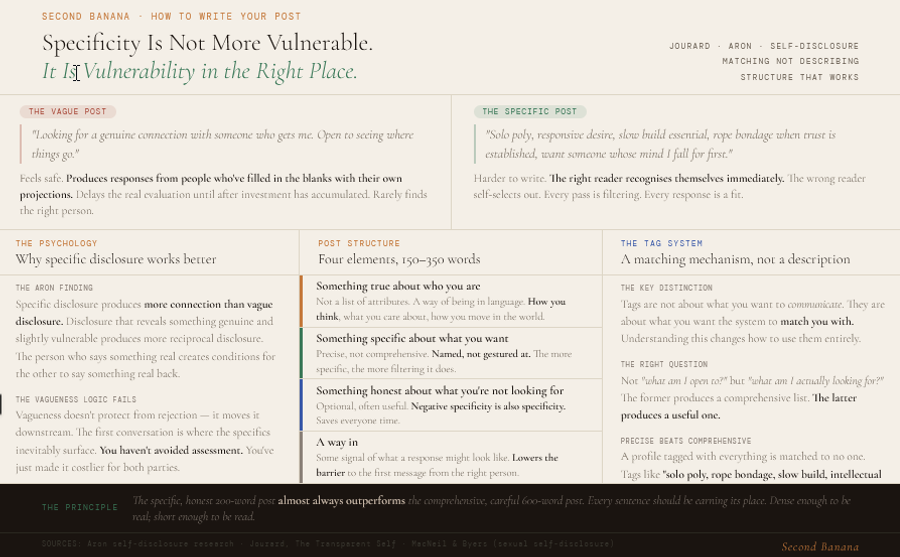
There are two kinds of Second Banana posts. The first is vague in a way that feels safe: it gestures at desire without committing to it, uses soft language that could mean many things to many people, and keeps enough back that if someone responds badly, the poster can tell themselves they weren’t really rejected — only a version of themselves they weren’t fully invested in anyway. This post is comfortable to write. It rarely finds the right person.
The second kind is specific. It names what the poster actually wants, in language that can’t be misread, with enough detail that the right reader recognises themselves in it immediately — and the wrong reader knows it’s not for them. This post is harder to write. It is almost always the one that works.
The difference between these two posts is not primarily stylistic. It is psychological. Writing the specific post requires doing something that runs against most people’s trained social instincts: committing to a desire in public, before knowing who’s reading, with the knowledge that some people will read it and decide you’re not for them. This feels like risk. It is actually the opposite of risk. Vagueness in a desire-disclosure context doesn’t protect you from rejection. It just makes rejection slower and less informative.
This piece is about how to write the second kind of post. The psychology behind what makes it work, the structural elements that distinguish effective posts from ineffective ones, what the tag system is actually for, and — for the people who know what they want but haven’t found the words yet — how to find them.
The Psychology of Desire Disclosure
Writing about what you want sexually and relationally is a specific form of self-disclosure, and it activates the same dynamics that make self-disclosure difficult in every other context — amplified by the stakes of the domain.
The self-disclosure research — built substantially on the foundational work of Sidney Jourard and developed extensively by social psychologist Arthur Aron — establishes several things consistently: disclosure increases liking and connection between people; specific disclosure produces more connection than vague disclosure; disclosure that reveals something genuine and slightly vulnerable produces more reciprocal disclosure than disclosure that is safe and general. The person who says something real and specific creates the conditions for the other person to say something real and specific back.
This dynamic is directly relevant to what makes a Second Banana post work. The post is a form of disclosure that happens before any specific person is in the picture — which removes some of the immediate social pressure of face-to-face disclosure, while retaining the essential dynamic. The reader who encounters a post that feels genuinely, specifically, honestly offered is significantly more likely to respond than the reader who encounters a post that feels hedged and provisional.
The Vulnerability That Isn’t
The specific post feels more vulnerable than the vague one because it commits to something that can be evaluated. If you write that you’re looking for a slow-burn dynamic with someone whose mind attracts you before their body does, who wants explicit conversation about what they want before anything physical happens, who is interested in [specific dynamic], and who is [specific orientation] — that is a real thing that a real person can either recognise themselves in or not.
The vagueness-as-protection instinct is understandable but the logic doesn’t hold. The vague post produces a different kind of exposure: it attracts responses from people who have filled in the blanks with their own projections, which means the first actual conversation — where the specifics inevitably emerge — is the moment of real evaluation. You haven’t protected yourself from assessment. You’ve just moved it downstream to where it’s more costly for both parties.
Specificity upfront is not more vulnerable. It is vulnerability in the right place, at the right time, with the right function: filtering for the people who are actually a fit before anyone has invested in each other.
What Makes a Post Findable
Second Banana’s tag system is a matching mechanism, not a description mechanism. The distinction matters. Tags are not primarily about what you want to communicate — they are about what you want the system to match you with. Understanding this changes how to use them.
Tags: Be Precise, Not Comprehensive
The impulse with tags is often to be comprehensive — to include everything that might be true, to cast the widest possible net. This produces profiles that are hard to read and harder to match. The tag system works better when it’s precise: the tags that most specifically describe what you’re actually looking for, rather than everything that might be loosely relevant.
A profile tagged with “ENM, polyamory, open, kink, BDSM, casual, serious, long-term, hookup, connection” is not well-matched to anyone, because the tags contradict each other or are too broad to filter for actual compatibility. A profile tagged with “solo poly, rope bondage, slow build, intellectual chemistry first, ethical slut, long-term casual” is very precisely matched to a specific kind of person who will immediately recognise that these tags describe them too.
Ask yourself not “what am I open to?” but “what am I actually looking for?” The former produces a comprehensive list. The latter produces a useful one.
The Post Itself: Structure That Works
Effective Second Banana posts tend to share a structure, whether or not the writer is conscious of it:
- Something true about who you are — not a list of attributes but a real thing: how you think, what you care about, the way you move through the world. This is not the same as a biography. It is a way of being in language that gives the reader a sense of the actual person rather than a catalogue of facts about them.
- Something specific about what you want — as discussed above: precise rather than comprehensive, named rather than gestured at. The more specific this is, the more filtering it does, and the better the conversations that follow.
- Something honest about what you’re not looking for — optional but often useful. The person who can say “I’m not looking for a primary partner” or “I’m not in a place for anything that requires a lot of scheduling” or “I’m not interested in people who need to keep this completely secret” is doing the reader a service and themselves a service. Negative specificity is also specificity.
- A way in — some signal of what a response might look like or what you’d want to know about someone. This lowers the barrier to the first message from the right person, which is the barrier that matters most.
Length: Enough, Not More
The effective post length is long enough to give the reader something real to respond to and short enough that it doesn’t exhaust them. In practice this is usually 150-350 words for the post body, not including tags. Long enough to be specific; short enough to be readable; dense enough that every sentence is earning its place.
The failure mode of posts that are too short is that they don’t give the reader enough to work with — the reader who is interested doesn’t know how to respond because there’s nothing specific to respond to. The failure mode of posts that are too long is that they become exhausting, feel like they’re trying too hard, and bury the most important information in a mass of detail. The specific, honest 200-word post almost always outperforms the comprehensive, careful 600-word post.
Finding the Words for What You Want
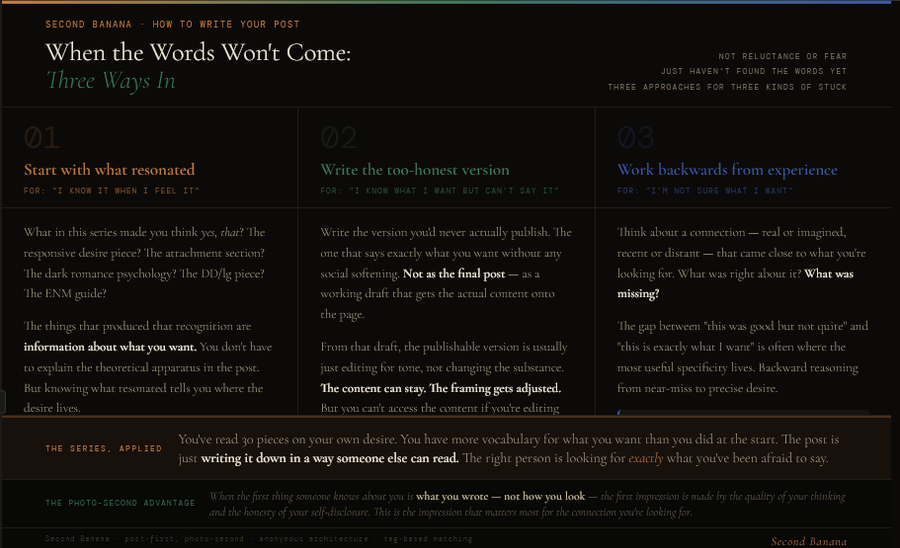
The most common obstacle to writing the specific post is not reluctance or fear. It’s not having found the words yet. Many people know — at some level of embodied, half-articulated sense — what they want from a connection. They don’t always have the precise language for it.
This is one of the things this series exists to address. Across 29 pieces on desire, kink, relationship structures, attachment, jealousy, communication, fantasy, and the neuroscience of arousal, one of the consistent side effects is vocabulary. Readers who have been through this series have, among other things, a larger set of words for what they want and why they want it than they did before.
But vocabulary alone doesn’t produce the post. Here are three approaches that tend to help when the words won’t come:
Start With What You’ve Read
What in this series resonated most strongly? The responsive desire piece, which describes a specific architecture of arousal that you recognised as yours? The attachment piece, which named something about how you move in relationships that you’d never had a word for? The DD/lg piece, the ENM guide, the section on dark romance in the erotic fiction piece?
The things that made you think yes, that are information about what you want. Start from there. You don’t have to explain the whole theoretical apparatus in the post. But knowing what resonated tells you where the desire lives, and from there the words tend to follow.
Write the Version That’s Too Honest
Write a version of the post you’d never actually publish — the one that says exactly what you want without any of the social softening. Not as the final post, but as a working draft that gets the actual content onto the page. The specific desire that feels too exposing, the thing you want that you’ve never said out loud, the relationship configuration that you know is right for you but that you’ve been hesitant to name.
From that draft, the publishable version is usually just a matter of editing for tone rather than changing the substance. The content — what you actually want — can stay. The framing can be adjusted to feel less raw. But the content is the valuable part, and you can’t access it if you’re editing for publishability from the first word.
Work Backwards From a Recent Experience
Think about a connection — real or imagined, recent or distant — that came close to what you’re looking for. What was right about it? What was missing? The gap between “this was good but not quite” and “this is exactly what I want” is often where the most useful specificity lives.
The person who can write “I’ve had connections that were intellectually matched but not physically present, and connections that were physically present but didn’t feel like they saw me — I’m looking for someone where both things are true” has told the reader something specific and real about what they need. That specificity came from backward reasoning from experience, not from trying to articulate desire in the abstract.
The Anonymous Architecture: What It Actually Gives You
Second Banana’s post-first, anonymous model is not primarily a privacy feature, though it functions as one. It is primarily a specificity enabler. It removes the social pressure that makes specific desire disclosure difficult — the real-time face-to-face evaluation, the known audience, the immediate requirement to manage a specific person’s response — and replaces it with a context in which you can say what you actually want before any particular person is in a position to react to it badly.
The photo-second model is part of this. When the first thing a potential connection knows about you is what you wrote — not how you look, not what your relationship status is, not what your job is — the first impression is made by the quality of your thinking and the honesty of your self-disclosure. This is the first impression that matters most for the kind of connection most people on this platform are looking for.
The anonymity also means the post can be genuinely honest in a way that posts on non-anonymous platforms often can’t. You don’t have to write the version of your desire that’s safe for your colleagues to read, or your family, or your ex. You can write the version that’s true. This is the version that finds the right person.
A Note on Rejection
The specific post will be passed over by more people than the vague post. This is the point, not a failure.
The person who reads your specific, honest post and decides it’s not for them has done you a service. They have self-selected out of a connection that would have mismatched in exactly the ways that make connections costly — the timing conversation, the dynamic conversation, the what-are-we conversation that happens too late and with too much already invested. They have saved you both that time.
The person who reads your specific, honest post and recognises themselves in it — who feels the specific thing you described as something they have also been looking for, or are, or want — that person would not have found you through the vague post. The vague post doesn’t give them enough to recognise. The specific post does.
Every person who passes over your post without responding is the system working. Every person who responds is a potential fit. The ratio is better than the vague post produces, even though the absolute number of responses may be lower. Quality of fit over quantity of responses is the only metric that matters here.
The Post Is Already Most of the Work
The people who find what they’re looking for here are the people who wrote the specific post. Not because the platform rewards honesty with some algorithmic bonus, but because specificity is how two people who are right for each other find each other in a population of people who are mostly not.
You know your desire. You know more about what you want than you did when you started. The post is just writing it down in a way that someone else can read.
Write it. The right person is looking for exactly what you’ve been afraid to say. 🍌