
What Is CNC? Consensual Non-Consent, the Fantasy and the Reality | Second Banana
Consensual Non-Consent:
The Fantasy, the Psychology, and Why the Shame Has Always Been Misplaced
The Fantasy That Nobody Discusses Honestly
There is a particular silence around this fantasy. Not the silence of something rare or fringe — the research is unambiguous that non-consent fantasy is among the most commonly reported sexual fantasies across genders, and among the most common for women specifically. It is the silence of something so thoroughly stigmatised that the people who have it often spend years believing they are uniquely aberrant, uniquely broken, uniquely at odds with who they think they should be.
The silence has costs. It means people carry this fantasy in isolation, without language for it, without community, without the kind of honest information that would tell them not only that they are far from alone but that there is a coherent, well-developed practice — consensual non-consent, CNC — that gives this fantasy a real-world architecture. A way to pursue it with care, with communication, with genuine safety, and with partners who want exactly the same thing.
This piece is that information. What CNC actually is and what it isn’t. What the research says about how common the fantasy is and who has it. The psychological mechanisms that explain why it works for the people it works for. The negotiation framework that makes real-world CNC function safely. And how Second Banana’s tag system gives people the vocabulary to find each other without having to explain the basics from scratch every time.
It is written for the person who has had this fantasy and never said it out loud. And for the person who already knows what they want and is looking for the right place to find it.
The fantasy is more common than almost any other. The silence around it is cultural, not statistical. These are not the same thing.
What CNC Actually Is
Consensual non-consent — CNC — is a category of BDSM practice in which participants agree in advance to a scene that will involve the simulation of non-consent. One person plays a role in which they appear to resist, refuse, or be overpowered; the other plays a role in which they appear to ignore or override that resistance. Both have negotiated this in advance, both have agreed to it, and both have the means to stop the scene immediately if needed.
The word ‘appear’ is doing essential work in that definition. CNC is not actual non-consent. It is a theatrical and erotic simulation of non-consent within a framework of complete, explicit, prior consent. The apparent resistance is part of the agreed-upon scene. The apparent ignoring of that resistance is part of the agreed-upon scene. Everything that happens is happening because both people want it to happen — including, and especially, the things that look like the opposite.
This is the distinction that the cultural conversation around CNC almost always gets wrong, because it requires holding two things in mind simultaneously: that what is happening looks like one thing and is actually another. A CNC scene looks like coercion and is an expression of exceptionally thorough mutual consent. The appearance is the point. The reality is the opposite of the appearance. Both of these things are true at the same time, and the erotic charge of CNC for the people who seek it lives precisely in that gap.
The Range of CNC Practice
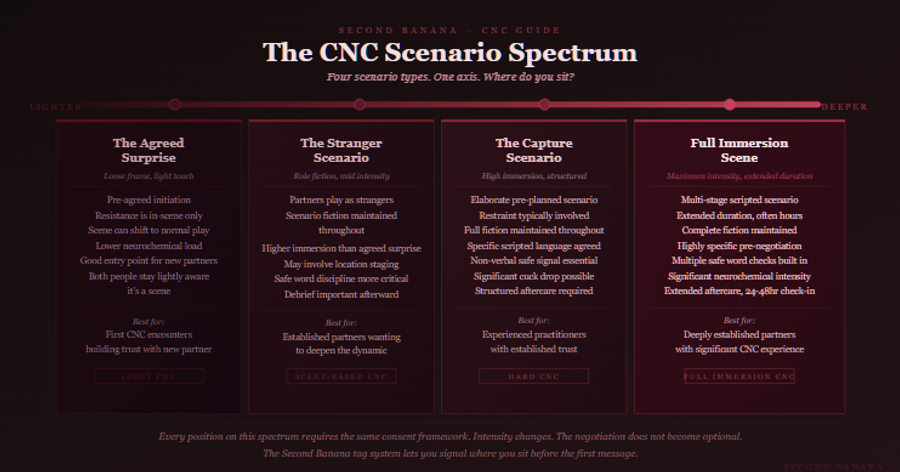
CNC covers a wide range of intensity and scenario. At the lighter end: a scene in which one partner ‘surprises’ the other with advances that have been negotiated in advance, with the receiving partner playing the role of someone who initially resists but is ‘persuaded.’ At the more intense end: elaborate, multi-stage scenes involving restraint, specific language, scripted scenarios, and carefully negotiated acts that might span hours and require extensive debriefing afterward.
Common CNC scenarios include: the stranger scenario, in which partners play as though they don’t know each other; the intruder scenario, with a negotiated ‘surprise’ element; the capture or kidnapping scenario; authority dynamics in which one partner plays a figure of institutional power; and the somnophilia-adjacent scenario in which one partner plays as though asleep or unaware. Each of these has its own specific appeal and its own specific negotiation requirements.
CNC also exists on a spectrum of theatrical explicitness. Some couples prefer high-realism scenes in which the fiction is maintained completely throughout; others prefer a looser frame in which both people know they are playing and the scene is more erotic game than full immersion. Both approaches are legitimate. The important variable is not which approach is taken but whether both people have agreed to it in advance.
What CNC Is Not
CNC is not actual sexual assault. This distinction is not in need of elaboration — anyone reading this piece already understands it. But it is worth naming cleanly because the cultural conflation of CNC fantasy with endorsement of actual assault is the primary mechanism through which the shame around this fantasy operates, and it is a conflation that does not survive examination. The person who fantasises about CNC is not endorsing or desiring actual assault any more than someone who enjoys a thriller is endorsing murder. The fantasy is about the experience of a specific kind of intensity within a context of complete safety. The safety is not incidental to the fantasy. For most people who practice CNC, it is constitutive of it.
The Data: How Common Is This?
The research on non-consent fantasy is both extensive and consistently surprising to people who encounter it for the first time. A 2009 study by Joseph Critelli and Jenny Bivona, reviewing decades of research on women’s sexual fantasies, found that between 31% and 57% of women reported having rape fantasies — with approximately one in three reporting them frequently. A 2012 study by Brett Stulhofer and Aleksandar Jurin found similar figures in a Croatian sample. Justin Lehmiller’s large-scale 2018 survey of American adults found that 61% of women and 54% of men had fantasised about being forced to have sex.
These figures are not outliers. They are consistent across decades of research, across multiple countries, and across diverse demographic groups. Non-consent fantasy is, by any measure, one of the most statistically normal sexual fantasies that exists. It is also, by any measure of cultural discussion, one of the most thoroughly suppressed.
The gap between prevalence and discussion is not accidental. It reflects the specific way in which this fantasy implicates cultural anxieties about gender, power, and sexual violence — anxieties that are real and serious and worth taking seriously, and that are nonetheless frequently misdirected at the people having the fantasy rather than at the conditions that produce actual sexual violence. People who fantasise about CNC are not a risk factor for sexual violence. Research consistently finds no correlation between non-consent fantasy and either perpetration or tolerance of actual assault. The fantasy and the act are psychologically and behaviourally distinct categories, and treating the former as continuous with the latter causes harm without producing any corresponding benefit.
Between a third and a majority of women have this fantasy. The silence around it has nothing to do with its prevalence and everything to do with its subject matter.
The Psychology: Why This Fantasy Works
Surrender Without Responsibility
The most consistent explanation in the psychological literature for the appeal of non-consent fantasy is what researchers call ‘surrender without responsibility’ — the experience of full erotic engagement without the cognitive and social burden of having chosen it. Female sexuality in particular exists within a cultural context that has historically stigmatised female desire: the ‘good girl’ problem, in which women internalise the message that wanting sex actively is transgressive, while having sex done to them is passive and therefore acceptable. The non-consent fantasy resolves this double bind by removing the question of choice entirely. She cannot be judged for wanting something she was ‘forced’ to experience.
This is not a sign of internalised misogyny, though it can be misread as one. It is a sign of a person navigating a genuinely coercive cultural environment — one that punishes female desire — and finding an erotic architecture that sidesteps that punishment. The fantasy is a response to an external cultural problem, not an internal psychological one. As sexual culture becomes more genuinely permissive about female desire, research suggests the specific form of the non-consent fantasy shifts — but the underlying appeal of intense, overwhelming erotic experience persists.
Intensity and the Erotic Value of Being Wanted
Non-consent fantasy is also, at its psychological core, a fantasy about being desired with overwhelming intensity — being wanted so completely that normal social inhibitions dissolve. The ‘force’ in the fantasy is a metaphor for desire so powerful it cannot be restrained. This is an erotic idea that has nothing to do with violence and everything to do with the experience of being the object of consuming, unstoppable want.
This dimension of the fantasy is consistent with research on erotic intensity more broadly. Experiences that involve high physiological arousal — even arousal with aversive components — are frequently interpreted as more intensely pleasurable than lower-arousal experiences. The intensity itself is part of the appeal, and CNC is one of the most effective mechanisms for producing that intensity in a consensual context.
Control Through the Performance of Its Absence
The psychology of CNC, for people in the submissive role, parallels the psychology of other forms of consensual submission: the experience of having negotiated a context in which you can surrender control completely, because the structure that makes that surrender safe has been built with care. The submissive in a CNC scene has typically done more preparatory work — more negotiation, more explicit communication, more careful boundary-setting — than most people do in their entire sexual lives. The apparent absence of control is the product of an extraordinarily deliberate exercise of it.
For people in the dominant role, the appeal is its own specific psychology: the experience of being trusted with someone’s most vulnerable and precisely calibrated desire, of being the person whom a partner trusts enough to hold this. Dominants in CNC scenes frequently report that the responsibility of holding the scene safely is among the most intense and meaningful sexual experiences they have had — not because it is transgressive but because the trust it involves is so complete.
The Brain Chemistry of Intensity
CNC scenes, particularly at higher intensity levels, produce significant neurochemical responses. The combination of adrenaline, endorphins, and oxytocin that accompanies intense physical and psychological arousal creates a physiological state that many practitioners describe as distinctly altered — analogous to, though distinct from, the subspace experience in other BDSM contexts. This neurochemical dimension helps explain why CNC can feel qualitatively different from other sexual experiences even when the physical acts involved are not themselves unusual. The psychological frame transforms the neurochemistry.
The Negotiation Architecture: How CNC Actually Works Safely
The consent negotiation required for CNC is more extensive than for almost any other sexual practice. This is not a burden — it is the feature. The thoroughness of the negotiation is what makes the scene possible, what produces the trust that makes the intensity achievable, and what distinguishes CNC from the thing it is simulating. People who practice CNC well tend to be among the most articulate and thoughtful communicators about sex of anyone in any context.
What Gets Negotiated
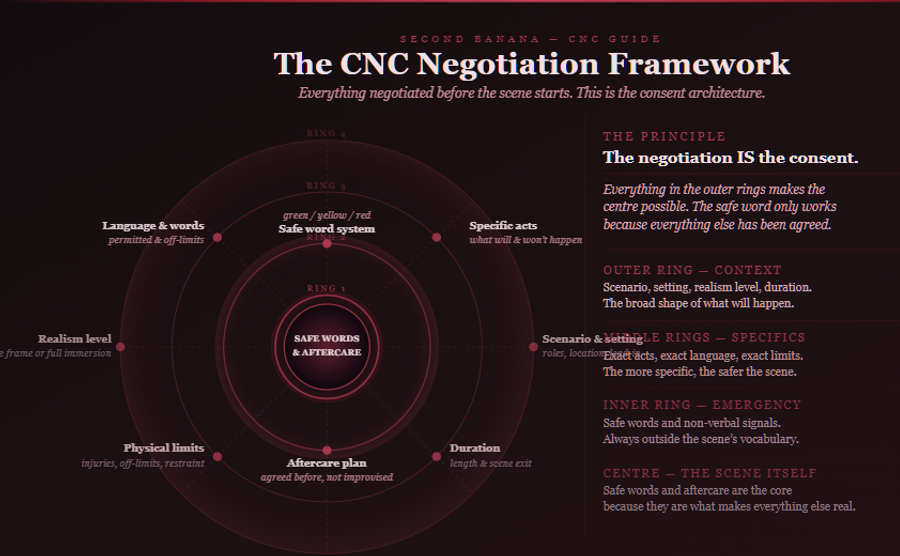
Experienced CNC practitioners negotiate across several specific dimensions before any scene:
- Specific acts — exactly what will and won’t happen, in as much detail as necessary. Not ‘roughly’ but specifically. The specificity is what makes the scene feel safe enough to fully inhabit.
- Specific language — what words can be used and what words are off-limits. This matters because language that is intensely arousing for one person can be genuinely destabilising for another, and the difference is entirely individual.
- Physical limits — injuries, medical conditions, parts of the body that are off-limits, levels of restraint that are acceptable.
- The scenario itself — setting, roles, how the scene starts, whether there is a lead-in or whether it begins immediately, how much realism is wanted.
- Duration — how long the scene will run and how the transition out of the scene will work.
- Safe words and signals — see below.
- Aftercare — what each person needs after the scene. This is non-negotiable and gets planned before the scene, not improvised afterward.
Safe Words and the Traffic Light System
CNC presents a specific challenge to the standard safe word model because the whole point of the scene is that ‘no’ and ‘stop’ are part of the fiction. The solution is a pre-agreed word or signal that is clearly outside the scene’s vocabulary — something that will never come up naturally in the scenario and whose presence therefore unambiguously signals a genuine need to stop.
The traffic light system is the most widely used framework: ‘green’ means continue, ‘yellow’ means slow down or check in, ‘red’ means stop immediately. These words are chosen precisely because they are not part of any realistic CNC scenario. Many practitioners also establish a non-verbal signal — a specific hand gesture or a physical object held in one hand that, if dropped, signals a stop — for scenes in which verbal communication may be difficult.
The dominant’s responsibility to monitor the submissive’s genuine state throughout the scene is as important as the safe word system itself. Experienced CNC practitioners develop the ability to distinguish between in-scene performance and genuine distress — a skill that is built through communication, through practice, and through the kind of attentiveness that only develops when both people are genuinely invested in each other’s experience.
Aftercare
Aftercare following a CNC scene is typically more extensive and more important than aftercare following other BDSM practices, because the psychological intensity of what has been simulated can produce significant emotional responses in the hours and days following. The submissive may experience a version of sub drop — a sudden emotional crash as the neurochemical intensity dissipates. The dominant may experience their own version of this, sometimes called dom drop, as the sustained responsibility of holding the scene releases.
What aftercare looks like varies by person and by scene: physical closeness and warmth, verbal reassurance, food and water, a debriefing conversation about what worked and what didn’t. What matters is that it is planned in advance rather than improvised, that both people understand what each other needs, and that there is explicit agreement to check in with each other in the day or two following the scene.
The Ongoing Conversation
CNC is not a one-time negotiation. Desires evolve, comfort levels shift, what felt right in one scene may not feel right in the next. Experienced practitioners treat negotiation as an ongoing conversation rather than a settled contract — each scene is debriefed, each debrief informs the next negotiation. The communication architecture of CNC is not an obstacle to the experience. It is what makes the experience possible, what deepens it over time, and what produces the level of trust that makes the intensity achievable.
The Shame, and What Produces It
The shame around CNC fantasy is among the most intense of any sexual interest, and it operates on a specific mechanism: the conflation of fantasy content with moral endorsement. The person who fantasises about CNC is assumed, by this logic, to be endorsing non-consent in reality — to be revealing something troubling about their values rather than something specific about their psychology.
This logic does not survive examination. Human beings fantasise about things they would never endorse in reality — violence, transgression, scenarios that are arousing precisely because they are forbidden or impossible. The erotic imagination is not a policy document. It is a space in which the normal rules of social endorsement do not apply, and its contents do not map onto beliefs, values, or desires in any straightforward way. The research supports this without qualification: there is no correlation between CNC fantasy and tolerance for actual sexual violence. The two are not the same category.
What the shame does produce is harm. People who carry this fantasy in silence, who believe it makes them aberrant or dangerous, who suppress it rather than exploring it with willing partners, are not protected by that silence. They are simply deprived of something they want, without any corresponding benefit to anyone. The silence does not make the fantasy go away. It makes the person carrying it more isolated, more self-critical, and less able to pursue genuine sexual fulfilment.
The CNC community — and the broader BDSM community of which it is part — has spent decades building the frameworks that make this fantasy safe to pursue: the negotiation culture, the informed consent practices for BDSM, the aftercare protocols, the community knowledge about what works and what doesn’t. That infrastructure exists because people took the fantasy seriously rather than treating it as something to be ashamed of. It is considerably more sophisticated than the approaches to consent that govern most mainstream sexual encounters.
The fantasy does not require justification. It requires a framework. CNC has one of the most thorough consent frameworks of any sexual practice that exists.
What This Has to Do With Second Banana
The practical challenge of CNC — one that comes up repeatedly in community accounts — is finding partners who understand the dynamic before you have to explain it from first principles. The negotiation required is extensive and requires a specific kind of partner: someone who understands what CNC is, who has thought about what they want from it, who can communicate clearly and specifically, and who is capable of the attentiveness and responsibility the dominant role requires or the genuine vulnerability the submissive role involves.
Finding that person on a platform that requires you to represent your desires through photographs and a handful of demographic checkboxes is effectively impossible. The post-first model changes this entirely. A person interested in CNC can write about what they’re looking for with the specificity the dynamic requires: the kind of scenarios that appeal, the role they’re seeking, the level of intensity they want to explore, the communication style they need from a partner. The people who respond have already read that and decided it resonates.
The Second Banana tag system gives the CNC community specific vocabulary that does the filtering before the conversation starts:
- CNC / consensual non-consent — the orientation itself
- Dominant / submissive — role sought or offered
- Scene-based / ongoing dynamic — whether this is a single encounter or a recurring structure
- Scenario-specific tags — stranger, intruder, authority, somnophilia-adjacent
- Intensity level — light CNC through high-intensity
- Aftercare important — signalling seriousness about the emotional dimension
- Experience level — new to CNC, experienced practitioner
These tags mean that the person reading a CNC post already understands the basic framework of what’s being offered. They know what safe words are. They know what aftercare means. They know that negotiation comes before the scene. The Second Banana community self-selects for exactly this kind of communicative literacy — because the post-first model attracts people who are willing and able to write honestly about what they want, which is exactly the kind of person CNC requires.
The anonymous posting option is particularly significant for CNC. Of all the sexual interests in the Second Banana content series, this is the one most likely to produce professional or social consequences for the person whose name is attached to it. The ability to be fully, specifically honest about what you want before deciding whether to attach your identity to that honesty is not a workaround. For most people in this community, it is the condition under which honesty becomes possible at all.
The piece of information this community most needs is simple and has always been true: the fantasy is normal, the practice is safe when done correctly, the framework exists, and the people who share this interest are not rare. They are, statistically, sitting next to you at work. They are in your social circle. They are, in significant numbers, on Second Banana.