Why Long-Term Ethical Non-Monogamy Works (And Why It Sometimes Doesn't) | Second Banana
The Structure That Holds. Not the One That Collapses.
On the research behind long-term ENM, what makes it durable, and where it actually breaks down
The Conversation Nobody Wants to Have
Ethical non-monogamy has a marketing problem and a durability problem, and they are not the same problem, though they get talked about as if they were.
The marketing problem is familiar: ENM is either romanticized as a permanently novel, permanently thrilling alternative to the supposed staleness of monogamy, or pathologized as a phase, a red flag, or a slow-motion breakup. Neither framing is particularly interested in what actually happens to people five, ten, fifteen years into a non-monogamous structure — whether it holds, what it costs to hold it, and what predicts which couples and polycules are still standing a decade in.
The durability problem is the real one, and it's the one this piece is about. Long-term ENM is not simply "more relationships, indefinitely." It has its own developmental arc, its own failure modes, and its own body of research — thin compared to monogamy research, but growing — that says some fairly specific things about why some non-monogamous structures remain stable and satisfying for decades while others quietly, or not so quietly, come apart.
This is the honest version of that conversation: what actually sustains long-term ENM, what the research says about compersion and jealousy over time, where the structure most reliably fails, and what that means for people building or already living inside one.
What "Long-Term" Actually Selects For
The population of people in ENM structures at year one and the population still in ENM structures at year ten are not the same population, and the difference is not random.
Research on relationship dissolution in consensually non-monogamous populations — including work summarized in Conley and colleagues' ongoing program of CNM research — consistently finds that CNM relationships are not less stable than monogamous ones on standard measures of relationship satisfaction and commitment, but that the people who remain in CNM structures long-term differ systematically from those who exit. Longitudinal attrition in this area is a selection problem as much as a mechanism problem: some of what looks like "what makes ENM work long-term" is actually "what kind of person and what kind of couple self-selects into staying."
This matters because it means two different questions get collapsed together in most popular writing on the subject. One is what psychological and structural conditions make non-monogamy sustainable. The other is what kind of person is suited to sustain it. Both are worth answering, and they have different answers.
The Jealousy Question, Revisited
Jealousy is the variable non-monogamy skeptics reach for first, and it deserves a more precise treatment than it usually gets.
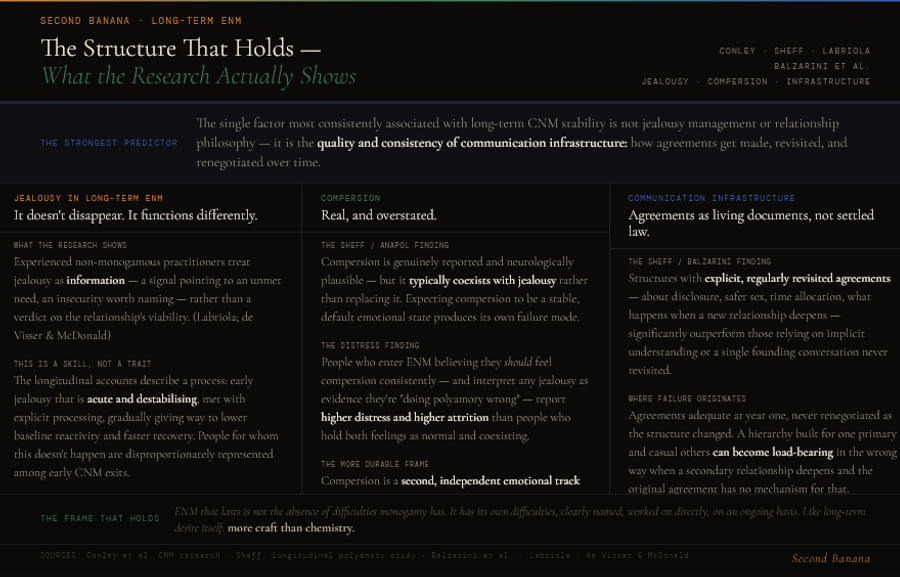
The research on jealousy in long-term CNM relationships does not show that jealousy disappears. It shows something more specific: that jealousy in experienced non-monogamous people tends to function differently than it does in people new to the structure or in monogamous people imagining it from outside. Work by Kathy Labriola and by researchers studying polyamorous communities (including de Visser and McDonald's qualitative work on long-term polyamorists) finds that jealousy among experienced non-monogamous practitioners is more often treated as information — a signal pointing to an unmet need, an insecurity worth naming, a boundary worth revisiting — than as a verdict on the relationship's viability.
This is a skill, not a trait. People are not sorted at birth into jealous and non-jealous categories. What the longitudinal accounts describe is a process: early jealousy that is acute and destabilizing, met with explicit processing rather than avoidance or structural retreat, gradually giving way to a lower baseline reactivity and a faster recovery time when jealousy does occur. The people for whom this process doesn't happen — where jealousy stays acute and doesn't get metabolized through communication — are disproportionately represented among those who exit CNM structures within the first few years.
What tends not to work: suppressing jealousy through avoidance, treating any jealous feeling as a personal failure to be hidden, or resolving jealousy by unilaterally restricting a partner rather than addressing the underlying need.
What the research associates with durability: naming jealousy out loud and early, distinguishing the feeling from the demand it seems to be making, and treating recurring jealousy as data about a specific unmet need rather than a global argument against the structure.
Compersion Is Real, and It Is Also Overstated
Compersion — the experience of positive feeling in response to a partner's other relationship — occupies an outsized place in ENM discourse, partly because it is the structure's best answer to the assumption that non-monogamy must be a constant exercise in gritted-teeth tolerance.
The research complicates the popular version of compersion in a useful way. Studies on emotional experience in polyamorous relationships (including survey work summarized by Deborah Anapol and later empirical follow-up by researchers like Elisabeth Sheff, whose longitudinal work on polyamorous families is among the more sustained bodies of research in the area) find that compersion is a genuinely reported and neurologically plausible experience — but that it typically coexists with jealousy rather than replacing it, and that expecting compersion to be a stable, default emotional state produces its own kind of failure mode. People who enter ENM believing they should feel compersion consistently, and who interpret any jealousy as evidence they are "doing polyamory wrong," report higher distress and higher attrition than people who hold both feelings as normal and coexisting.
The more durable frame the research points toward: compersion is available, real, and worth cultivating, but it is not the absence of jealousy. It is a second, independent emotional track that can run alongside jealousy rather than replacing it. Long-term practitioners tend to describe both, often in the same week, sometimes about the same relationship.
The Structural Variable That Predicts the Most
If there is a single factor in the research most consistently associated with long-term CNM stability, it is not attitude, jealousy management, or relationship anarchy versus hierarchy as a philosophy. It is the quality and consistency of communication infrastructure — the actual mechanics of how agreements get made, revisited, and renegotiated over time.
Sheff's longitudinal work on polyamorous families and Balzarini and colleagues' comparative research on relationship agreements both point toward the same conclusion from different angles: structures with explicit, regularly revisited agreements — about disclosure, about safer sex practices, about time allocation, about what happens when a new relationship becomes serious — significantly outperform structures that rely on implicit understanding or a single founding conversation that is never revisited. Non-monogamy that works long-term is non-monogamous and highly administrated, in the sense that it treats its own rules as living documents rather than settled law.
This is where a meaningful fraction of long-term ENM failure actually originates — not in jealousy, not in logistics fatigue alone, but in agreements that were adequate for the structure as it existed at year one and were never renegotiated as the structure, the people in it, and their needs changed. A hierarchy that made sense when there was one primary partner and casual others can become load-bearing in the wrong way when a secondary relationship deepens and the original agreement has no mechanism for reflecting that.
Where It Breaks
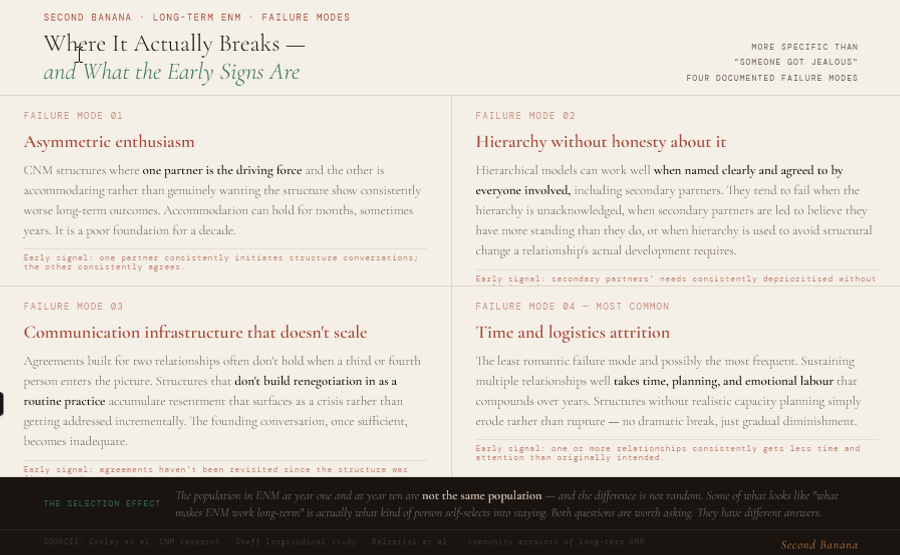
The failure modes the research and the long-term community accounts converge on are more specific than "someone got jealous."
Asymmetric enthusiasm. CNM structures where one partner is the driving force and the other is accommodating rather than genuinely wanting the structure show consistently worse long-term outcomes. Accommodation can hold for a while. It is a poor foundation for a decade.
Hierarchy without honesty about it. Many long-term structures use hierarchical models — primary and secondary partners, nesting partners and others — and these can work well when named clearly and agreed to by everyone involved, including the secondary partners. They tend to fail when the hierarchy is unacknowledged, when secondary partners are led to believe they have more standing than they do, or when the hierarchy is used to avoid making the structural changes a relationship's actual development requires.
Communication infrastructure that doesn't scale. Agreements built for two relationships often don't hold when a third or fourth person enters the picture, and structures that don't build in renegotiation as a routine practice tend to accumulate resentment that surfaces as a crisis rather than getting addressed incrementally.
Time and logistics attrition. This is the least romantic failure mode and possibly the most common: sustaining multiple relationships well takes time, planning, and emotional labor that compounds over years, and structures without realistic capacity planning for this simply erode rather than rupture.
The Frame That Holds Up
The research on long-term consensual non-monogamy converges on a version of the same insight the desire literature converges on for long-term monogamy: the thing that sustains a relationship structure over a decade is rarely the initial motivation for choosing it. It's the ongoing practice of maintaining it — the explicit communication, the willingness to revisit agreements that no longer fit, the treatment of jealousy as information rather than verdict, and the honesty about what compersion is and isn't doing for you on any given week.
ENM that lasts is not the absence of the difficulties monogamy has. It has its own difficulties, clearly named, worked on directly, on an ongoing basis. It is, like long-term desire itself, more craft than chemistry.
What This Means for Second Banana
Second Banana's post-first, tag-based architecture is built around explicit articulation — of what you want, what you're looking for, and what stage of relationship life you're in. That orientation maps directly onto what the research on long-term ENM identifies as the strongest predictor of durability: people who can name their structure, their agreements, and their needs clearly, and who are looking for others capable of doing the same.
The Second Banana tags that belong in this conversation: "ENM," "poly," "hierarchy — clearly named," "compersion," "communication first," "existing structure, new connection." People who are not looking to be talked into non-monogamy or talked out of it. People already doing the work of it, looking for the next honest connection inside a structure they've built with care.