CBT Kink: The Psychology of Cock and Ball Torture, Vulnerability, and Why Intense Sensation Here Carries Specific Erotic Weight | Second Banana
CBT:
The Psychology of Cock and Ball Torture, the Specific Weight of Genital Vulnerability, and What Happens When the Most Sensitive Place Becomes the Site of Intense Focus
The Anatomy of Why This Feels the Way It Does
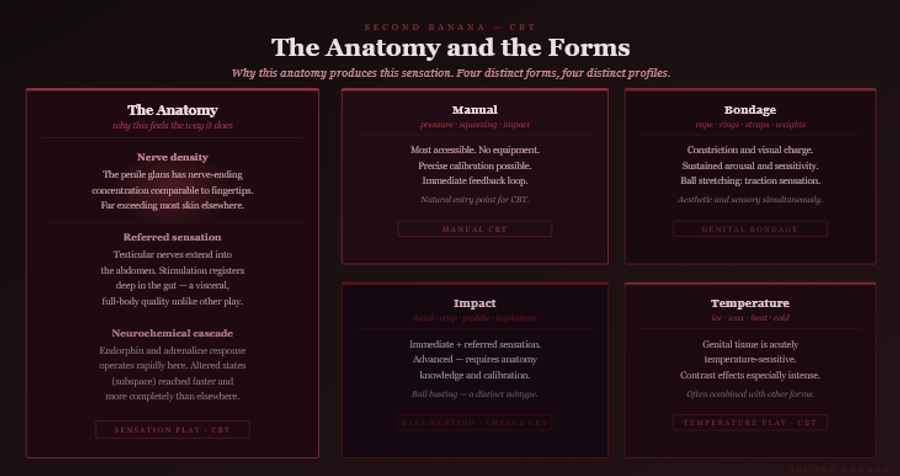
The penis and scrotum are among the most densely innervated structures in the human body. The penile glans — the head — contains a concentration of nerve endings comparable to the fingertips and far exceeding most skin elsewhere on the body. The scrotal skin, the epididymis, and the testes themselves are supplied by a nerve network that extends into the abdomen, which is why testicular trauma produces the distinctive referred pain that registers deep in the gut rather than only at the site of impact. This anatomy is not incidental to CBT’s appeal. It is the anatomical foundation on which everything else is built.
Intense stimulation of this anatomy — pressure, constriction, impact, temperature, stretching — produces a specific and intense sensation profile that is qualitatively different from sensation play elsewhere on the body. The combination of extreme sensitivity, the deep referred quality of some sensations, and the specific neurological character of genital stimulation under intensity produces an experience that many practitioners describe as occupying a unique position in the sensation landscape: not just more intense, but different in kind.
The endorphin and adrenaline cascade that intense physical sensation activates — the same neurochemical mechanism that produces subspace in other forms of sensation play — operates particularly strongly in genital CBT because the nerve density and the visceral quality of the sensations involved produce a more rapid and more intense neurochemical response. Practitioners who engage with CBT often describe reaching altered states more quickly and more completely than with sensation play elsewhere on the body.
The genitals are not just the most sensitive place on the body. They are the place around which the most anxiety, identity, and cultural weight has accumulated. Putting that place under someone else’s control is not incidentally significant. It is the most significant act of trust available in the sensation play landscape.
The Vulnerability Dimension
CBT’s psychological charge is not only about sensation. It is, for most practitioners, primarily about vulnerability — the specific quality of trust required to place the body’s most sensitive and most culturally loaded anatomy under another person’s control.
The genitals carry cultural weight that no other part of the body quite matches. They are the site of reproductive function, sexual identity, a significant portion of male gender identity, and the accumulated anxiety of a lifetime of cultural messaging about vulnerability, performance, and physical integrity. Allowing someone to have not merely physical access to this anatomy but deliberate, intense, controlling access — to squeeze, strike, bind, or otherwise apply focused intensity to this specific site — is an act of trust that goes beyond most other forms of physical vulnerability.
This is why CBT is often experienced as more psychologically significant than its technical category (sensation play) would suggest. The physical sensation is intense and specific, but the psychological weight of the vulnerability is what makes CBT feel different in kind from flogging, wax play, or other forms of intense sensation. You are not giving someone access to your back or your thighs. You are giving them access to the most loaded, most sensitive, most identity-adjacent part of your body.
The Trust Required
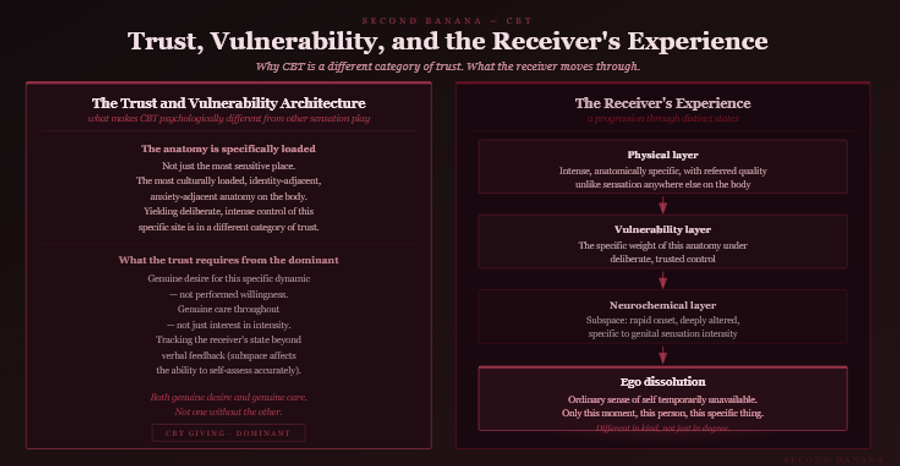
The trust dimension of CBT is specific and worth examining directly. What the receiving partner is trusting when they yield their genitals to CBT is not merely that their partner will not cause serious harm — though that is part of it — but that their partner will engage with this specific vulnerability with the combination of genuine desire and genuine care that it requires.
A CBT partner who is not genuinely drawn to this dynamic — who is performing willingness rather than bringing genuine interest — is not providing the trust foundation that CBT requires. And a CBT partner who has genuine interest but not genuine care — who is interested in the intensity but not in the specific person experiencing it — is similarly not providing what the receiving partner needs. CBT requires both: a partner who genuinely wants this, who finds the specific dynamic erotically compelling, and who holds the receiving partner’s wellbeing with genuine attention throughout.
When both of these are present — genuine desire and genuine care, held together by a partner who knows what they’re doing — the trust dimension of CBT produces a specific quality of intimacy that many practitioners describe as unlike anything else in their erotic experience. Being held in this specific vulnerability by someone who is both genuinely interested and genuinely careful is an experience that compounds the physical intensity with a psychological depth that transforms the encounter.
The Forms CBT Takes
Manual Stimulation
The most common and most accessible form of CBT involves manual application of pressure, squeezing, stretching, or impact with the hands. Manual CBT allows for precise calibration — the applying partner can feel exactly what they’re doing and adjust continuously in response to the receiving partner’s feedback. For people new to CBT, manual play is typically the entry point: it requires no equipment, allows immediate response to feedback, and can range from mild squeezing to quite intense pressure depending on what both parties want.
The specific sensations available through manual CBT are themselves varied: compression of the testes, stretching of the scrotum, squeezing of the shaft, pressure on the glans, impact with the palm or the back of the hand. Each produces a distinct sensation profile, and experienced CBT practitioners develop a specific vocabulary of manual techniques that allows for considerable variety within this single category.
Cock and Ball Bondage
Genital bondage — binding the penis and scrotum with rope, cord, leather straps, or purpose-designed restraints — produces a specific constriction effect that changes the sensation profile of both arousal and stimulation. The visual dimension of genital bondage is also significant for many practitioners: the appearance of bound genitalia carries its own specific erotic charge, particularly in contexts where the visual is important to the dynamic.
Cock rings — the most accessible form of genital bondage — work by constricting blood flow and maintaining engorgement, producing a specific quality of sustained arousal and heightened sensitivity. More elaborate genital bondage using rope or cord can produce sustained constriction, aesthetic binding, or specific pressure points that each have their own sensation profile. Ball stretching devices and weights produce the specific sensation of downward traction on the scrotum, which for many practitioners occupies a distinct and valued place in the CBT sensation landscape.
Impact and Temperature
Impact CBT — striking the genitals with the hand, a crop, a paddle, or other implements — produces a specific sensation profile that combines the immediate impact sensation with the deep referred quality of testicular stimulation and the afterglow of genital tissue struck. This is a more advanced form of CBT that requires specific knowledge of anatomy and calibration to practice safely, but for practitioners who are drawn to impact sensation in general, genital impact is described as occupying a particularly intense and specific place in the sensation landscape.
Temperature play — ice, warm wax, or other temperature stimuli applied to genital tissue — combines the general properties of temperature sensation play with the specific sensitivity of genital anatomy. Genital tissue is particularly temperature-sensitive, and the contrast between heat and cold, or between the baseline temperature of the skin and an applied stimulus, is experienced with an intensity that exceeds temperature play elsewhere on the body.
The Power Exchange Dimension
CBT maps closely onto D/s dynamics, but the genital specificity of the power exchange adds a dimension that general sensation play or general submission does not provide. The dominant who controls their partner’s genitals — who determines what sensation is applied, at what intensity, for how long, and in what form — holds a specific and particularly loaded form of authority.
For the submissive or receiving partner, yielding this specific control is the most complete form of physical deference available. There is no more fundamental form of physical submission than allowing another person direct, deliberate, intense authority over the anatomy that is most central to physical and sexual identity. Many practitioners who engage with CBT in a D/s context describe it as the form of submission that most fully realises the dynamic — not because it is the most painful or the most extreme, but because the specific anatomy involved makes the trust and the yielding feel most complete.
For the dominant partner, CBT provides a specific form of authority that carries its own distinct charge. The knowledge that one’s partner is yielding this specific vulnerability — that the trust being placed in them is this complete and this specific — produces a quality of responsibility and care that many dominant practitioners describe as among the most engaged they experience. The stakes are high enough that genuine attention is required throughout, and this required attention produces a quality of presence in the dominant that transforms the encounter for both parties.
The Receiver’s Experience
CBT’s receiver experiences a specific combination of sensation, vulnerability, and neurochemical state that is distinct from other forms of play. The sensation profile — intense, specific, anatomically concentrated, with the distinctive referred quality that genital stimulation produces — is the physical layer. Beneath it is the psychological layer: the specific experience of having this particular anatomy under another person’s deliberate control, the trust that makes that possible, and the specific freedom that the complete yielding of this specific thing enables.
Many CBT receivers describe the experience as producing a quality of ego dissolution that other forms of play approach but do not quite achieve. The intensity of the sensation combined with the depth of the vulnerability creates a state in which the ordinary sense of self — its boundaries, its management of presentation, its maintenance of social coherence — becomes temporarily unavailable. What remains is immediate physical experience, the specific quality of being in this moment with this person doing this specific thing, with no cognitive layer managing anything at all.
This state is what experienced CBT practitioners are typically seeking when they say that CBT feels different in kind from other play rather than simply different in degree. The combination of anatomical specificity, sensory intensity, psychological vulnerability, and the depth of trust required produces something that many practitioners locate at the most significant end of their entire erotic experience.
Safety and Anatomy
CBT involves real anatomical risk that responsible practice takes seriously. The testes are vulnerable to injury from severe compression or impact, and testicular torsion — twisting of the testicular cord — is a medical emergency that can occur with certain forms of genital bondage or extreme impact. Practitioners new to CBT should begin conservatively and develop their practice incrementally, building knowledge of anatomy and sensation response before engaging with more intense forms.
Communication throughout CBT is more important than in many other forms of play because the sensation profile can shift rapidly and because some injuries may not be immediately apparent in the intensity of the moment. Clear safewords, attention to the receiving partner’s responses beyond verbal feedback, and conservative limits early in a practice are the foundations of responsible consent in CBT.
The neurochemical altered state that CBT can produce — the same subspace mechanism that operates in other intense sensation play — can reduce the receiving partner’s ability to accurately assess what they are experiencing. An attentive dominant partner who is tracking the receiving partner’s state throughout and not relying solely on explicit feedback is an important safety element of CBT practice.
What This Has to Do With Second Banana
CBT is an orientation that requires a very specific partner: someone who is genuinely drawn to this specific dynamic, who has or is willing to develop the knowledge and skill it requires, and who brings both genuine desire and genuine care to an encounter that demands both. Finding this partner through general dating platforms — where naming this interest directly is either impossible or produces responses from people who are merely curious rather than genuinely compatible — is consistently frustrating for CBT practitioners.
The post-first Second Banana tag model gives CBT practitioners the ability to represent their orientation specifically before anyone responds. A post that describes what one is looking for — the specific forms of CBT, the dynamic context, the level of experience and intensity one is seeking, the trust requirements that matter — finds partners who understand the orientation and are genuinely compatible rather than partners who need to be educated about it.
The tag system gives CBT practitioners specific vocabulary:
- CBT — the orientation itself
- Cock and ball torture — explicit naming for search and matching
- Genital bondage — for those specifically drawn to binding
- Ball busting — for those oriented toward impact
- Ball stretching — for those drawn to the traction sensation
- Cock torture — shaft and glans focused play
- CBT giving / CBT receiving — role orientation
- Experienced CBT — for those with established practice
- CBT curious — for those approaching this for the first time
- Genital focus important — for those for whom this anatomical specificity is central to their orientation