Daddy Kink: The Psychology of Protective Authority, Warmth, and Why This Dynamic Is Not What the Memes Think It Is | Second Banana
Daddy:
The Psychology of Protective Authority, Genuine Warmth, and Why This Dynamic Has Nothing to Do With What the Memes Think It Is
The Most Misunderstood Word in the Kink Vocabulary
Before anything else: daddy kink is not about literal paternal attraction, family role-play, or anything that resembles an incestuous dynamic. This needs to be stated clearly and immediately because the single biggest source of cultural confusion about this kink is the assumption that the word ‘daddy’ implies a literal father figure or a fantasy about a literal family relationship. It does not, and the conflation has done real damage to how this dynamic is understood and discussed.
What ‘daddy’ actually names is a specific quality of erotic authority: confident, protective, experienced, and — critically — warm. This is the dynamic’s defining and most frequently missed feature. Daddy is not simply another word for dominant. It is a specific combination of dominance and tenderness, authority and genuine care, command and protection, that distinguishes it from other forms of D/s authority. A daddy dynamic without warmth is not a daddy dynamic — it is just dominance wearing a label that does not fit it.
This piece covers what daddy kink actually is, the specific psychological combination that defines it, the experience from both the daddy’s side and the receiving partner’s side, the honest psychology of why this combination is so consistently compelling, and what ‘daddy energy’ means as something distinct from age or literal paternal status.
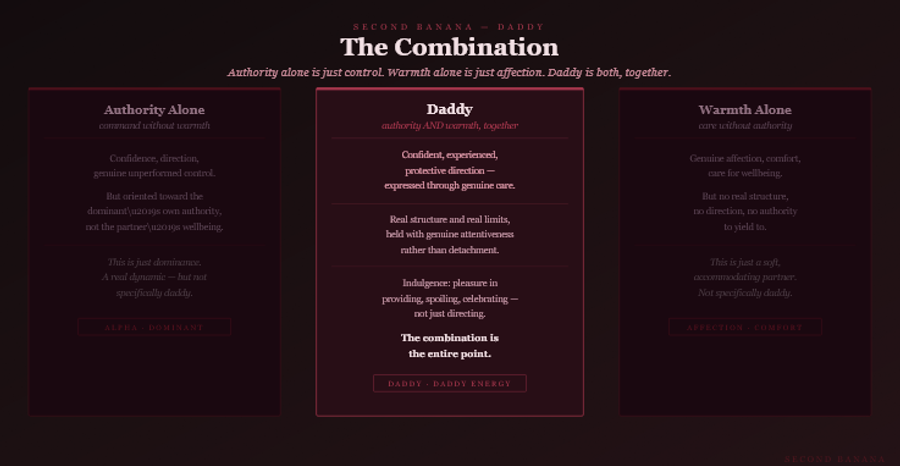
Authority without warmth is just control. Warmth without authority is just affection. Daddy is the specific combination of both — and the combination is the entire point.
What Daddy Actually Is
The daddy dynamic describes a specific erotic and relational configuration in which one partner embodies confident, experienced, protective authority combined with genuine warmth, care, and attentiveness to the other partner’s wellbeing. The daddy directs, protects, and indulges; the receiving partner — sometimes called ‘little’ in the most explicit version of this dynamic, though many practitioners use other or no specific complementary label — receives this combination of authority and care.
The defining feature, again, is the combination. A purely dominant partner who is cold, exacting, or punitive is not occupying the daddy role, regardless of age or other surface markers. A purely indulgent, permissive partner who provides comfort without any authority or direction is also not occupying the daddy role — that is simply a soft or accommodating partner. Daddy specifically requires both halves of the combination: someone who will take charge and someone whose taking charge is expressed through care rather than coldness.
Daddy Energy Without Age
Daddy kink does not require an actual age gap between partners, though it frequently involves one and the age gap dynamic adds its own dimension when present. ‘Daddy energy’ is a quality of presence and authority that can be embodied by a partner of any age, including a partner who is the same age as or younger than their partner. What matters is not chronological age but the specific quality of confident, protective, warm authority that the term describes.
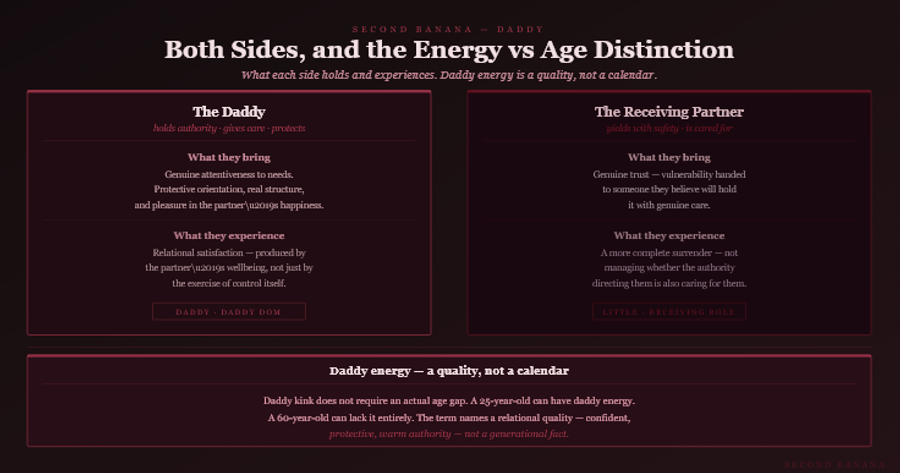
This distinction matters because it clarifies that daddy kink is fundamentally about a relational and erotic quality rather than about literal generational difference. A 25-year-old can have daddy energy. A 60-year-old can lack it entirely. The term names the psychological and relational configuration, not the calendar.
The Specific Combination: Why Authority Plus Warmth
The Authority Dimension
The authority component of daddy kink overlaps significantly with the alpha kink dynamic covered elsewhere in this series: genuine, unperformed confidence, the capacity to direct without negotiating the right to do so, a settled internal certainty that does not require external validation. Daddy authority shares this quality of genuine, inhabited confidence.
Where daddy authority differs from generic alpha authority is in its specific orientation: daddy authority is oriented toward the wellbeing and pleasure of the partner it directs. The daddy’s confidence is expressed in service of taking care of their partner, not merely in service of their own dominance. This orientation toward the partner’s wellbeing is what produces the warmth dimension and what distinguishes daddy from authority that exists primarily for its own sake.
The Warmth Dimension
The warmth dimension is what most popular treatments of daddy kink miss entirely, and it is the dynamic’s most psychologically significant feature. Daddy warmth manifests as genuine attentiveness to the partner’s needs, real pleasure in their partner’s happiness and wellbeing, a protective orientation that takes the partner’s vulnerability seriously and responds to it with care rather than exploitation, and a quality of unconditional positive regard that many practitioners describe as central to what makes the dynamic specifically erotic for them.
This warmth is not soft in the sense of being weak or permissive without limits. A good daddy sets and maintains boundaries, provides structure, and exercises real authority — but does all of this from a place of genuine care rather than detachment or control for its own sake. The combination of firm structure and genuine warmth is what produces the dynamic’s specific erotic and emotional charge.
Indulgence and Spoiling
A specific element of the warmth dimension is indulgence — the daddy’s pleasure in providing for, spoiling, and rewarding their partner. This is not merely material (though gift-giving and material indulgence are common expressions of it) but extends to attention, praise, physical affection, and the specific pleasure of making a partner feel cared for and celebrated. Many practitioners describe this indulgent dimension as central to what they find specifically erotic about the daddy dynamic: not just being directed, but being delighted in.
The Receiving Partner’s Experience
The Combination of Safety and Surrender
For the partner receiving daddy energy, the specific appeal is the combination of genuine authority to yield to and genuine safety within that yielding. This is distinct from submission to a purely dominant partner, where the yielding may carry more anxiety about whether one’s vulnerability will be handled with care. The daddy dynamic’s explicit warmth component provides a specific quality of safety that allows for a more complete and less anxious surrender.
Many practitioners describe the daddy dynamic as providing the specific combination of being told what to do and being genuinely cared for in the process — not having to manage whether the authority directing them is also looking out for them, because the warmth makes clear that it is. This combination of direction and care produces a quality of relief and safety that purely dominant dynamics, however skillfully executed, do not always provide in the same way.
On the Psychology Often Attributed to This Dynamic
Popular discourse about daddy kink frequently attributes it to ‘daddy issues’ — the assumption that attraction to this dynamic indicates an unresolved relationship with one’s actual father, whether through absence, conflict, or inadequacy. This framing should be approached with real caution. It is neither accurate as a universal explanation nor appropriate as a casual diagnostic frame applied to people’s erotic preferences.
What can be said carefully is this: for some practitioners, the appeal of a dynamic that provides consistent, attuned, protective authority and care may connect to a genuine desire for the kind of secure, reliable attentiveness that was inconsistent or absent in their developmental experience — not exclusively from a father, but from any primary caregiving relationship. This is not pathological. The desire for secure attachment and reliable care is a basic and entirely healthy human need, and finding an erotic context in which that need is met explicitly and consensually is not evidence of damage. For many other practitioners, the appeal has no connection to family history at all and is simply a genuine preference for this specific combination of authority and warmth, the same way other people have genuine preferences for other dynamics. Neither explanation should be assumed without the practitioner naming it themselves.
The Daddy’s Experience
The experience of occupying the daddy role has its own specific and frequently underexamined psychology. Being a daddy means holding genuine authority while remaining genuinely, attentively focused on a partner’s wellbeing — a combination that requires real emotional presence rather than simple command.
Many practitioners who occupy this role describe a specific satisfaction in the protective and providing dimension of the dynamic: the pleasure of genuinely taking care of someone, of being trusted with someone’s vulnerability and handling it well, of the specific warmth that comes from a partner’s genuine happiness and security in the dynamic. This is distinct from the satisfaction of pure dominance, which centres more on the exercise of authority itself. The daddy’s satisfaction is relational — it depends on and is produced by the partner’s wellbeing within the dynamic, not merely by the daddy’s own exercise of control.
The responsibility this places on the daddy is significant and worth naming directly: a partner who is genuinely yielding to this dynamic, who is trusting the daddy to hold their vulnerability with care, deserves a partner who takes that responsibility seriously. The daddy who enjoys the authority without genuinely investing in the warmth and care that defines the role is not occupying it well — they are borrowing its language for something that is, in practice, just dominance.
What This Has to Do With Second Banana
The daddy dynamic’s specific combination of authority and warmth makes it one of the dynamics most damaged by surface-level cultural flattening — the reduction of ‘daddy’ to a meme or a punchline obscures the genuine psychological richness of what practitioners are actually seeking, and makes it harder to find partners who understand and can embody the full combination rather than just the label.
The post-first model gives daddy-dynamic practitioners the ability to communicate the full specificity of what they want — not just ‘daddy’ as a label, but the genuine combination of authority and warmth, protection and direction, indulgence and structure that defines the dynamic at its best. A post that describes this combination specifically finds partners who understand and can embody it, rather than partners who have only encountered the flattened cultural version.
The Second Banana tag system gives daddy-dynamic practitioners specific vocabulary:
- Daddy — the role itself
- Daddy energy — for those signalling the quality without requiring an age gap
- Little — for the complementary receiving role, where that label fits
- Daddy dom — for those who combine the daddy dynamic explicitly with formal D/s
- Protective and warm — explicit emphasis on the care dimension
- Indulgent / spoiling — for those for whom the providing dimension is central
- Age gap welcome — for those drawn to the literal generational configuration
- Structure and care — for those who want the full combination named explicitly