
Discreet: The Psychology of the Compartmentalised Self, and Why a Hidden Life Carries Its Own Specific Charge | Second Banana
Discreet:
The Psychology of the Compartmentalised Self, and Why a Carefully Guarded Hidden Life Carries Its Own Specific Erotic Charge
Not Anonymous. Something More Specific.
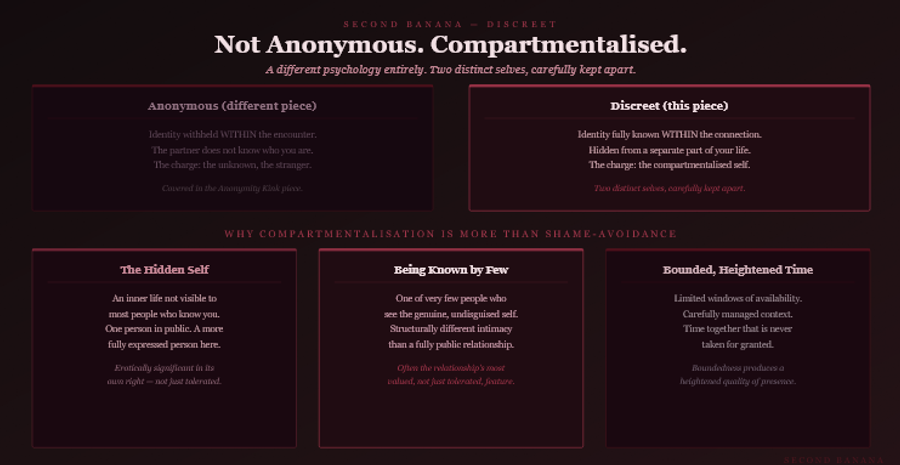
Discreet and anonymous are frequently used interchangeably in dating and kink contexts, and the conflation obscures something important. Anonymity kink, covered elsewhere in this series, is about the charge of an encounter in which identity is withheld or unknown — the stranger, the masked partner, the connection without a name attached. Discreet is a different orientation entirely. It is not about not being known within an encounter. It is about maintaining a hidden sexual or relational life alongside a known, public one — the specific psychology of compartmentalisation, of living with two distinct selves that are carefully kept apart.
The person seeking discretion is not anonymous to their partner. They may be fully known, fully named, in an ongoing and intimate connection with someone who knows exactly who they are. What they require is that this connection remain separate and concealed from another part of their life — their marriage, their family, their professional world, their community, their public identity. The erotic and psychological territory here is compartmentalisation, not anonymity, and it deserves its own treatment rather than being folded into the anonymity piece.
This piece covers the psychology of discretion directly: what compartmentalisation actually feels like and why it can be erotically significant rather than merely practically necessary, the range of circumstances that produce a genuine discretion requirement, what discretion specifically asks of a partner, and how Second Banana’s architecture is suited to this orientation.
A double life is not always a moral failure or a tragedy waiting to happen. For some people, the maintenance of a carefully separated self is the condition under which their most honest erotic life becomes possible at all.
The Psychology of Compartmentalisation
More Than Shame Avoidance
The most common assumption about people who require discretion is that they are simply avoiding shame or consequence — hiding something they would rather not have to hide, managing risk because exposure would be unpleasant. This is part of the picture for many practitioners, but it is not the whole psychology, and reducing discretion to pure shame-avoidance misses what is often a more specific and more interesting erotic dynamic.
For many people who maintain a discreet erotic or relational life, the existence of a separate, carefully guarded self is not merely tolerated as a cost of doing what they want — it has its own specific psychological texture. The awareness of a hidden identity, the heightened sense of having an inner life that is not visible to most of the people who know them, the specific quality of being one person in public and a different, more fully expressed person in this particular guarded space — this compartmentalisation can be erotically significant in its own right, independent of whatever specific acts occur within the discreet relationship.
The Specific Intimacy of Being Known
A particular and frequently underexamined dimension of discreet connections is the specific intimacy produced by being one of a very small number of people who know someone’s full, undisguised self. The partner in a discreet relationship is often privy to a version of the other person that almost no one else in their life encounters — their genuine desires, their unperformed self, the parts of their identity that public life requires them to keep concealed.
This produces a quality of intimacy that is structurally different from intimacy in a fully public relationship. Being trusted with someone’s hidden self — being one of the very few people who sees them this clearly — is its own specific form of closeness, and many practitioners on both sides of a discreet dynamic describe this specific intimacy as one of the relationship’s most significant and valued features, not merely an unfortunate constraint they have to work around.
The Heightened Quality of Bounded Time
Discreet relationships are frequently bounded in time and context in ways that fully public relationships are not — specific windows of availability, specific contexts in which the relationship can exist, careful management of when and how contact happens. This boundedness, while practically necessary, often produces a heightened quality of presence and intensity within the time that is available. Many practitioners describe their discreet connections as carrying a specific charge of focus and presence precisely because the time together is limited and carefully protected — nothing about the encounter is taken for granted or treated as infinitely available.
The Range of Circumstances
Discretion is required by a wide range of people for genuinely different reasons, and the psychology and stakes vary considerably across this range. Understanding the differences helps in being specific about what kind of discretion is actually being sought.
Married or Partnered People Seeking Outside Experiences
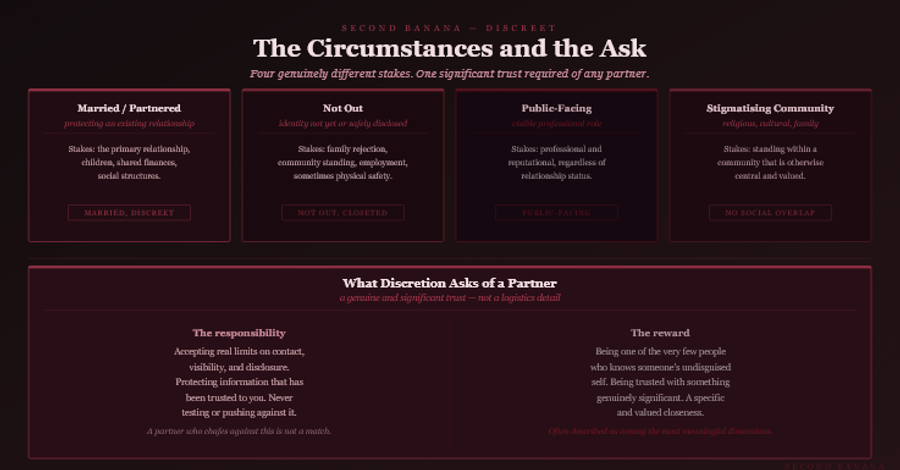
For people in committed relationships — whether monogamous relationships where the outside connection is not disclosed, or relationships with some negotiated openness that nonetheless requires careful management — discretion protects an existing relationship and family structure. The stakes here typically involve the primary relationship itself, potentially children, shared finances and social structures, and a complex web of consequences that extend well beyond personal embarrassment.
People Who Are Not Out
For LGBTQ+ people who are not out, or not out in all contexts, discretion is not about an additional secret life layered onto an otherwise open one — it is about the management of an identity that has not yet been or cannot safely be disclosed at all. The stakes here can include family rejection, community standing, employment in unsupportive environments, and in some contexts genuine physical safety. This is a different category of discretion requirement from the married-person scenario, even though both may use similar language and similar platform tools to manage it.
Public-Facing Professional Lives
People whose professional roles involve public visibility — in politics, certain corporate positions, public-facing community roles, or contexts where personal conduct is subject to professional or institutional scrutiny — may require discretion not because of any relationship to hide but because of the professional consequences of any sexual or kink-related disclosure, regardless of their relationship status or orientation. The stakes here are professional and reputational rather than relational.
Communities With Strong Sexual or Kink Stigma
People embedded in religious, cultural, or family communities with strong stigma against their specific sexual interests or relationship structures may require discretion to maintain standing and connection within communities that are otherwise central and valuable to their lives. This form of discretion is often the most painful to navigate because it requires concealment from people the practitioner may be close to and value deeply, not merely from a general public.
What Discretion Asks of a Partner
Entering a discreet dynamic with someone is a significant ask, and it deserves to be named honestly rather than treated as an incidental logistics detail. A discreet partner is asking their counterpart to be trusted with something that carries real consequences if mishandled — not hypothetical embarrassment but, depending on the specific circumstances, genuine risk to relationships, employment, family standing, or safety.
The Specific Trust Required
Being the partner of someone who requires discretion means accepting real limits: on when and how contact can happen, on what can be shared publicly or with mutual friends, on the visibility of the relationship in any context outside the carefully bounded space where it exists. It also means accepting responsibility for protecting information that the discreet partner has trusted them with — not exposing them, not creating situations that risk exposure, not treating the secrecy as something to be tested or pushed against.
This is a genuine and significant form of trust, and partners who enter discreet relationships well are partners who take this responsibility seriously — not merely tolerating the constraints as an annoying condition of access to the discreet person, but genuinely respecting what is being protected and why it matters. A partner who chafes against discretion requirements, who treats them as obstacles to be worked around rather than genuine needs to be honoured, is not a good match for a discretion-requiring practitioner regardless of other compatibility.
The Specific Reward
For partners who do honour this trust well, the reward is the specific intimacy described above: being one of the very few people who knows someone’s undisguised self, being trusted with something genuinely significant, and the particular closeness that develops within a carefully bounded and protected space. Many partners in successful discreet relationships describe this specific quality of trusted intimacy as one of the most meaningful dimensions of the connection.
What This Has to Do With Second Banana
Discretion is one of the requirements that general dating platforms handle worst. Public profiles, visible activity, social connections that overlap with real-world networks, and platforms that assume disclosure as a default all create genuine risk for people who require discretion, regardless of their specific reasons for needing it.
Second Banana’s anonymous posting model is structurally well-suited to discretion-requiring practitioners in a way that goes beyond what the anonymity kink piece describes. The ability to post without attaching a known identity, to communicate specifically about what one needs in terms of discretion before any identifying information is exchanged, and to find partners who understand and are prepared to honour discretion requirements before the relationship begins — this infrastructure directly serves the population for whom discretion is not a kink preference but a genuine practical necessity tied to real consequences.
The Second Banana tag system gives discretion-requiring practitioners specific vocabulary:
- Discreet — the requirement itself
- Discretion required — explicit statement of necessity rather than mere preference
- Married / partnered, discreet — for those managing an existing relationship
- Not out / closeted — for those whose discretion relates to identity disclosure
- Public-facing, discreet — for those with professional visibility concerns
- Limited availability — practical signal about contact and scheduling constraints
- Understanding partner sought — for those seeking a partner who will genuinely honour the requirement
- No social overlap — for those who need to avoid shared social or professional circles