Kingston Kink & Fantasy Dating | Find Your Match | Second Banana
SECOND BANANA · KINGSTON, ON
Kingston Was Built To Hold Things. It Has Spent Two Centuries Learning How To Let Them Go.
Kingston calls itself the Limestone City, and the name is accurate in a way that goes beyond architecture. The downtown core — City Hall, the old fort, the university buildings, the churches — is built from the same grey-gold stone, quarried locally, dressed by hand, assembled into a city that looks, from the water, like something designed to last and to hold.
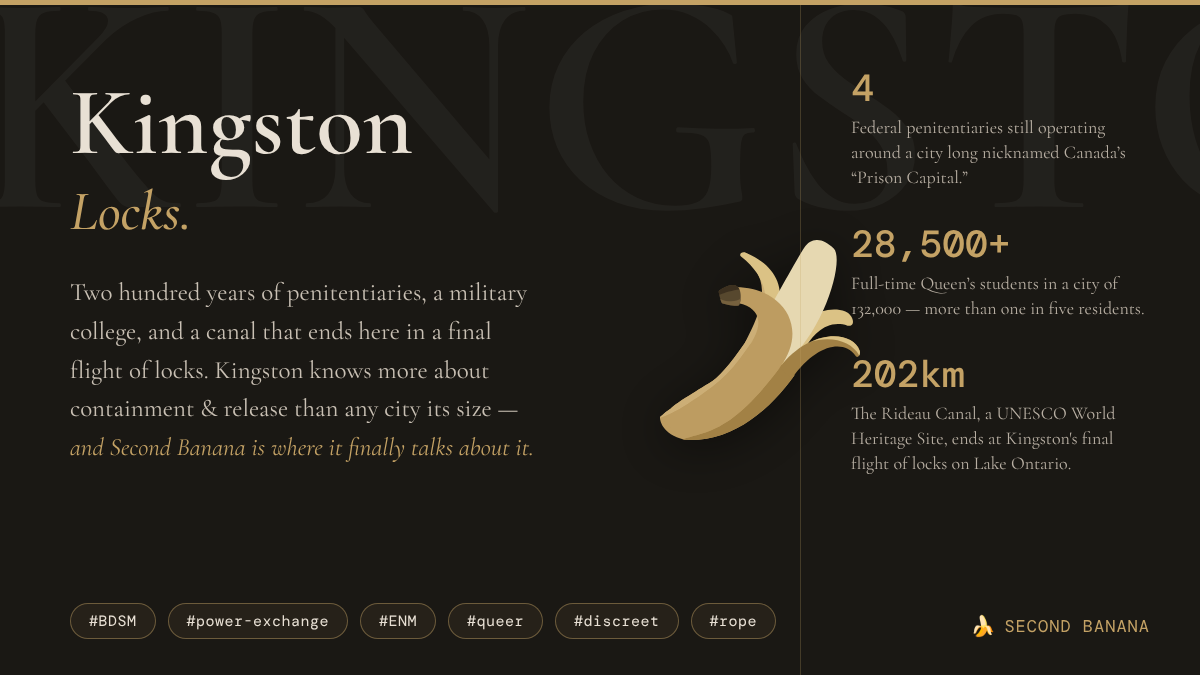
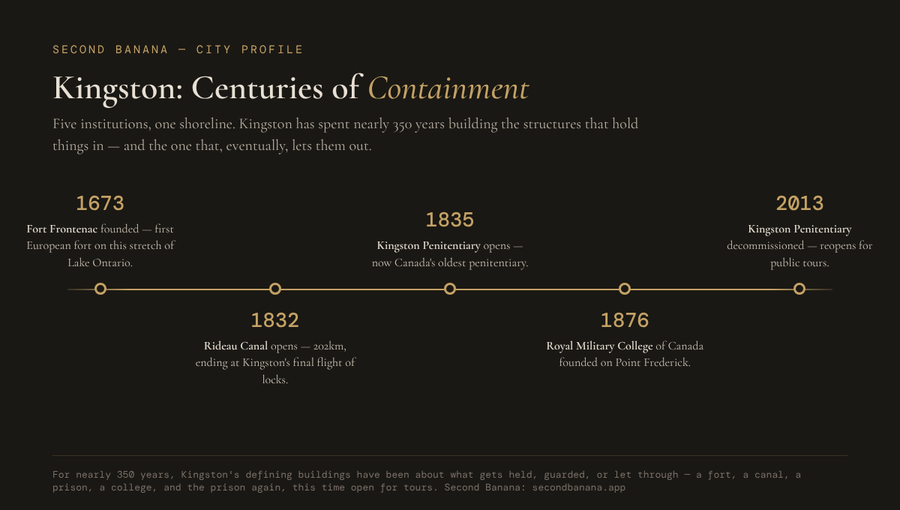
That impression isn't wrong. Kingston was built to hold things. A French fort in 1673. A British naval dockyard. The first capital of the Province of Canada in 1841. A penitentiary in 1835 that would become the most famous prison in the country. A military college in 1876. And at the end of it all, the final flight of locks on a 202-kilometre canal that spends its entire length holding water at one level so that something can pass, safely, to another.
Cities organised around restraint produce people who understand restraint — what it costs, what it protects, and what it feels like when it is chosen rather than imposed. Kingston's kink and ENM community has been quietly working that difference out for a long time. It is smaller than Toronto's and quieter than Montreal's. It is also, for its size, considerably more serious than either.
A City Of Containers
Start with the obvious one. Kingston has been nicknamed Canada's "Prison Capital" for most of its modern history — a title nobody at the Chamber of Commerce particularly wanted and nobody could argue with. Kingston Penitentiary opened in 1835 and operated for 178 years. The Prison for Women ran here from 1934 to 2000. Collins Bay, Joyceville, Millhaven and Bath still operate around the city today. When Kingston Penitentiary closed in 2013, it reopened for tours, and people now queue to walk through the architecture of confinement as a kind of civic heritage.
Then there's the Royal Military College, on a point of land jutting into the harbour, which has spent a century and a half producing officers trained in exactly the kind of disciplined self-command its stone walls visually imply. A city that hosts both of these institutions absorbs something from them — a fluency in hierarchy, protocol, rank, and the difference between authority held well and authority abused. Kingstonians know what structure looks like up close. Some of them have become very interested in what it looks like when two adults build it deliberately, for each other, and can take it apart again whenever they choose.
And then there's the canal. The Rideau runs from Ottawa and ends here, at a final flight of locks that step boats down to Lake Ontario. A lock is, mechanically, a container: it holds something at one level so that it can be raised or lowered safely to another. Kingston is the place where the whole system terminates — where nearly two centuries of careful, regulated containment finally opens onto open water.
A city built around penitentiaries, a military college and the last locks of a canal is a city that has spent two hundred years thinking very carefully about the difference between holding something in and letting it out.
One University, A Fifth Of The City
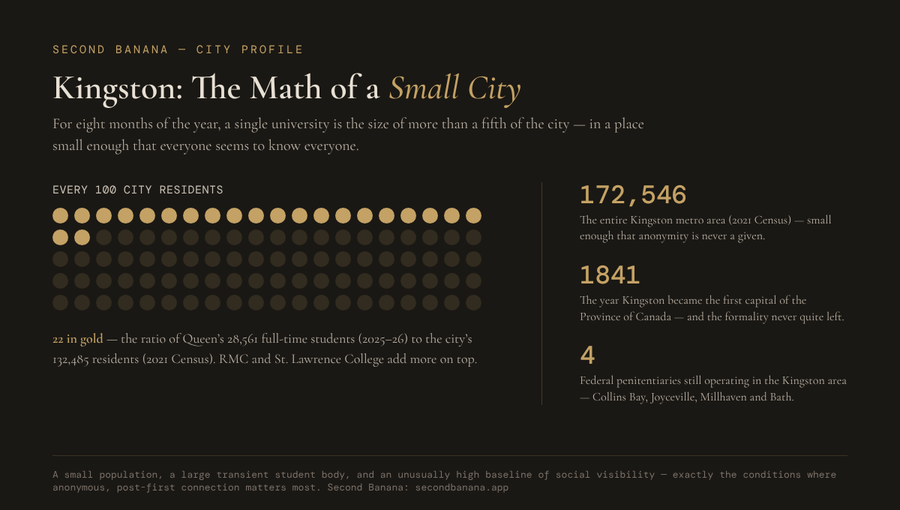
Kingston had 132,485 residents at the last census. Queen's University alone had 28,561 full-time students in 2025–26. Add the Royal Military College and St. Lawrence College and the picture is clear: for eight months of the year, a very large share of the people walking down Princess Street are here temporarily, away from home, often for the first time, in a city whose whole built environment is a lesson in structure.
That rhythm shapes the community. Every September brings a new cohort figuring out what they actually want — some of them at nineteen, some of them at thirty-four in a graduate program, some of them discovering it later than they expected. Every April, some of them leave. The ones who stay — the grad students who became professors, the nurses who trained at Queen's and took jobs at Kingston General, the RMC graduates posted back to the base — become the people who hold the community steady between cohorts. The result is a scene that is always partly new and always partly very experienced, which is a better combination than it sounds.
The Problem Of Being Known
Here is the practical reality of kink in a city this size. The whole metro area is about 172,000 people. Your teaching assistant might be at the same munch as your landlord. The person you match with might work at the hospital your mother goes to. An RMC officer cadet carries an institution's reputation on their shoulders whether they want to or not, and a corrections officer at Millhaven works in a profession where discretion is not a preference but a condition of employment. Kingston isn't unwelcoming — by most accounts it is easygoing, liberal-leaning and quietly queer-friendly. It is simply small, and small changes the arithmetic of visibility.
This is exactly the problem Second Banana's anonymous, post-first model was designed around. You don't lead with your face. You lead with what you want, written as specifically as you're willing to make it, and the people who match it find you on the basis of what you wrote rather than who you are to everyone else in town. For a city where discretion is structural rather than optional, that ordering matters enormously. You decide when your name, your photo and your life enter the conversation — and with whom.
In a city where everyone is two introductions from everyone else, being able to say what you want before you say who you are is not a feature. It is the whole point.
Structure, Chosen
It would be strange if a city this saturated in imposed structure didn't produce people fascinated by the consensual version. And the consensual version is a fundamentally different thing. The prison and the barracks run on structure nobody inside them chose. A power-exchange dynamic, a rope scene, a protocol-heavy D/s relationship runs on structure that both people negotiated in advance, can renegotiate at any time, and can end with a single word. That is not a smaller version of institutional authority. It is close to its opposite.
Kingstonians who come to kink tend to grasp this quickly, partly because they've seen the other kind up close. The scene here leans toward the deliberate: explicit negotiation, clear limits, real aftercare, and a low tolerance for people who treat "dominant" as a personality rather than a responsibility. Rope has a natural home in a city named for its locks. So does chastity, protocol, uniform play and every other dynamic built on the pleasure of something held — and then, at exactly the right moment, released.
It isn't only kink. Kingston's ENM and polyamorous community has the same small-city challenge — in a place this size, the polycule overlaps with the dinner party, the department and the climbing gym — and the same appetite for doing it properly. Graduate students and academics are disproportionately represented, and they bring the habits of their training: they read the books, they name the structures, and a surprising number of them are solo poly precisely because a career that might take them to another city in three years makes the escalator an awkward fit.
Who You'll Find Here
The Second Banana community in Kingston reflects every layer of the city. The Queen's graduate student who has spent two years reading about consent and is ready to stop theorising. The officer cadet or serving member who knows more about hierarchy than they ever wanted to and is curious what it feels like when it's chosen. The nurse, the professor, the public servant who has lived here for fifteen years and knows exactly how small this city is.
It is also the person from Napanee, Brockville, Gananoque or Belleville who drives in because Kingston is the closest city with an actual scene — and the person in Ottawa or Toronto who has realised Kingston's community is smaller, kinder and far more legible than the one at home. Like Halifax and Victoria, Kingston is a small Canadian city whose community punches well above its population, and for the same reason: when everyone knows everyone, people learn to be honest or learn to leave.
Tags that index well here: BDSM, power exchange, dominant, submissive, switch, rope, protocol, chastity, discreet, anonymous, ENM, polyamory, solo poly, queer, trans-inclusive, aftercare-focused, consent-literate, ongoing. Post specifically. In a city this size, specificity is how the right person recognises you — and how everyone else doesn't.
→ Write your first Second Banana post — say what you want before you say who you are.
The Locks At Kingston Mills
There's a version of Kingston's history that reads purely as restraint — the prisons, the military discipline, the Loyalist propriety of a city that was briefly a capital and never entirely lost the formality that came with it. But the canal is the other half of the story, and it's the half that matters more.
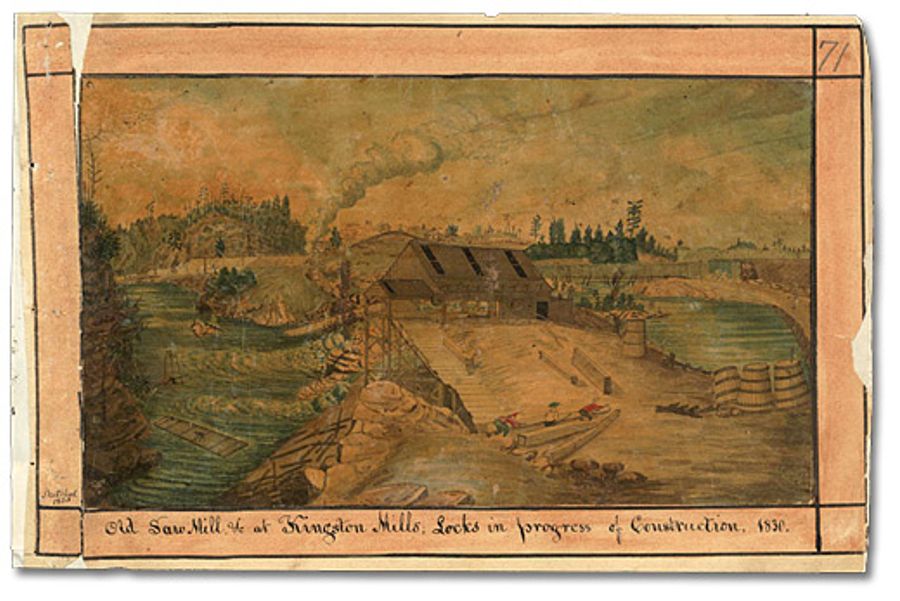
Every lock on the Rideau exists for one purpose: to let something through, safely, on terms that work for everyone involved, and then to close again until the next time. The lockmaster doesn't open the gates until both levels are ready. Nothing is forced. Nothing is rushed. And when the water finally evens out and the gates swing open, the boat simply goes. That is not a metaphor for repression. It is a metaphor for consent — deliberate, mutual, working exactly as designed, and ultimately about movement rather than stillness.
Kingston didn't build two hundred years of structure because it doesn't believe in release. It built two hundred years of structure because it understands, better than most cities, that release works best when it's deliberate.