Ottawa Kink & Fantasy Dating | Find Your Match | Second Banana
SECOND BANANA · OTTAWA, ON
Ottawa Spent Forty Years Treating Desire As A Security Risk. Its Community Has Been Answering Ever Since.
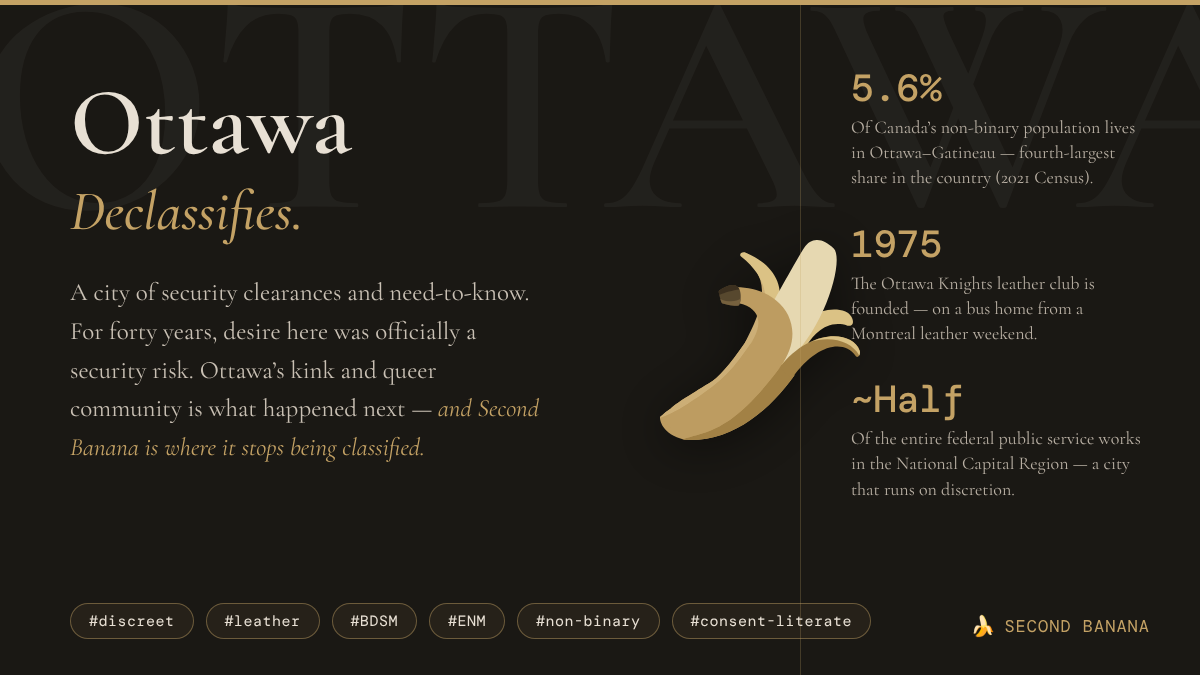
Ottawa is a city that runs on paperwork. Briefing notes, security clearances, access-to-information requests, documents stamped with words like Secret and Protected B. Roughly half of Canada's entire federal public service works in the National Capital Region, and the culture that produces is unmistakable: careful, procedural, discreet, a little buttoned-up, and very, very good at keeping things to itself.
For a long time, one of the things it kept to itself was desire. From the 1950s into the 1990s, the federal government treated gay and lesbian public servants, soldiers and Mounties as national security risks — people who could be blackmailed, who could not be trusted with secrets, who had to be found and removed. That history played out in this city's offices, on this city's streets, in this city's bars. It is not abstract here. It is Ottawa's own file.
And the community that grew up in answer to it — queer, leather, kinky, gender-diverse, fiercely discreet and deeply organised — is one of the more quietly remarkable in the country. It just doesn't advertise. Ottawa never does.
The File
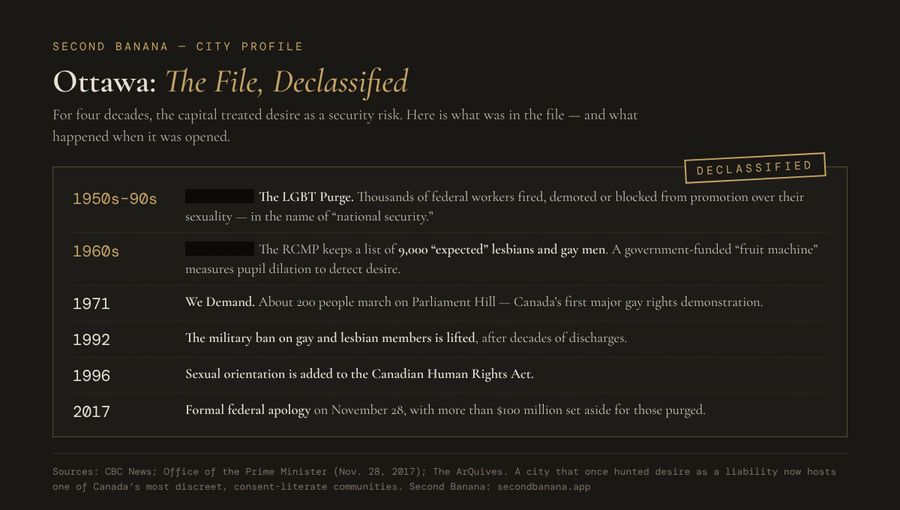
The LGBT Purge is one of the strangest chapters in Canadian government history, and Ottawa was its headquarters. Through the Cold War, officials worried that gay and lesbian employees could be blackmailed into betraying state secrets. The solution they arrived at was to hunt them. By the 1960s, the RCMP had compiled a list of some 9,000 suspected lesbians and gay men. The government funded a Carleton University professor to build a device — nicknamed the "fruit machine" — that tried to detect homosexuality by measuring whether a subject's pupils dilated in response to erotic images. Thousands of people lost careers, security clearances and futures.
The file has since been opened. Homosexuality was decriminalised in 1969. In 1971, about 200 people marched on Parliament Hill in the We Demand rally — Canada's first major gay rights demonstration, held right here, under the windows of the institutions doing the purging. The military ban fell in 1992. Sexual orientation entered the Canadian Human Rights Act in 1996. And in November 2017, the Prime Minister stood in the House of Commons and formally apologised, with more than $100 million set aside for the people who had been driven out. A national monument to the purge is now being built beside the Ottawa River.
In most cities, the history of sexual secrecy is a metaphor. In Ottawa, it is a government file — one that was finally declassified, and a community that never stopped being careful anyway.
A City That Runs On Need-To-Know
The purge is over. The culture of discretion it fed on is not. Ottawa is still a city full of people with security clearances, people in policy and defence and intelligence roles, people who work in buildings where you badge in and leave your phone at the door. Nobody gets fired for being queer anymore. But a lot of people in this city still live by a professional rule that predates all of that: you do not leave a trail you don't control.
That instinct shapes Ottawa's kink and ENM scene profoundly. People here are not, as a rule, posting face pics on public profiles. They are discreet by profession as much as by temperament, and they extend that discretion to everyone they play with. The upside is a community with a deeply ingrained respect for privacy, confidentiality and need-to-know. The downside is that it can be genuinely hard to find.
Second Banana was built for exactly that tension. You post what you're looking for anonymously — no face, no name, no employer — and the right person finds you because of what you wrote, not because of who you are on LinkedIn. You decide what gets declassified, to whom, and when. In a city built on clearance levels, that's simply good tradecraft.
→ Post on Second Banana — anonymous by default, declassified on your terms.
Leather On The Hill
Ottawa's leather community has deep roots. The Ottawa Knights were founded in 1975 — the story goes that a group of friends formed the club on the bus ride home from a leather weekend in Montreal — and for decades their monthly bar nights were a fixture of the city's queer social calendar. From 1992, the Knights ran the Mr. Leather Ottawa contest, which became one of the capital's signature fetish events and sent titleholders on to compete internationally.
There is something fitting about a leather tradition thriving a short walk from Parliament Hill. Leather culture has always been about chosen hierarchy, protocol and earned trust — structures that look a lot like the formal power of government, with one decisive difference: everyone in the room picked them, everyone negotiated them, and everyone can walk away. In a city that knows the other kind of authority intimately, people tend to appreciate the difference between power held well and power imposed.
Two Languages, Two Provinces, One Quietly Diverse Capital
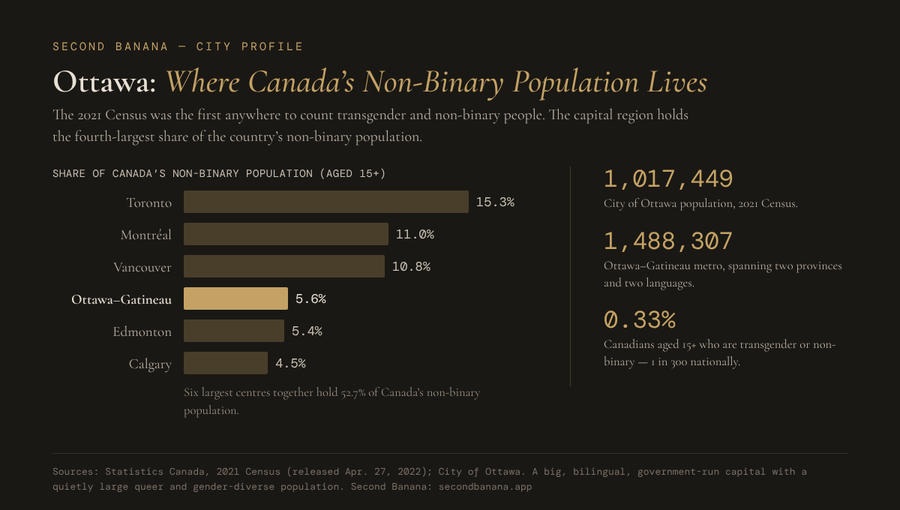
When the 2021 Census became the first in the world to count transgender and non-binary people, Ottawa–Gatineau turned out to hold 5.6% of Canada's entire non-binary population — the fourth-largest share in the country, behind only Toronto, Montréal and Vancouver, all of them considerably bigger cities. The capital is a lot more gender-diverse than its reputation suggests, and Second Banana is built to reflect that: trans and non-binary people are welcome here as a matter of principle, not policy.
Part of that is the universities. The University of Ottawa and Carleton bring tens of thousands of students and researchers into the city every year, and a capital full of policy analysts, scientists, lawyers and engineers is a capital full of people who like to name things precisely — including their identities and their desires. It's no accident that so many people in Ottawa's scene sit at the intersection of queer, kinky and neurodivergent, or that they gravitate to communities where communication is explicit and rules are written down.
And then there's the river. Ottawa–Gatineau is the only Canadian metro that straddles two provinces, and the bilingual, cross-river character of the region gives its community a particular texture. People live in Gatineau and work downtown, or the reverse. They switch languages mid-sentence. They are used to holding two identities at once — which, for a lot of people in this scene, is a familiar skill.
Ottawa's community doesn't announce itself. It doesn't need to. It is large, organised, gender-diverse and deeply discreet — a capital that learned the hard way exactly how much privacy is worth.
Who You'll Find Here
The Second Banana community in Ottawa reflects the city's layers. The analyst with a top secret clearance who wants a dominant partner who understands that discretion isn't optional. The non-binary grad student at uOttawa who knows exactly what they want and how to negotiate it before anything starts. The longtime leatherman who remembers the Knights' bar nights. The Gatineau couple exploring ENM who would rather not run into a colleague on a mainstream app.
It is also the person in Kanata, Orléans or Aylmer who has never once been to a munch and isn't sure they ever will, but wants to find someone who shares their tags. And it's the regional crowd who drive in from Cornwall, Pembroke or down the Rideau from Kingston, because the capital has the deepest community in eastern Ontario.
Tags that index well here: discreet, anonymous, BDSM, leather, dominant, submissive, switch, protocol, power exchange, ENM, polyamory, queer, non-binary, trans-inclusive, bilingual, aftercare-focused, consent-literate, ongoing. Be specific. Ottawa rewards people who say exactly what they mean — and keep everything else on a need-to-know basis.
→ Write your first Second Banana post — you decide what gets declassified.
Declassified
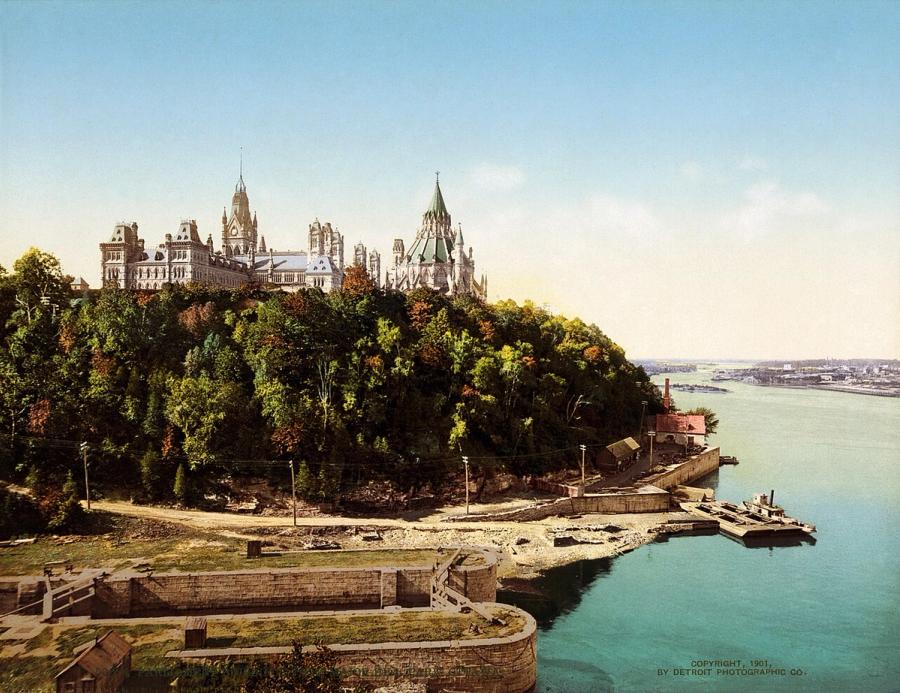
Stand on Major's Hill Park at dusk and look across at Parliament — the same view the photograph above captured more than a century ago. The buildings were already old then. They have watched the country's secrets get written, filed, classified, hidden and, eventually, made public. Some of those secrets were about people who simply loved, wanted or were differently than the government of the day found acceptable.
Ottawa's kink and queer community is, in a real sense, the answer to that history. Careful without being ashamed. Private without being hidden. Organised around the idea that what two consenting adults choose to do — and how they look after each other afterwards — is nobody else's business, and that declassifying it is a decision you make for yourself, one trusted person at a time.
The capital spent forty years trying to classify desire. The people who live here have spent every year since proving it can't be done.