Providence Kink & Fantasy Dating | Find Your Match | Second Banana
SECOND BANANA · PROVIDENCE, RI
Providence Was Founded By A Man Banished For His Conscience. It Has Been Siding With Dissenters Ever Since.
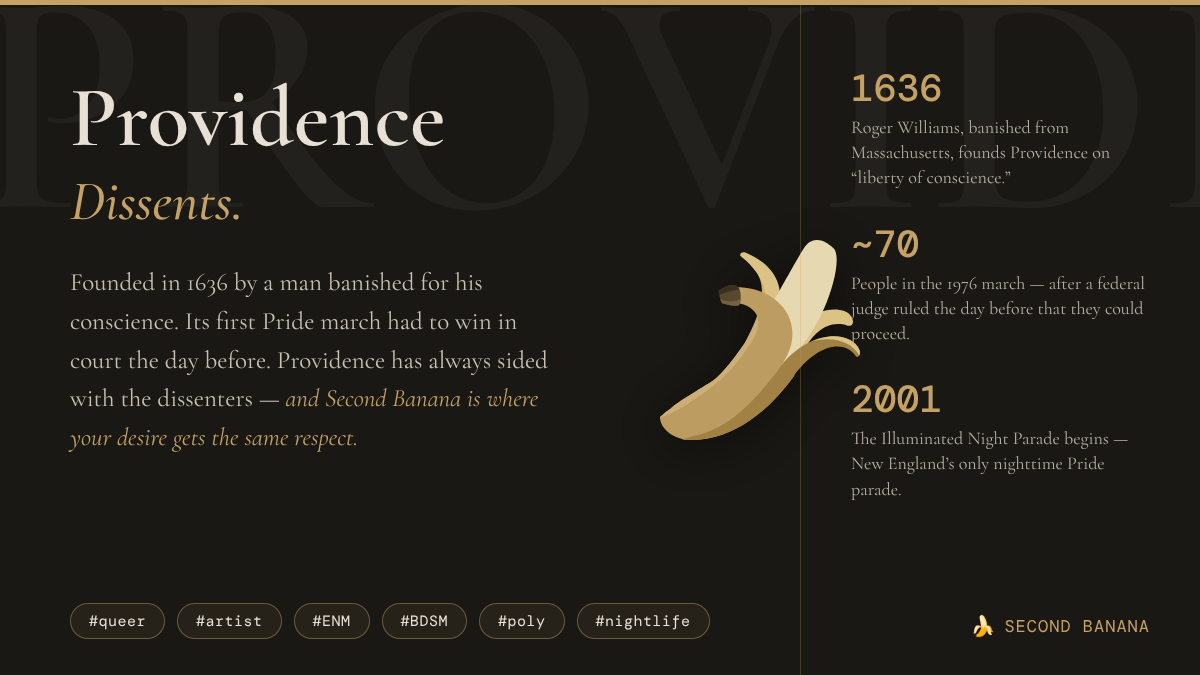
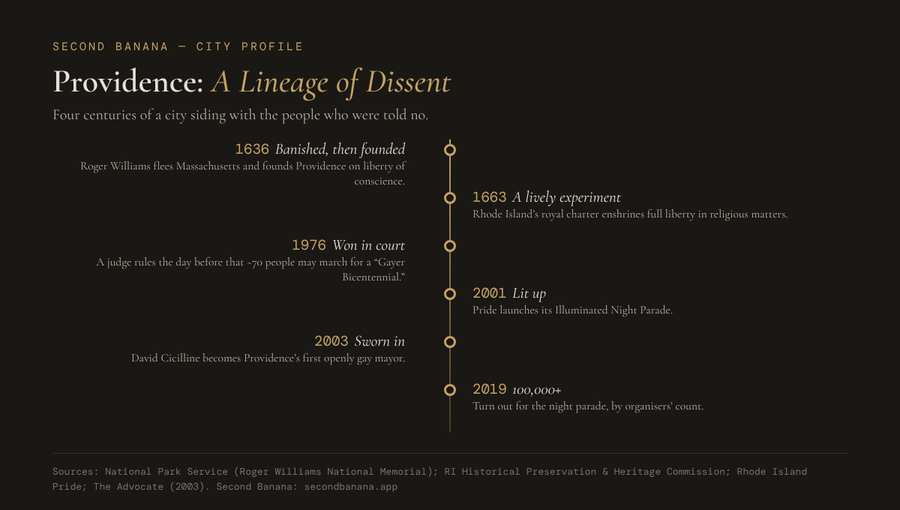
In 1636, the Massachusetts Bay Colony ordered Roger Williams deported. His crimes were ideas: that church and state should be separate, and that English charters had no right to take Native land without paying for it. Williams fled before he could be arrested, spent the winter with the Wampanoag, and settled at the head of Narragansett Bay on land negotiated from the Narragansett. He named the settlement Providence, and its founders agreed to "hold forth liberty of conscience" — to make laws only in civil matters and leave people's inner lives alone.
When Rhode Island received its royal charter in 1663, that principle was written in: the colony was to be "a lively experiment" in a civil state with full liberty in matters of belief. Nearly four centuries later, Providence is still a small, scrappy, argumentative capital that instinctively takes the side of whoever is being told they can't.
That instinct is why Providence makes such a natural home for Second Banana. A city founded on the idea that your conscience is your own business tends to extend the same courtesy to your desires.
Toward A Gayer Bicentennial
In 1976, as the United States celebrated two hundred years of independence, a group of Rhode Island activists formed the Toward a Gayer Bicentennial Committee. They wanted to hold a symposium at the Old State House and march in the official Bicentennial parade. The state's Bicentennial Commission said no to both.
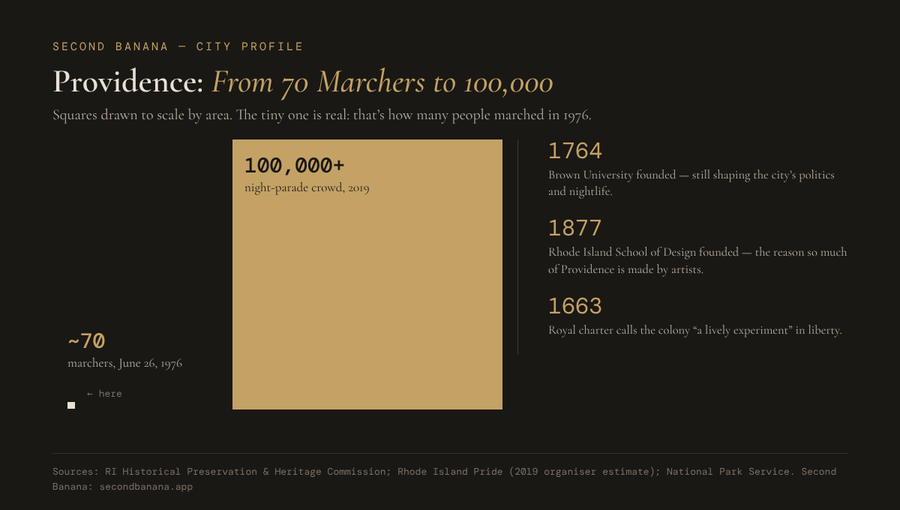
So they did what Rhode Islanders have done since Roger Williams: they dissented. The activists sued, and on June 25, 1976, federal judge Raymond Pettine ruled in their favour. The next day, about seventy people marched through downtown Providence in the state's first Pride parade. It was small, it was legally hard-won, and it was very much in the spirit of the place.
What followed is a classic Providence arc. In 2001, Rhode Island Pride launched its Illuminated Night Parade — a Pride march held after dark, glowing down the streets of downtown, and the only one of its kind in New England. In 2003, David Cicilline was sworn in as the city's first openly gay mayor. And by 2019, organisers estimated more than a hundred thousand people turned out for the night parade. From seventy people with a court order to a six-figure crowd, in a single lifetime.
Providence's first Pride march needed a federal judge's permission. Its night parade now draws six-figure crowds. That's what happens when a city refuses to accept no as the final answer.
→ Post on Second Banana — your desire, your conscience, your call.
Brown, RISD And The Creative City
Two institutions shape modern Providence more than any others. Brown University, founded in 1764, gives the city a constant population of young people who argue about everything and take identity seriously. The Rhode Island School of Design, founded in 1877, gives it something rarer: a city full of artists, designers and makers whose relationship to the body, aesthetics and self-expression is professional as well as personal. Between them, they produce one of the more queer, creative and neurodivergent small-city scenes on the East Coast.
That creative population tends to approach relationships the way it approaches art: as something to design rather than inherit. Providence has a visible polyamorous and ENM community, a strong streak of relationship anarchy, and a general scepticism of anyone who insists there's only one right way to love or desire. Roger Williams would recognise the attitude.
Liberty Of Conscience, Applied
Williams's radical idea was that the state had no business policing what happened inside a person — what they believed, how they worshipped, what they held sacred. Second Banana's idea of sexual sovereignty is a direct descendant: what consenting adults want, and how they arrange their intimate lives, belongs to them. It's also why Second Banana welcomes people of every belief, including those whose faith and kink sit side by side.
Rhode Island has kept some of that spirit in its modern law, too: as of this writing it has no age-verification law aimed at adult websites on the books, and it has long been one of the more LGBTQ-friendly states in the country. Second Banana matches that: trans and non-binary people are fully welcome, and the platform doesn't assume a default anything.
Providence was built on the idea that your inner life is nobody else's business. Second Banana runs on the same principle.
A Small State That Knows Everyone
The flip side of a small, tight-knit state is that everyone really does know everyone. Rhode Islanders famously give directions by landmarks that closed decades ago, and your Tinder match is quite possibly your cousin's ex. Second Banana sidesteps that problem. Write a post describing what you're looking for — anonymously if you prefer — and let the right people find you on the strength of what you wrote, not who your mother plays bingo with.
It also widens your reach. Providence sits between Boston and New York on the Northeast Corridor, an hour from the Cape, and a manageable drive from Provincetown. A post here reaches the city, Pawtucket, Warwick and Newport, and the people in southeastern Massachusetts and eastern Connecticut who'd happily make the trip.
Dissent, Negotiated
Providence's dissenters never just shouted; they organised, argued their case and went to court. The best kink works the same way. Refusing the default script is only half of it. The other half is negotiating what you want instead, agreeing limits, and looking after each other afterwards. Freedom without care isn't liberty; it's just chaos.
Who You'll Find Here
The Second Banana community in Providence reflects the city's layers. The RISD grad who builds sculpture by day and rope suspensions by night. The Brown PhD student who has opinions about relationship anarchy and wants someone who'll argue back. The Federal Hill chef who keeps work and play very separate. The Fox Point couple who've been happily polyamorous for a decade. The East Side lawyer who remembers the night parade's early years.
It's also the people from across Rhode Island — Newport, Warwick, Woonsocket — for whom Providence is the only real city in the state, and the Bostonians and New Yorkers who've discovered that Providence has much of their cities' creativity at a fraction of the rent.
Tags that index well here: queer, trans-inclusive, non-binary, artist, creative, ENM, polyamory, relationship anarchy, BDSM, rope, switch, sensation play, nightlife, discreet, aftercare-focused, consent-literate. Be specific — and if you disagree with the default, say so. This city respects that.
→ Write your first Second Banana post — dissent from the default.
Lit Up Downtown
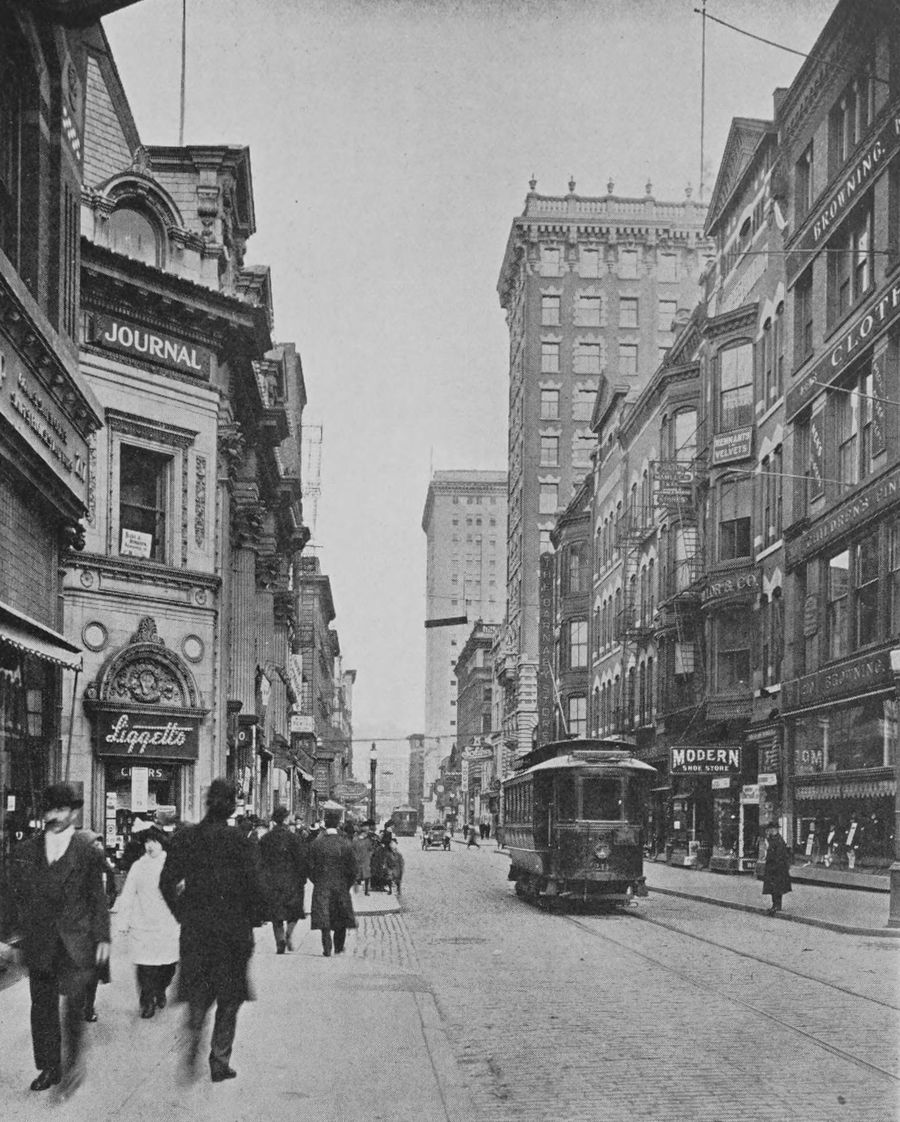
Walk down Westminster Street today and you're walking the same downtown blocks that appear in the photograph above, a little over a century old. It's the same downtown where seventy people marched in 1976 with a court order in their pocket, and where, a generation later, the night parade lights up the streets with crowds the original marchers could barely have imagined.
Providence has always worked on a simple principle: when the default isn't good enough, you don't accept it — you make the case for something better, and you build it with other people who agree to it. That's not a bad description of a good relationship, either.
Roger Williams was banished for refusing to let anyone else govern his conscience. Nearly four hundred years later, the city he founded still won't let anyone govern your desire.